

CONTACT
Please contact us for shipping details.
This document provides an in-depth examination of the 12 volt lead acid battery, a foundational technology in energy storage. It explores the electrochemical principles governing its operation, detailing the reversible reaction between lead, lead dioxide, and sulfuric acid. The analysis extends to the primary typologies of lead-acid batteries, including flooded (wet cell), Absorbent Glass Mat (AGM), and gelled electrolyte, comparing their respective construction, performance characteristics, maintenance requirements, and application suitability. A significant portion of the discourse is dedicated to the common modes of failure and performance degradation, such as sulfation, acid stratification, grid corrosion, and water loss. The text outlines seven critical user errors that precipitate these failure modes, offering corrective and preventative strategies grounded in established battery science. These strategies encompass proper charging protocols, maintenance routines, application-specific selection, and environmental management to optimize the battery's service life and reliability. The objective is to equip the reader with a nuanced understanding necessary for maximizing the utility and longevity of this ubiquitous power source.
Before we can appreciate the mistakes that lead to the premature demise of a battery, we must first develop a sense of the entity itself. What exactly is a 12 volt lead acid battery? To think of it merely as a plastic box that provides power is to miss the elegant, albeit sensitive, chemical dance occurring within. At its core, a lead-acid battery is a collection of individual electrochemical cells connected in series. Each cell, a world unto itself, produces approximately 2.1 volts. By linking six of these cells together (6 x 2.1V), we arrive at the familiar nominal voltage of about 12.6 volts for a fully charged battery batterystuff.com.
The magic, or rather the science, happens within each cell. Imagine two different types of lead plates—one of pure, spongy lead (the negative plate) and another of lead dioxide (the positive plate)—immersed in a bath of electrolyte, which is a solution of sulfuric acid and water. When you connect a device to the battery terminals, a chemical reaction begins. The sulfuric acid reacts with both types of plates, converting them into lead sulfate. This process releases electrons, which flow out of the battery as electrical current, powering your device. Discharging is, in essence, a process of gradual homogenization, where both plates become more chemically similar.
Charging reverses this process. By applying an external electrical current, you force the lead sulfate on the plates to react back into their original forms: spongy lead and lead dioxide. The sulfate returns to the electrolyte, increasing its acidity. This cycle of discharging and recharging is the lifeblood of the battery, but it is a process fraught with potential for error and degradation.
Not all 12 volt lead acid batteries are created equal. They are broadly categorized by how they contain their electrolyte, which dictates their maintenance needs and ideal uses.

Understanding the fundamental differences between flooded, AGM, and Gel batteries is perhaps the most important first step in responsible ownership. Each design represents a different philosophy in managing the electrolyte and the gases produced during charging, leading to distinct advantages and disadvantages.
Flooded (Wet Cell) Batteries: This is the oldest and most traditional design. The lead plates are fully submerged in a liquid electrolyte that can move freely within the casing. During the charging cycle, particularly in the final stages, some of the water in the electrolyte is broken down into hydrogen and oxygen gas through a process called electrolysis. These gases vent into the atmosphere through removable caps on the battery. This water loss is a normal part of operation and necessitates that you periodically top off the cells with distilled water. They are typically less expensive and, when properly maintained, can be very robust. However, they must be mounted upright to prevent spills, and the venting of flammable gases requires they be used in a well-ventilated area.
Absorbent Glass Mat (AGM) Batteries: An AGM battery represents a significant evolution. Instead of a liquid electrolyte sloshing around, the sulfuric acid is absorbed and held in a very fine glass mat separator, which is sandwiched between the lead plates. The mats are saturated with just enough electrolyte to function, but not so much that it's a free liquid. This construction makes them spill-proof and position-insensitive. More importantly, it facilitates a process called "oxygen recombination." The oxygen gas produced at the positive plate during charging can travel through the glass mat to the negative plate, where it recombines with hydrogen to form water. This internal recycling of gas means the battery is sealed and does not require watering, making it "maintenance-free" in that regard. AGM batteries can also handle vibration better and often have a lower internal resistance, allowing them to deliver and accept charge more quickly than flooded batteries batterystuff.com.
Gel Batteries: In a gel battery, the sulfuric acid electrolyte is mixed with a silica agent, creating a thick, gel-like substance. Like AGM batteries, they are sealed, spill-proof, and maintenance-free. The gel immobilizes the electrolyte, making them exceptionally resistant to vibration and shock. Their primary advantage lies in their performance in very deep discharge cycles and their tolerance for a wider range of temperatures. However, they have a higher internal resistance than AGM batteries, which means they are more sensitive to charging rates. Overcharging a gel battery can create permanent voids or pockets in the gel, which irreversibly damages its capacity.
To clarify these distinctions, consider the following comparison.
| Feature | Flooded (Wet Cell) | Absorbent Glass Mat (AGM) | Gel Cell |
|---|---|---|---|
| Electrolyte | Free-flowing liquid sulfuric acid | Acid absorbed in fine glass mats | Acid mixed with silica to form a gel |
| Maintenance | Requires periodic watering | Maintenance-free (sealed) | Maintenance-free (sealed) |
| Orientation | Must be installed upright | Can be installed in any position | Can be installed in any position |
| Spill-Proof | No, can leak if tipped or damaged | Yes, highly spill-resistant | Yes, highly spill-resistant |
| Vibration Resistance | Moderate | High | Very High |
| Charging Sensitivity | Tolerant of some overcharging | Sensitive to over-voltage | Very sensitive to charge rate/voltage |
| Cost | Lowest | Higher | Highest |
| Best For | Cost-conscious applications where maintenance is feasible (e.g., older vehicles, some off-grid) | High-performance starting, deep cycle RVs, marine, vehicles with high accessory loads | Deep, slow discharge applications; environments with extreme vibration or temperatures |
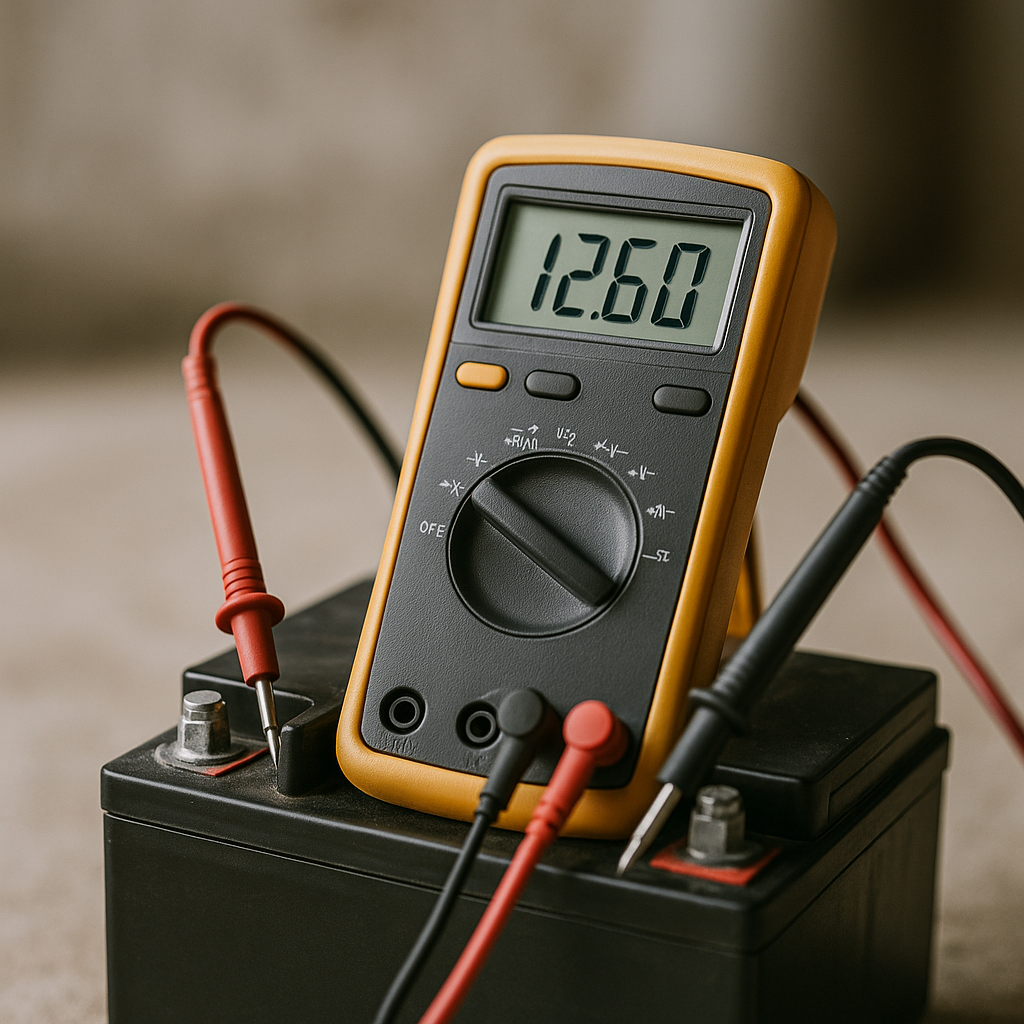
To properly care for a battery, you must learn to read its vital signs. The most accessible of these is voltage. As we learned, a fully charged 12 volt lead acid battery will show a resting voltage of around 12.6 to 12.7 volts. This is called the Open Circuit Voltage (OCV)—the voltage when the battery is not connected to any load or charger.
As the battery discharges, its voltage drops in a predictable way. By measuring the OCV (after the battery has been resting for a few hours to allow surface charge to dissipate), you can get a reasonable estimate of its State of Charge (SoC), which is its remaining capacity as a percentage. This relationship is a fundamental tool for battery health assessment.
| Open Circuit Voltage (OCV) | Estimated State of Charge (SoC) |
|---|---|
| 12.65V+ | 100% |
| 12.45V | 75% |
| 12.24V | 50% |
| 12.06V | 25% |
| 11.89V or less | 0% (Discharged) |
Why is a reading of 50% SoC at 12.24V so important? Because for deep cycle lead-acid batteries, regularly discharging them below 50% significantly shortens their lifespan. Think of a battery's life in terms of cycles. A deep cycle battery might give you 1,000 cycles if you only discharge it to 50% each time. If you consistently discharge it to 20%, you might only get 300 cycles. That 12.24V reading is a critical threshold, a warning sign that it's time to recharge. With this foundational knowledge of what a 12 volt lead acid battery is, its variations, and its vital signs, we can now explore the common missteps that curtail its potential.
Of all the ways a 12 volt lead acid battery can be harmed, improper charging is the most common and perhaps the most insidious. It is a mistake with two faces: overcharging and undercharging. Both are born from a misunderstanding of the battery's needs, and both lead to a premature and costly replacement. Thinking of a charger as just "filling up" the battery is a dangerous oversimplification. A proper charging process is more like a carefully managed, multi-course meal tailored to the battery's state of hunger.
Imagine trying to pour more water into a bucket that is already full. The excess water just spills over, creating a mess and wasting water. Overcharging a battery is similar, but the consequences are far more destructive. When you continue to force current into a fully charged lead-acid battery, the electrical energy has nowhere to go to reverse the sulfation process. Instead, it turns to the next easiest chemical reaction: the electrolysis of water in the electrolyte.
In a flooded battery, this process is visible as "gassing" or bubbling. The water (H₂O) is split into its constituent parts, hydrogen and oxygen gas, which are then vented out of the battery. This has two immediate negative effects. First, you are losing water from the electrolyte. As the water level drops, the tops of the lead plates can become exposed to air. An exposed plate is an inactive plate, leading to a permanent loss of capacity. Second, as the water leaves, the remaining sulfuric acid becomes more concentrated, which can accelerate the corrosion of the positive plate grids. These grids are the structural skeleton of the plate, and their corrosion weakens them, causing them to eventually fall apart.
In a sealed AGM or Gel battery, the situation is even more critical. While they have an oxygen recombination cycle to manage normal gassing, excessive overcharging can overwhelm this system. The pressure can build until it forces open a safety valve, permanently venting gas and water vapor. You cannot add this water back into a sealed battery. Every time the valve opens, the battery's life is irreversibly shortened. Chronic overcharging is a guaranteed way to dry out and kill a sealed 12 volt lead acid battery.
If overcharging is a violent assault, undercharging is a slow, creeping poison. When a battery is not brought back to a full 100% state of charge, some of the lead sulfate crystals formed during discharge remain on the plates. This is where we first encounter our primary antagonist: sulfation.
Think of the lead sulfate formed during normal discharge as soft and fluffy, like fresh snow. It is easily converted back to lead and lead dioxide during a proper recharge. However, if that "snow" is left on the plates due to undercharging, it begins to recrystallize and harden, much like old snow turning into stubborn ice. This hardened, crystalline lead sulfate is very difficult to dissolve with a normal charge.
This process has a devastating twofold effect. First, the hardened sulfate crystals cover the active material on the plates, effectively blocking off areas that can no longer participate in the chemical reaction. This directly reduces the battery's capacity. A 100Ah battery might start acting like an 80Ah, then a 60Ah battery as more of its surface area becomes inert. Second, as these large, hard crystals grow, they can physically damage the delicate, porous structure of the lead plates, and in extreme cases, even grow large enough to create a short circuit between a positive and negative plate, killing the cell instantly. A battery that is consistently undercharged—perhaps by short trips in a car that don't allow the alternator enough time, or a solar system that is improperly sized—is on a one-way path to failure from sulfation.
How do we navigate between the Scylla of overcharging and the Charybdis of undercharging? The answer lies in using a modern, multi-stage "smart" charger. These devices are a world away from the old "trickle chargers" that applied a constant, low current indefinitely. A smart charger acts like an intelligent battery technician, constantly monitoring the battery's voltage and adjusting its output accordingly through several distinct stages.
Bulk Stage: This is the first and fastest stage. The charger delivers its maximum rated current, bringing the battery's voltage up. This is the "main course" of the meal, rapidly restoring the bulk of the battery's energy, typically up to about 80% state of charge.
Absorption Stage: Once the battery's voltage reaches a preset level (e.g., 14.4V-14.8V), the charger switches to the absorption stage. In this phase, it holds the voltage constant while the current gradually tapers off. This is like the "dessert" phase, allowing the battery to absorb the final 20% of its charge and ensuring the lead sulfate is fully converted. This stage is absolutely vital for preventing sulfation from undercharging. Skipping or shortening it is a common mistake.
Float/Maintenance Stage: After the absorption stage is complete (detected when the current drops to a very low level), the charger switches to a low, constant float voltage (e.g., 13.5V-13.8V). This is not an active charging stage; it's a maintenance phase. It provides just enough current to counteract the battery's natural self-discharge rate, keeping it at 100% SoC without overcharging it. A battery can be left on a quality float charger indefinitely, making it perfect for long-term storage of vehicles, boats, or RVs.
Some advanced chargers also include an Equalization Stage for flooded batteries (which we will discuss later) or a Desulfation Stage, which uses special voltage pulses to attempt to break down hardened sulfate crystals. Investing in a quality multi-stage charger that is appropriate for your battery's chemistry (AGM and Gel batteries have slightly different voltage requirements than flooded) is the single best action you can take to ensure a long and healthy life for your 12 volt lead acid battery.
In our modern world of sealed electronics and "maintenance-free" promises, the idea of performing regular upkeep on a device can feel antiquated. Yet, for the traditional flooded 12 volt lead acid battery, neglect is a death sentence. The very design that makes it affordable and robust also makes it dependent on a few simple, but non-negotiable, maintenance tasks. To ignore them is to fundamentally misunderstand the nature of the battery you own.
As we touched upon during our discussion of overcharging, the process of charging a flooded lead-acid battery inevitably causes some water to be lost through electrolysis, or "gassing." This is not a sign of a fault; it is a normal and expected part of its operation. The mistake is not in the water loss itself, but in the failure to replenish it.
The electrolyte in your battery is a precise mixture of sulfuric acid and water. The lead plates must remain completely submerged in this solution to function. When the water level drops, the upper portions of the plates become exposed to the air inside the battery case. This exposed area can no longer participate in the charge-discharge cycle, which results in an immediate and permanent loss of capacity. A battery that has been operated with low electrolyte levels will never regain its original performance, no matter how well you charge it afterward.
Furthermore, as water is lost, the concentration of the sulfuric acid in the remaining electrolyte increases. This highly concentrated acid is more aggressive and accelerates the corrosion of the positive plate's internal grid structure. It also promotes sulfation.
The solution is simple and requires only diligence.
It may seem purely cosmetic, but keeping the top of your 12 volt lead acid battery clean and dry is an important maintenance task. Dirt, grime, and moisture, especially when mixed with small amounts of acid residue that can escape during gassing, can create a conductive path between the battery terminals.
This creates a small but constant electrical leak, a form of self-discharge that slowly drains the battery over time. While the drain from a dirty battery top is usually small, over weeks or months of storage, it can be enough to significantly deplete the battery's charge, leading to the dreaded sulfation we discussed earlier. A voltmeter can often detect a small voltage potential across a dirty battery case from terminal to terminal.
Cleaning is straightforward:
These simple acts of watering and cleaning are the core responsibilities of owning a flooded lead-acid battery. They are the small price paid for a reliable and long-lasting power source. To view AGM and Gel batteries as simply "better" because they don't require these steps is to miss the point; they are simply different, trading the serviceability of a flooded battery for the convenience of a sealed design, often at a higher initial cost.
We have already encountered the concept of sulfation, but its role in the premature death of the 12 volt lead acid battery is so central that it deserves its own focused examination. If there is one overarching villain in the story of lead-acid battery failure, it is the irreversible hardening of lead sulfate crystals. Approximately 85% of lead-acid batteries that fail prematurely do so because of sulfation batterystuff.com. It is a silent, progressive disease that begins the moment a battery's state of charge drops below 100%.
Let us revisit the chemistry with a more focused lens. During discharge, the active material on both the positive (lead dioxide) and negative (spongy lead) plates is converted into lead sulfate (PbSO₄). In a healthy battery, these sulfate deposits are composed of very small, amorphous crystals, presenting a large surface area that can be easily reconverted during charging.
The mistake occurs when the battery is left in a partially or fully discharged state for any length of time. The longer it sits, the more these small, soft crystals begin to merge and grow into larger, stable, and highly ordered crystalline structures. This is the transition from reversible (soft) sulfation to irreversible (hard) sulfation.
Why is this so destructive?
Think about a car or boat you put into storage for the winter. You park it, and the battery is at, say, a 90% state of charge. The battery naturally self-discharges, and there may be small parasitic loads from the vehicle's electronics. Within a few weeks, it might be at 75%. After a month or two, it could be at 50% or lower. All this time, the process of hard sulfation is silently at work, cementing the battery's plates into a state of uselessness. When you return in the spring, you are likely to find a battery that will not accept a charge or cannot hold a charge under load. The damage is already done.
Preventing sulfation is not complex, but it does require discipline. The guiding principle is simple: a lead-acid battery is happiest when it is fully charged.
Sulfation is the natural enemy of every 12 volt lead acid battery. But it is an enemy that can be defeated not through a single battle, but through a consistent strategy of vigilance and proper care, centered on the foundational habit of keeping the battery at or near a full state of charge.
A common and costly error arises from the assumption that any 12 volt lead acid battery is suitable for any 12-volt application. This is akin to assuming that a marathon runner's shoes are equally suited for a ballet dancer. While both are footwear, their internal construction is optimized for vastly different demands. The same is true for the two primary families of lead-acid batteries: starting batteries and deep cycle batteries. Using one where the other is required will lead to poor performance and a drastically shortened lifespan.
A starting, lighting, and ignition (SLI) battery, such as the one in most cars and trucks, is designed for one primary purpose: to deliver an enormous burst of current for a very short period to turn over a cold engine. It is a sprinter, not a marathon runner.
To achieve this, its internal construction features a large number of very thin lead plates. This design maximizes the surface area of the plates that is exposed to the electrolyte. Think of it like having many thin slices of bread to soak up a liquid, rather than one thick loaf. This massive surface area allows for a very rapid chemical reaction, releasing a huge number of electrons all at once. This ability to deliver high current is measured in Cold Cranking Amps (CCA), which specifies the amperage a battery can deliver for 30 seconds at 0°F (-18°C) without dropping below a certain voltage batteryuniversity.com.
However, the thin-plate construction that makes a starting battery so powerful also makes it fragile. It is not designed to be deeply discharged. Discharging a starting battery by more than 20-25% repeatedly will cause the thin plates to warp and shed their active material rapidly. The battery's life is measured in shallow cycles. Once the engine starts, the vehicle's alternator immediately takes over, quickly recharging the battery. If you were to use a starting battery to power a trolling motor on a fishing boat, you would be subjecting it to a deep, prolonged discharge. After only a handful of such cycles, the battery would be permanently damaged and unable to hold a charge.
A deep cycle battery, in contrast, is designed to be the workhorse. It is engineered to provide a steady amount of current over a long period and to be repeatedly discharged and recharged. It is the marathon runner.
Its internal construction reflects this different purpose. Deep cycle batteries use fewer, but much thicker and more robust, lead plates. The active material on these plates is also denser. This construction is less effective at delivering massive, instantaneous current (hence, they have a much lower CCA rating than a starting battery of the same size), but it is far more resilient to the physical stresses of a deep discharge. The thick plates resist warping and shedding, allowing the battery to survive hundreds or even thousands of deep discharge cycles.
These are the batteries required for applications like:
Using a deep cycle battery to start an engine is also not ideal. While a large, fully charged deep cycle battery might have enough power to start an engine in a pinch, its lower CCA rating means it will struggle, especially in cold weather. This can put a strain on both the battery and the vehicle's starter motor. Some batteries, known as "dual-purpose" or "marine cranking" batteries, attempt to bridge this gap with a hybrid plate design, offering a compromise between starting power and deep cycle tolerance. They can be a good option for smaller boats where a single battery must perform both functions, but they will not excel in either role compared to a dedicated starting or deep cycle battery.
The mistake lies in failing to match the battery's design to the application's demand profile. Before purchasing a 12 volt lead acid battery, you must ask: what is the primary job this battery will do?
Choosing correctly is not about finding the "best" battery, but the right battery. This single decision sets the stage for either a long, successful service life or a frustrating cycle of premature failure and replacement.
Lead-acid batteries are creatures of comfort. They perform best within a narrow range of temperatures, ideally around 77°F (25°C). Exposing a 12 volt lead acid battery to the extremes of either heat or cold has a profound and detrimental effect on both its performance and its lifespan. Many battery failures attributed to other causes are, in fact, rooted in damage initiated by temperature.
Heat is the arch-enemy of battery longevity. While a warm battery might seem to perform better in the short term—the chemical reactions inside speed up, increasing its apparent capacity and power—this comes at a steep price. High ambient temperatures accelerate nearly every undesirable process within the battery.
Accelerated Corrosion and Water Loss: The most significant impact of heat is the dramatic increase in the rate of grid corrosion on the positive plates. A general rule of thumb in chemistry is that for every 18°F (10°C) increase in temperature above 77°F (25°C), the rate of chemical reactions roughly doubles. This means a battery consistently operated at 95°F (35°C) will see its grid corrosion rate double, effectively cutting its potential service life in half compared to one kept at 77°F. A battery in Phoenix, Arizona, will simply not last as long as the same battery in Seattle, Washington, all other factors being equal. Heat also increases the rate of water loss through gassing in flooded batteries, requiring more frequent maintenance.
Increased Self-Discharge: All batteries slowly lose their charge over time, even when not in use. This is called self-discharge. Heat dramatically accelerates this process. A battery stored at 95°F (35°C) might self-discharge twice as fast as one stored at 77°F (25°C). This means a battery stored in a hot garage over the summer is at high risk of becoming deeply discharged, which, as we know, invites sulfation to take hold.
To mitigate the effects of heat:
Cold temperatures present a different set of challenges, primarily impacting performance rather than causing the rapid, permanent damage of heat.
Reduced Capacity and Power: As temperatures drop, the electrochemical reactions inside the battery slow down considerably. The electrolyte becomes more viscous, and ion mobility is reduced. The result is a significant reduction in the battery's available capacity and its ability to deliver current. A battery that has 100% of its capacity available at 80°F might only have 65% of its capacity available at 32°F (0°C), and as little as 40% at 0°F (-18°C). This is why starting a car on a frigid winter morning is so difficult: the engine oil is thick, requiring more power to crank, at the exact moment the battery's ability to deliver that power is severely diminished.
Risk of Freezing: The freezing point of the electrolyte depends on the battery's state of charge. A fully charged battery contains a high concentration of sulfuric acid, and its electrolyte might not freeze until temperatures drop below -70°F (-57°C). However, a fully discharged battery is composed mostly of water, and its electrolyte can freeze at or just below 32°F (0°C). When the electrolyte freezes, the expanding ice can cause catastrophic physical damage, cracking the case and buckling the lead plates, destroying the battery completely. Attempting to charge a frozen battery is extremely dangerous, as it can cause an internal short circuit and potentially lead to an explosion.
To manage cold weather operation:
Temperature is an invisible but powerful force acting on your battery. Understanding its effects and taking simple steps to shield your 12 volt lead acid battery from its extremes is a fundamental aspect of extending its service life and ensuring it is ready to perform when you need it most.
For owners of traditional flooded lead-acid batteries, there is a specific maintenance procedure that is often overlooked or misunderstood: the equalization charge. This is a controlled overcharge, performed intentionally to correct a specific and common problem known as acid stratification. Failing to perform periodic equalization charges on a flooded battery, especially one used in deep cycle applications, allows this condition to fester, leading to reduced capacity and premature failure. It is important to note that equalization is only for non-sealed, flooded lead-acid batteries. Attempting to equalize a sealed AGM or Gel battery is a critical mistake that will cause irreversible damage through excessive gassing and pressure buildup.
The electrolyte in a flooded battery is a solution of sulfuric acid in water. Sulfuric acid is significantly denser than water. During the charge-discharge cycles, especially if the battery is not being vigorously gassed or physically agitated, this density difference can cause the electrolyte to stratify, or form layers. The heavier, more concentrated acid settles at the bottom of the battery cells, while a lighter, less concentrated solution of mostly water accumulates at the top.
This layering is highly detrimental to the battery's health and performance.
Acid stratification is most common in batteries that are used in stationary applications (like off-grid solar) or that undergo frequent deep cycles without ever reaching a full, gassing charge.
An equalization charge is the remedy for acid stratification. It involves applying a higher-than-normal, controlled voltage (typically 15.3V to 16.2V for a 12V system) for a specific period (usually 1-3 hours) after the battery has already been fully charged.
The purpose of this controlled overcharge is to induce vigorous gassing. The bubbles of hydrogen and oxygen rising through the electrolyte act as a mixing agent, stirring the solution and forcing the heavier acid at the bottom to recombine with the lighter water at the top. This restores the electrolyte to a uniform consistency from top to bottom. This process also helps to break up some of the newly formed, soft sulfate crystals on the plates.
How to perform an equalization charge:
Forgetting to equalize a flooded 12 volt lead acid battery is like never stirring a can of paint that has been sitting on a shelf. Over time, the heavy pigments settle out, and you are left with a useless, separated mixture. A regular equalization charge is the simple act of "stirring" your battery, ensuring its internal chemistry remains balanced, healthy, and ready to perform.
For many applications, from large RVs to off-grid homes, a single 12 volt lead acid battery is not enough. To achieve the required voltage or capacity, multiple batteries are connected to form a larger "battery bank." They can be connected in two ways: in series or in parallel. The critical mistake here is creating a bank with mismatched batteries, an error that guarantees the premature failure of the entire bank, not just a single battery.
Imagine you have two identical 12V 100Ah batteries.
In either configuration, the battery bank will only ever be as strong as its weakest cell. During charging and discharging, all the batteries in the bank are supposed to work in unison. The problem arises when the batteries are not identical.
"Mismatched" can mean several things: batteries of different ages, different capacities (Ah ratings), different types (e.g., mixing an AGM with a Gel), or even different brands that may have slightly different internal characteristics. When you create a bank with mismatched batteries, you create an inherent imbalance that grows worse with every cycle.
Let's consider a parallel bank with one new 100Ah battery and one older, slightly degraded 90Ah battery.
The result is a vicious cycle. The weaker battery gets weaker, and the stronger battery is worn down by having to do more than its share of the work and being overcharged. The entire bank's performance suffers, and its lifespan is drastically reduced. The new battery you added to "help" your old one is instead sacrificed, and you will soon find yourself needing to replace the entire bank.
To avoid this costly mistake, you must follow a strict set of rules when building or replacing batteries in a bank. The goal is to create a bank that is as electrically uniform as possible.
A battery bank is a team. For the team to succeed, every member must be identical in strength and ability. Any imbalance will cause the team to tear itself apart from the inside. Adhering to these rules of uniformity is the only way to ensure a long and productive life for your multi-battery system.
The lifespan of a 12 volt lead acid battery varies greatly depending on its type, application, and how well it is maintained. A typical car (SLI) battery might last 3-5 years. A high-quality deep cycle AGM or Gel battery used in an RV or solar application can last 5-8 years or even longer if it is properly charged, maintained, and not regularly discharged below 50% of its capacity. Heat is a major factor; a battery in a hot climate will have a significantly shorter life than one in a moderate climate.
No, this is not recommended. A car battery is a starting (SLI) battery, designed to provide a very high current for a few seconds to start an engine. A trolling motor requires a steady, lower current for a long period, which deeply discharges the battery. This type of deep cycling will quickly ruin a car battery, often in as few as 10-20 cycles. For a trolling motor, you must use a true deep cycle battery, which is constructed with thicker plates to withstand repeated deep discharges.
Sulfation is a process where lead sulfate crystals form on the battery's plates during discharge. "Soft" sulfation is a normal part of the process and is easily reversed by a full recharge. "Hard" sulfation occurs when a battery is left in a discharged state, causing the crystals to grow large and hard. This hard sulfation reduces capacity and increases internal resistance. Mild to moderate hard sulfation can sometimes be partially reversed using a special "desulfation" or "reconditioning" mode on an advanced smart charger, which uses high-frequency voltage pulses. Severe sulfation, however, is permanent.
A "dead" battery can mean several things. If it is simply deeply discharged but otherwise healthy, it can often be revived by a slow, patient charge with a quality smart charger. If it is old and has lost its capacity, it cannot be revived. If it is severely sulfated, a desulfation charger may help, but success is not guaranteed. If a cell has an internal short, it is unrecoverable. First, check the voltage. If it is above 10.5V, there is a good chance a smart charger can recover it. If it is much lower, recovery is less likely. Never attempt to charge a battery that is frozen or has a cracked case.
No, it is extremely dangerous. A discharged battery's electrolyte is mostly water and can freeze near 32°F (0°C). Attempting to charge a frozen battery can cause an internal short, leading to a rapid and uncontrolled release of gas, which can cause the battery to explode. If you suspect a battery is frozen, you must bring it to a warm location and let it thaw completely for at least 24-48 hours before attempting any charging.
Yes, it is highly recommended. While a standard charger might seem to work, AGM and Gel batteries are more sensitive to voltage than traditional flooded batteries. They require specific charging profiles to prevent damage. A quality multi-stage smart charger with selectable modes for "AGM" or "Gel" will adjust the bulk, absorption, and float voltages to the manufacturer's specifications for that chemistry, ensuring a safe, full charge without causing over-pressurization or damage to the sealed design.
The 12 volt lead acid battery, in all its forms, is a remarkable piece of technology. For over a century, it has been the quiet, dependable workhorse powering our vehicles, securing our homes against outages, and enabling our recreational pursuits. Yet, its reliability is not unconditional. It is contingent upon our understanding and our stewardship. The seven mistakes detailed here—from improper charging to mismatched banks—all stem from a failure to appreciate the battery's fundamental chemical nature.
By embracing the roles of diligent student and careful technician, we can move beyond these common errors. Investing in a smart charger, performing simple maintenance, respecting temperature limits, and selecting the right tool for the job are not burdensome chores. They are the practical application of knowledge. They represent a partnership with the technology, a commitment to coaxing from it the full measure of its designed potential. A well-maintained battery is not just a cost-saving measure; it is a testament to a more thoughtful and sustainable relationship with the devices that power our world.
Battery University. (2010, September 6). BU-105: Battery definitions and what they mean. https://batteryuniversity.com/article/bu-105-battery-definitions-and-what-they-mean
BatteryStuff.com. (2025). Gel vs AGM: Not quite the battle of the ages, but nice to know. https://www.batterystuff.com/kb/articles/battery-articles/gel-vs-agm.html
BatteryStuff.com. (2025). How do batteries die? Well, let me tell you…. https://www.batterystuff.com/kb/articles/battery-articles/how-do-batteries-die.html
BatteryStuff.com. (2025). The super secret workings of a lead acid battery explained. https://www.batterystuff.com/kb/articles/battery-articles/secret-workings-of-a-lead-acid-battery.html
iPowerQueen. (2025). Products.
Keeppower. (2023, August 20). New products.
OutBack Power Inc. (2023, November 13). EnergyCell™ TT.
Power-Sonic. (2025, July 23). Battery and energy solutions.
Xtra Power Batteries. (2023). Battery selector tool.
{"one"=>"Select 2 or 3 items to compare", "other"=>"{{ count }} of 3 items selected"}