

CONTACT
Please contact us for shipping details.
The selection of a 12v 18ah battery in 2025 presents a significant choice between two dominant chemistries: the traditional Sealed Lead-Acid (SLA) and the modern Lithium Iron Phosphate (LiFePO4). This examination provides a comprehensive analysis of the fundamental distinctions that define their suitability for various applications, including uninterruptible power supplies (UPS), electric mobility scooters, and off-grid solar systems. The objective is to move beyond superficial comparisons by delving into the core operational principles of each technology. Key differentiating factors such as cycle life, depth of discharge, energy density, weight, voltage stability under load, and intrinsic safety mechanisms are critically evaluated. The analysis also explores the economic dimension, contrasting the lower initial acquisition cost of SLA batteries with the superior long-term total cost of ownership offered by LiFePO4 technology. This guide aims to equip both enthusiasts and professionals with the nuanced understanding required to make a data-driven, contextually appropriate decision based on performance, longevity, and value.
Before we can properly evaluate the merits of different battery types, it is foundational to first establish a clear understanding of what the designation "12v 18ah" truly signifies. Think of these numbers not as mere labels, but as the fundamental specifications that define the battery's role and capabilities, much like the displacement of an engine or the resolution of a camera sensor. These are the core parameters from which all performance characteristics flow.
The first number, "12v," refers to the nominal voltage. Voltage, in the simplest terms, is the electrical pressure the battery can provide. Imagine a water tank with a hose at the bottom; the voltage is analogous to the water pressure. A 12-volt system is an extremely common standard in DC (Direct Current) applications, ranging from automotive systems to recreational vehicles and home security alarms. This standardization allows for widespread compatibility of devices and accessories. A battery rated at 12 volts is designed to operate devices that expect this level of electrical pressure.
The second number, "18ah," stands for Ampere-Hours, or Amp-Hours. This is a measure of the battery's capacity—its ability to store and deliver electrical energy over time. Let’s return to our water tank analogy. If voltage is the pressure, amp-hours represent the total amount of water stored in the tank. An 18Ah rating means the battery can, in theory, deliver a current of 18 amps for one hour, or 1 amp for 18 hours, or any combination thereof. For instance, if you have a device that draws 2 amps of current, this 12v 18ah battery could power it for approximately 9 hours (18Ah / 2A = 9h). This capacity makes it a versatile middle-ground option, robust enough for demanding applications like a mobility scooter or a small solar setup, yet compact enough to fit within a standard UPS backup system.
With these basics established, the central question arises: while two batteries might both be labeled "12v 18ah," are they truly the same? The answer is a resounding no. The label only tells us the voltage and capacity, not how the battery achieves it or how it behaves under real-world conditions. This is where battery chemistry becomes the most important consideration. For the 12v 18ah form factor, the market is dominated by two primary chemistries: the long-standing Sealed Lead-Acid (SLA) and the ascendant Lithium Iron Phosphate (LiFePO4).
SLA batteries are a mature, proven technology. They are the dependable workhorses found in everything from emergency lighting to children's ride-on toys. They are built on a century-old principle involving lead plates submerged in a sulfuric acid electrolyte. The "sealed" nature means the electrolyte is immobilized, typically in an Absorbent Glass Mat (AGM), which prevents spills and allows for more flexible mounting. They are known for their reliability and, most notably, their low upfront cost.
On the other hand, LiFePO4 represents a newer, more advanced approach to energy storage. It is a specific subtype of lithium-ion battery technology, prized for its exceptional safety, long life, and stable performance. Instead of heavy lead, it uses a lightweight carbon anode and a cathode made of iron phosphate. An internal circuit board, the Battery Management System (BMS), actively monitors and protects the cells. This technology promises not just to store 18 amp-hours of energy, but to deliver that energy more efficiently, for far more cycles, and in a much lighter package.
The choice between an SLA and a LiFePO4 12v 18ah battery is not merely a matter of preference; it is a decision with profound implications for the performance, longevity, and overall cost of your system. To illuminate these differences, consider the following direct comparison.
| Feature | Sealed Lead-Acid (SLA) 12v 18ah | Lithium Iron Phosphate (LiFePO4) 12v 18ah |
|---|---|---|
| Nominal Voltage | 12V | 12.8V |
| Typical Cycle Life | 200 - 500 cycles | 2,500 - 7,000 cycles |
| Usable Capacity (DoD) | 50% recommended (9Ah usable) | 80-100% (14.4 - 18Ah usable) |
| Average Weight | 12 - 15 lbs (5.4 - 6.8 kg) | 4 - 6 lbs (1.8 - 2.7 kg) |
| Self-Discharge Rate | 4-6% per month | 1-3% per month |
| Safety | Can vent explosive gas if overcharged | Inherently stable, protected by BMS |
| Maintenance | Requires periodic checks, sensitive to storage | Virtually maintenance-free |
This table provides a stark, quantitative overview, but the numbers alone do not capture the full story. The lived experience of using these two batteries is vastly different. The subsequent sections of this guide will explore the qualitative and practical dimensions of these differences, empowering you to understand not just what these batteries are, but which one is the right partner for your specific needs.
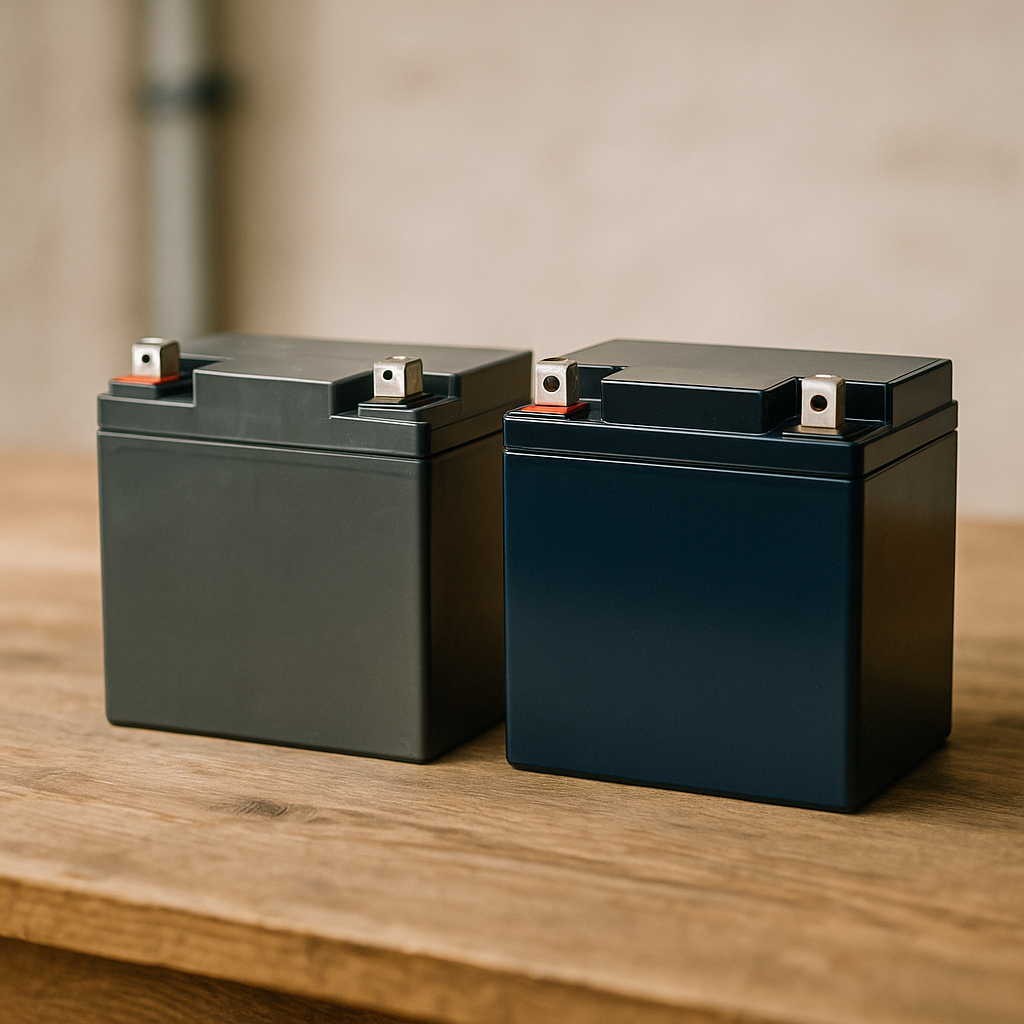
When we invest in a battery, we are essentially purchasing a finite vessel for energy. One of the most critical, yet often misunderstood, metrics of this vessel is its lifespan. How long will it serve its purpose before its ability to hold a useful charge diminishes to the point of requiring replacement? This question brings us to the concepts of cycle life and Depth of Discharge (DoD), which together paint a picture of a battery's endurance. It is in this domain that the distinction between SLA and LiFePO4 technologies is not just a matter of degrees but of orders of magnitude. The SLA battery performs a respectable sprint, while the LiFePO4 battery is engineered for a marathon, lasting years and thousands of cycles longer.
At its core, a "cycle" refers to one complete process of discharging a battery and then recharging it back to full. A battery's "cycle life" is the total number of these cycles it can endure before its capacity drops to a certain percentage of its original rating, typically 80%. It is crucial to understand that not all cycles are created equal. The key variable that governs the impact of a cycle is the Depth of Discharge (DoD). DoD represents the percentage of the battery's total capacity that has been used up. For example, discharging a 100Ah battery until it has 30Ah remaining means you have subjected it to a 70% DoD.
The relationship between DoD and cycle life is inverse and non-linear: the deeper you discharge a battery on a regular basis, the fewer total cycles you will get from it. This is a fundamental principle of battery chemistry. Think of it like bending a piece of metal; small, shallow bends can be done many times, but bending it back and forth to its absolute limit will cause it to fatigue and break much more quickly. A battery's chemistry undergoes stress during deep discharges, and this accumulated stress dictates its ultimate lifespan. Manufacturers provide charts that illustrate this relationship, and understanding them is key to predicting a battery's real-world longevity.
For a Sealed Lead-Acid (SLA) 12v 18ah battery, the cycle life is modest, even under ideal conditions. A typical SLA battery is rated for somewhere between 200 to 500 cycles. However, this rating is often based on a relatively shallow DoD, such as 50%. If you were to regularly discharge your 18Ah SLA battery by using its full rated capacity, its cycle life would plummet dramatically, perhaps to as few as 100-150 cycles. This is why it is common practice to only use about 50% of an SLA battery's stated capacity (9Ah in this case) to preserve its health.
The primary villain in the story of an SLA battery's demise is a process called sulfation. When a lead-acid battery discharges, the lead on the plates reacts with the sulfate in the electrolyte to form lead sulfate crystals. During recharging, this process is supposed to reverse. However, if the battery is left in a discharged state for too long, or if it is consistently undercharged, these soft lead sulfate crystals begin to harden and recrystallize. These hard crystals are very difficult to dissolve back into the electrolyte during charging. This has two detrimental effects: first, it reduces the active surface area of the lead plates, permanently lowering the battery's capacity. Second, the crystals can grow large enough to physically damage the battery's internal structure. It is a slow, creeping degradation that is the inevitable fate of every SLA battery. This chemical reality is why SLA batteries in demanding applications, like mobility scooters used daily, often require replacement every one to two years.
Now, let's turn our attention to the LiFePO4 12v 18ah battery. Here, the narrative of lifespan changes completely. LiFePO4 batteries are routinely rated for 2,500 to 7,000 full charge-discharge cycles before their capacity drops to 80% (ExpertPower, 2023). This is, at a minimum, ten times the cycle life of a typical SLA battery. What's more, LiFePO4 chemistry is far more resilient to deep discharges. While an SLA battery is crippled by high DoD, a LiFePO4 battery can be regularly discharged to 80% or even 100% of its capacity with a much smaller impact on its overall cycle life. For example, a LiFePO4 battery might offer 2,500 cycles at 100% DoD, but that number could increase to 8,000 cycles or more if it's only discharged to 60% on average (Jackery, 2024).
This remarkable longevity is due to the inherent stability of the lithium iron phosphate crystal structure. The bonds within the iron phosphate (PO4) cathode are incredibly strong, which prevents the material from breaking down during the repeated insertion and removal of lithium ions (the process of charging and discharging). Unlike lead-acid chemistry, there is no analogous process to hard sulfation. The degradation that does occur happens at a vastly slower rate. This means that a single LiFePO4 battery can realistically last for a decade or more in the same application where an SLA battery would have been replaced five or six times.
This staggering difference in lifespan has profound economic consequences. While the initial purchase price of a LiFePO4 battery is higher, it is a fallacy to consider it the "more expensive" option without accounting for its longevity. The true financial measure is the Total Cost of Ownership (TCO), which can be conceptualized as the cost per usable kilowatt-hour (kWh) over the battery's lifetime.
Let's imagine a simplified scenario. An SLA 12v 18ah battery might cost $40 and an equivalent LiFePO4 battery might cost $100. The SLA battery provides about 300 cycles at 50% DoD. The LiFePO4 battery provides 3,000 cycles at 80% DoD.
SLA TCO:
LiFePO4 TCO:
In this illustrative example, the energy from the LiFePO4 battery is nearly seven times cheaper over its lifespan. This calculation does not even factor in the cost of labor, shipping, and downtime associated with replacing the SLA battery multiple times. When viewed through the lens of longevity and TCO, the LiFePO4 battery is not just a better battery; it is a fundamentally better financial investment for any application that involves regular use.
Beyond the crucial consideration of how long a battery will last, we must examine how it performs during its operational life. The quality of the power a battery delivers is just as important as the quantity. A battery's performance profile determines how effectively it can run our devices, especially those with high power demands. This is another area where the underlying chemistries of SLA and LiFePO4 create two vastly different user experiences. The SLA battery, while capable, exhibits a phenomenon known as voltage sag, where its power delivery falters under load. The LiFePO4 battery, in contrast, is defined by its remarkably stable voltage output, providing consistent and efficient power from the beginning to the end of its discharge cycle.
To grasp the concept of voltage sag, let's revisit our analogy of a water tank. Imagine you have a full tank (a fully charged battery) with a wide hose attached. When you first open the tap, the water (current) flows out with strong pressure (voltage). However, as the tank drains, the pressure naturally decreases. Now, imagine you try to force a large amount of water through that hose all at once (a high-power-draw device). The pressure right at the tap will drop significantly as the hose struggles to deliver the volume. This drop in pressure is voltage sag.
In an SLA 12v 18ah battery, this effect is particularly pronounced due to its higher internal resistance. Internal resistance is an inherent property of a battery that impedes the flow of current. When a device demands a large current—for instance, the motor on an electric scooter accelerating up a hill—the SLA battery's voltage can drop significantly. A nominal 12V battery might drop to 11V, 10V, or even lower under a heavy load.
This has several negative practical consequences. First, many modern electronics have low-voltage cutoff circuits to protect themselves. A device might prematurely shut down, believing the battery is empty, when in fact it still has significant capacity remaining—it just can't deliver the power at the required voltage. Second, for motors and lights, lower voltage translates directly to diminished performance. The scooter will feel sluggish, and the lights will appear dimmer. You are not getting the full performance from your device, even when the battery is theoretically more than half full. This phenomenon, known as Peukert's Law, dictates that the faster you discharge a lead-acid battery, the less total capacity you can actually access (BatteryStuff.com, n.d.).
A LiFePO4 12v 18ah battery behaves in a fundamentally different way. Its internal resistance is substantially lower than that of an SLA battery. More importantly, its discharge curve—a graph of its voltage over the course of its discharge—is remarkably flat.
When a fully charged 12.8V LiFePO4 battery begins to discharge, its voltage drops slightly but then holds steady at around 12.8V-13V for the vast majority of its discharge cycle. Only when it is nearly depleted does the voltage begin to drop off sharply. This means that whether the battery is 90% full or 30% full, it delivers power at virtually the same voltage.
The practical benefit of this is immense. Your electric scooter will have the same zippy acceleration when the battery is low as it did when it was full. The lights on your RV or boat will remain bright and consistent. Your sensitive electronics will receive a stable, reliable voltage, preventing premature shutdowns and ensuring optimal operation. You are able to access the battery's full usable capacity without a corresponding degradation in performance. The experience is one of consistent, reliable power, from start to finish. This characteristic makes LiFePO4 particularly well-suited for high-drain applications where performance cannot be compromised.
Efficiency is a measure of how much energy you get out versus how much you put in. This applies to both discharging and charging a battery. Here again, LiFePO4 technology demonstrates a clear superiority.
SLA batteries suffer from lower charging efficiency. When you charge an SLA battery, only about 80-85% of the energy you put into it is actually stored. The remaining 15-20% is lost, primarily as heat. This is wasted electricity, which adds up over the hundreds of charge cycles the battery will see.
LiFePO4 batteries, by contrast, have a charging efficiency of around 99% (ExpertPower, 2023). Nearly all the energy from your charger or solar panel is stored in the battery for later use. This not only saves money on electricity but is particularly critical in solar applications. When you have a limited number of daylight hours to capture energy, you want to ensure that as much of that precious solar power as possible makes it into your battery bank. With LiFePO4, you can charge faster and waste less energy in the process, making your entire solar system more effective. For smaller systems, this efficiency can be crucial, as even a reliable 12V tool battery benefits from efficient charging to minimize downtime.
A battery's performance can be significantly affected by the ambient temperature. Both SLA and LiFePO4 batteries have their own unique responses to heat and cold.
SLA batteries tend to perform reasonably well in the cold, albeit with a temporary reduction in capacity. However, they are highly susceptible to damage from heat. High ambient temperatures accelerate the internal chemical reactions, leading to increased water loss (even in a "sealed" battery) and a dramatically shortened service life. An SLA battery that might last two years in a temperate climate could fail in less than a year in a hot environment like Arizona or Florida.
LiFePO4 batteries have a different profile. Their performance can be reduced in very cold temperatures, specifically when it comes to charging. Most LiFePO4 batteries with a standard BMS will prevent charging below freezing (0°C or 32°F) to protect the cells from damage (Outbound Power, 2024). However, they can still discharge power effectively at low temperatures. In hot conditions, LiFePO4 is far more robust than SLA. Its stable chemistry is less prone to thermal runaway, and while extreme heat can still shorten its lifespan, the effect is far less dramatic than with lead-acid. For applications in variable or high-temperature environments, the thermal stability of LiFePO4 provides a significant performance and safety advantage.
In many applications, the physical characteristics of a battery—its size and weight—are as important as its electrical properties. For anything that needs to be moved, whether it's a vehicle, a portable power pack, or a piece of marine equipment, weight is a critical factor that influences handling, efficiency, and usability. This is perhaps the most immediately obvious and tangible difference between SLA and LiFePO4 technologies. The lead-acid battery carries the literal and figurative weight of its primary component: lead, one of the densest common metals. In contrast, the lithium-based chemistry of LiFePO4 offers a revolutionary reduction in weight, a difference that stems from a superior energy density.
Let's consider our specific case: the 12v 18ah battery. A typical SLA battery of this size will weigh between 12 and 15 pounds (approximately 5.4 to 6.8 kilograms). Now, consider a LiFePO4 battery with the exact same 12v 18ah rating. It will typically weigh between 4 and 6 pounds (approximately 1.8 to 2.7 kilograms).
This is not a minor difference. The LiFePO4 battery is, on average, about one-third the weight of its lead-acid counterpart. To put this in perspective, imagine replacing a bank of four SLA batteries in an RV or a boat. You would be removing approximately 50-60 pounds of dead weight and replacing it with just 16-24 pounds. This is a weight saving equivalent to a large bag of concrete or a small child.
This reduction has immediate, practical benefits. For a person who needs to lift a battery out of a mobility scooter for charging, the difference between lifting 13 pounds and lifting 5 pounds is significant, especially for those with physical limitations. For a kayaker using a battery to power a fish finder or a small trolling motor, shedding 8-10 pounds of weight makes the vessel easier to transport, faster on the water, and more stable. In an RV, reducing weight contributes to better fuel economy and allows for more cargo capacity to be allocated to other essentials. The physical burden of lead is a very real constraint that LiFePO4 technology effectively eliminates.
The reason for this dramatic weight difference lies in a concept called energy density. Energy density is a measure of how much energy a battery can store for a given amount of mass (gravimetric energy density, measured in Watt-hours per kilogram or Wh/kg) or volume (volumetric energy density, measured in Watt-hours per liter or Wh/L). It is the fundamental metric of a battery's efficiency in storing power. A battery with higher energy density can store more power in a smaller, lighter package.
Lead-acid chemistry has a relatively low energy density. The chemical reactions involving lead and sulfuric acid are simply not very efficient at storing energy on a per-kilogram basis. Lithium, on the other hand, is the lightest of all metals and has the greatest electrochemical potential. This allows lithium-based batteries to achieve a much higher energy density.
Let's quantify this with our 12v 18ah example.
| Battery Type | Nominal Energy (Wh) | Average Weight (kg) | Gravimetric Energy Density (Wh/kg) |
|---|---|---|---|
| SLA 12v 18ah | 12V * 18Ah = 216 Wh | 6.1 kg | ~35 Wh/kg |
| LiFePO4 12v 18ah | 12.8V * 18Ah = 230 Wh | 2.2 kg | ~105 Wh/kg |
As the table clearly shows, the LiFePO4 battery has an energy density that is roughly three times higher than the SLA battery. It's not just that the LiFePO4 battery is lighter; it is fundamentally more efficient at its job of storing energy. This is a core scientific advantage that underpins many of the other performance benefits of lithium technology.
The high energy density of LiFePO4 opens up new possibilities for portable power. Applications that were once cumbersome or impractical with heavy SLA batteries become viable. Consider a freelance photographer or videographer who needs to power lights and equipment on a remote location shoot. Carrying a 15-pound SLA battery pack is a significant burden. A 5-pound LiFePO4 equivalent is far more manageable and encourages a more mobile and flexible workflow.
In the world of competitive fishing, where every ounce on the boat matters, upgrading from SLA to LiFePO4 for trolling motors and electronics is a common performance enhancement. The weight savings translate to higher top speeds and shallower drafts, allowing access to more areas. For off-grid enthusiasts and campers, the ability to pack more power into a smaller and lighter system means more energy independence without sacrificing precious cargo space or exceeding vehicle weight limits. The freedom from the "burden of lead" is a transformative advantage that directly enhances the user experience in any mobile application.
The reduced weight of LiFePO4 batteries also simplifies installation and handling. Mounting a 5-pound battery on a bulkhead or in a tight compartment is far easier and requires less robust structural support than wrestling with a 15-pound block of lead. This can reduce installation time and complexity.
Furthermore, the sealed, solid-state nature of LiFePO4 batteries allows them to be mounted in any orientation—sideways or even upside down—without any risk of leaking acid. While modern AGM-style SLA batteries are also "sealed" and can be mounted in various positions, they still contain a liquid electrolyte immobilized in glass mats. In cases of severe damage or casing failure, acid leakage remains a possibility. LiFePO4 batteries contain no free-flowing liquid acid, further enhancing their safety and flexibility during installation. This versatility, combined with the significant weight advantage, makes the LiFePO4 12v 18ah battery a superior physical object to handle, install, and live with.
When we place a battery into our home, vehicle, or equipment, we are entrusting it with storing a significant amount of energy. The safety and reliability of that energy storage are paramount. A battery should not be a source of anxiety; it should be a dependable component that operates predictably and safely with minimal intervention. In the domains of safety and maintenance, the architectural differences between SLA and LiFePO4 batteries are profound. The older SLA technology carries inherent risks and requires periodic attention, while the modern LiFePO4 battery is designed from the ground up with multiple layers of safety and is virtually maintenance-free, offering genuine peace of mind.
The term "Sealed Lead-Acid" can be somewhat misleading. While SLA batteries are designed not to leak acid under normal operation, they are not hermetically sealed. They are "valve-regulated," which means they are equipped with pressure-relief valves. This is a necessary safety feature because of the chemistry of charging a lead-acid battery.
During the final stages of charging, a process called electrolysis can occur, where the water in the electrolyte is split into hydrogen and oxygen gas. If a charger malfunctions and continues to apply a high voltage (overcharging), this gassing can become rapid and significant. The safety valves are designed to vent this gas to prevent the battery case from rupturing under pressure. However, the vented gas is a highly explosive mixture of hydrogen and oxygen. This is why it is always recommended to charge lead-acid batteries in a well-ventilated area, away from any potential sparks or sources of ignition. An accumulation of this gas in an enclosed space, like a small boat compartment or an unventilated RV bay, creates a serious explosion hazard. While this is a worst-case scenario, it is a risk inherent to the technology.
Lithium Iron Phosphate (LiFePO4) chemistry offers a stark contrast. One of the primary reasons this particular lithium chemistry was developed was for its exceptional safety profile. The oxygen atoms in the phosphate (PO4) cathode are held in a very strong covalent bond within the crystal structure. This makes it extremely difficult for the oxygen to be released, even under abusive conditions like overcharging or overheating. The release of oxygen from the cathode is a key step in the process of thermal runaway—the dangerous, self-sustaining chain reaction of overheating that can lead to fires in some other types of lithium-ion batteries (Outbound Power, 2024).
Because the iron phosphate cathode is so stable and reluctant to release its oxygen, LiFePO4 batteries are inherently resistant to thermal runaway. They can withstand conditions that would cause other lithium chemistries to fail catastrophically. This intrinsic chemical stability is the first and most important layer of safety in a LiFePO4 battery. You are starting with a chemistry that is fundamentally less volatile and safer than many of its counterparts.
If the stable chemistry is the first layer of safety, the second, active layer is the Battery Management System (BMS). Every modern LiFePO4 battery, including a 12v 18ah model, contains a sophisticated internal circuit board that acts as the battery's brain. The BMS constantly monitors the health and status of every individual cell within the battery pack. Its job is to protect the battery from any situation that could cause damage or create a safety hazard.
The functions of a typical BMS include:
The BMS is a comprehensive, active safety and management system that is simply absent in an SLA battery. It transforms the battery from a passive chemical block into a smart, self-protecting device, providing a level of safety and reliability that SLA technology cannot match.
The maintenance requirements of SLA and LiFePO4 batteries are also worlds apart. An SLA battery, to achieve its maximum (and already limited) lifespan, requires a degree of care. It should not be stored in a discharged state, as this accelerates sulfation. It should be kept on a maintenance charger or "float charge" when not in use. Even though it is "sealed," it can still lose water over time, especially in hot environments, and this loss is irreversible.
A LiFePO4 battery, on the other hand, is virtually maintenance-free. Thanks to its extremely low self-discharge rate (typically 1-3% per month), it can be stored for many months without needing to be recharged (Jackery, 2024). In fact, the ideal storage condition for a LiFePO4 battery is at a partial state of charge (around 50-70%), not fully charged. There is no water to check, no sulfation to worry about, and no need for constant float charging. The BMS takes care of protecting the cells. For the user, the experience is one of "set and forget." You install the battery, and it simply works, for years, without requiring any special attention. This convenience and freedom from maintenance chores is a significant quality-of-life improvement for any battery owner.
For many, the final decision in any purchase comes down to cost. When comparing a 12v 18ah SLA battery to its LiFePO4 counterpart, the difference in the initial price tag is undeniable and can often be the single factor that sways a buyer. The SLA battery is significantly cheaper to purchase upfront. However, a nuanced examination of cost reveals that this initial sticker price is a misleading metric for the true financial impact of the battery over its lifetime. The concept of value must extend beyond the initial transaction to encompass longevity, performance, and replacement frequency. When viewed through this more comprehensive lens of long-term value, the more expensive LiFePO4 battery often emerges as the far more economical choice.
The primary reason for the low upfront cost of SLA batteries is twofold: the raw materials are inexpensive, and the manufacturing process is mature and highly optimized. Lead and sulfuric acid are abundant and cheap commodities. The technology has been in mass production for over a century, meaning the factories and processes are extremely efficient, having benefited from decades of refinement. A brand new 12v 18ah SLA battery can often be purchased for between $35 and $50.
In contrast, a LiFePO4 battery of the same size might cost between $80 and $150, or even more for premium brands. This higher cost is driven by several factors. The raw materials, including lithium and copper, are more expensive than lead. The manufacturing process for lithium cells is more complex and must be done in highly controlled, clean-room environments. Furthermore, every LiFePO4 battery includes the additional cost of a sophisticated Battery Management System (BMS), a component that simply does not exist in an SLA battery. When looking solely at the price on the shelf, the SLA battery is the clear winner for the budget-conscious buyer.
The crucial flaw in the sticker-price comparison is that it ignores the dimension of time. A battery is not a single-use item; it is an asset that provides a service over its lifespan. The true cost should be amortized over the total amount of energy it will deliver before it needs to be replaced. As we established in the section on lifespan, a LiFePO4 battery can outlast an SLA battery by a factor of 10 or more.
Let's revisit and expand upon our earlier Total Cost of Ownership (TCO) calculation. Assume the following conservative figures:
Over a ten-year period in a daily-use application (e.g., a mobility scooter), you might need to replace the SLA battery every two years, resulting in five separate battery purchases.
In this realistic scenario, the LiFePO4 battery is already almost half the price over a decade, and this does not even account for the hassle, shipping costs, and downtime associated with five separate replacements.
Moreover, we can calculate the cost per usable watt-hour (Wh).
SLA usable energy: 12V * 18Ah * 50% = 108 Wh
LiFePO4 usable energy: 12.8V * 18Ah * 80% = 184 Wh
SLA lifetime energy: 108 Wh/cycle * 400 cycles = 43,200 Wh
LiFePO4 lifetime energy: 184 Wh/cycle * 4,000 cycles = 736,000 Wh
SLA cost per Wh: $45 / 43,200 Wh = $0.00104 per Wh
LiFePO4 cost per Wh: $120 / 736,000 Wh = $0.00016 per Wh
The energy delivered by the LiFePO4 battery over its lifetime is more than six times cheaper than the energy from the SLA battery. This demonstrates that while you pay more upfront for the LiFePO4 technology, you are buying a vastly larger reservoir of energy cycles, making it the superior long-term financial investment.
A manufacturer's warranty is a direct reflection of their confidence in a product's longevity. SLA batteries typically come with a 1-year warranty. This aligns with the expectation that in a demanding application, the battery may not last much longer than that. LiFePO4 batteries, on the other hand, often come with warranties ranging from 3 to 10 years (Power Queen, 2025). A longer warranty provides a form of insurance on your investment, protecting you from premature failure and adding to the overall value proposition. Choosing a battery from a reputable brand with a strong warranty is a critical part of ensuring you realize the long-term value of your purchase.
Despite the overwhelming advantages of LiFePO4, there are still specific, niche scenarios where an SLA 12v 18ah battery might be the more logical choice. These are typically applications where the battery is used infrequently and is not a critical component.
Consider a home alarm system's backup battery. It might only be called upon to discharge a handful of times over its entire service life. In this case, the extreme cycle life of a LiFePO4 battery is unnecessary overkill. The SLA battery's primary failure mode in this application will be age-related degradation, not cycle-based wear. Since it will likely need to be replaced every 3-5 years due to age regardless of use, the lower initial cost of the SLA makes it the more pragmatic economic choice. Similarly, for a child's electric toy that is used only occasionally, the durability and high performance of lithium may not be worth the extra upfront cost. The decision should always be context-driven, based on the expected frequency and depth of discharge. For any application involving regular, deep cycling, the long-term value of LiFePO4 is nearly impossible to dispute.
In most cases, yes. A LiFePO4 12v 18ah battery is often designed as a "drop-in" replacement for its SLA counterpart, meaning it has similar physical dimensions. However, the most critical consideration is your charging system. While many modern chargers have settings for lithium batteries, an old charger designed exclusively for SLA batteries may not charge a LiFePO4 battery correctly and could potentially damage it or fail to charge it fully. It is highly recommended to use a charger specifically designed for or compatible with LiFePO4 chemistry to ensure safety and get the best performance and lifespan from your new battery.
Yes, it is strongly recommended. LiFePO4 batteries require a specific charging algorithm, typically a CC/CV (Constant Current/Constant Voltage) profile, that is different from the multi-stage charging used for lead-acid batteries. A dedicated LiFePO4 charger ensures the battery is charged to the correct voltage without being overcharged. Using an SLA charger can lead to undercharging, which reduces performance, or overcharging, which can trigger the BMS protection and, in rare cases with a faulty BMS, pose a safety risk. Investing in the correct charger is a small price to pay to protect your larger investment in the battery itself. Just as you'd use a dedicated charger for specific power tool systems, like those for 12V WORX replacement batteries, your 12v 18ah battery needs a charger matched to its chemistry.
Absolutely. In fact, a LiFePO4 battery is significantly safer than an SLA battery for a home UPS system. Its inherent thermal stability makes it far less susceptible to overheating. The internal BMS provides robust protection against overcharging, over-discharging, and short circuits. Furthermore, unlike SLA batteries, LiFePO4 batteries do not vent flammable hydrogen gas, eliminating a potential fire hazard in an enclosed home or office environment. Their longer lifespan also means fewer replacements and less maintenance hassle.
For any electric mobility application like a scooter or e-bike, a LiFePO4 12v 18ah battery is overwhelmingly the superior choice. There are three main reasons: weight, performance, and lifespan. The LiFePO4 battery is about one-third the weight, which improves the vehicle's handling, acceleration, and range. Its flat discharge curve means you will get consistent motor performance and speed, even as the battery drains. Finally, its vastly superior cycle life means it will withstand the daily charging and discharging that mobility applications require, lasting for many years instead of just one or two.
Yes, you can connect batteries in series or parallel to increase voltage or capacity, respectively.
The journey through the intricate world of the 12v 18ah battery reveals a clear technological crossroads. On one path lies the familiar, well-trodden road of Sealed Lead-Acid technology—a choice defined by its low initial cost and a legacy of dependability in low-demand roles. On the other path is the modern highway of Lithium Iron Phosphate, a technology that, while demanding a greater initial investment, delivers a journey marked by superior endurance, unwavering performance, and profound safety.
The decision is no longer about simply buying a "battery," but about investing in an energy solution tailored to a specific purpose. For applications characterized by infrequent use, where the primary enemy is the simple passage of time rather than the stress of repeated cycling, the economic logic of an SLA battery can still hold. It serves its purpose as a standby power source adequately and affordably.
However, for any application that demands regular use—the daily commute on a mobility scooter, the weekend fishing trip powered by a trolling motor, the off-grid reliability of a solar system—the evidence points decisively toward LiFePO4. Its marathon-like lifespan, measured in thousands of cycles, transforms the battery from a disposable commodity into a long-term asset. Its flat discharge curve ensures that your devices perform at their peak from a full charge down to the last usable watt-hour. Its lightweight nature frees you from the burden of lead, enhancing portability and efficiency. And its combination of inherently stable chemistry and an intelligent, self-protecting BMS provides a level of safety and peace of mind that older technologies simply cannot offer. Viewing the choice through the comprehensive lens of total cost of ownership, performance, and safety empowers you to look beyond the sticker price and recognize the enduring value that modern battery chemistry provides.
BatteryStuff.com. (n.d.). Peukert’s law | A nerd’s attempt to explain battery capacity. Retrieved from https://www.batterystuff.com/kb/tools/peukert-s-law-a-nerds-attempt-to-explain-battery-capacity.html
ExpertPower. (2023). LiFePO4 series. Retrieved from
Fleet Lithium. (2024). How to pick the right battery: A guide to choosing the best power source for your needs. Retrieved from
Jackery. (2024, May 21). Ultimate guide to lithium-ion battery voltage chart (12V, 24V, 48V). Retrieved from https://www.jackery.com/blogs/knowledge/lithium-ion-battery-voltage-chart
Outbound Power. (2024, October 23). Understanding lithium battery types: A guide for portable power users. Retrieved from
Power Queen. (2025). Products. Retrieved from
Redway, G. (2023). LiFePO4 battery voltage charts (12V, 24V & 48V). Renogy.
{"one"=>"Select 2 or 3 items to compare", "other"=>"{{ count }} of 3 items selected"}