

CONTACT
Please contact us for shipping details.
The selection of an appropriate 24V charger is a determination that profoundly influences the longevity, performance, and safety of a 24-volt battery system. This document examines the multifaceted considerations integral to this choice, moving beyond superficial specifications to a deeper understanding of electrochemical principles and technological functionalities. It evaluates the fundamental distinctions between charging protocols for lead-acid and lithium-ion battery chemistries, particularly Lithium Iron Phosphate (LiFePO4), which is prevalent in modern deep-cycle applications. Key parameters such as amperage rating, the significance of C-rate, and the operational logic of multi-stage smart charging are analyzed in detail. The investigation extends to the critical role of safety features, including thermal compensation, reverse polarity protection, and industry certifications, which safeguard both the equipment and the user. By contextualizing these technical elements within specific applications—from marine and recreational vehicles to off-grid solar installations—this work provides a comprehensive framework for making an informed and judicious decision, ensuring the chosen 24V charger functions not merely as a power accessory but as an essential component for system preservation and optimization.
To contemplate the function of a battery charger is to consider the very sustenance of a power system. A battery, particularly one in a 24-volt configuration, is not a passive vessel but a dynamic electrochemical system, a small world of potential and kinetic energy. The charger is its partner in this dance of electrons, the provider of the structured energy needed for the battery to renew itself. Supplying the wrong kind of energy—an incompatible charging algorithm—is akin to providing the wrong type of nourishment. It may sustain the system for a time, but it will inevitably lead to diminished capacity, a shortened lifespan, and perhaps even catastrophic failure. The first and most profound step in selecting a 24V charger, therefore, is to develop an intimate understanding of the battery chemistry you intend to replenish. The two dominant families in the 24V landscape are the venerable lead-acid batteries and the ascendant lithium-ion variants. Each possesses a unique internal architecture and demands a correspondingly unique dialogue with its charger.
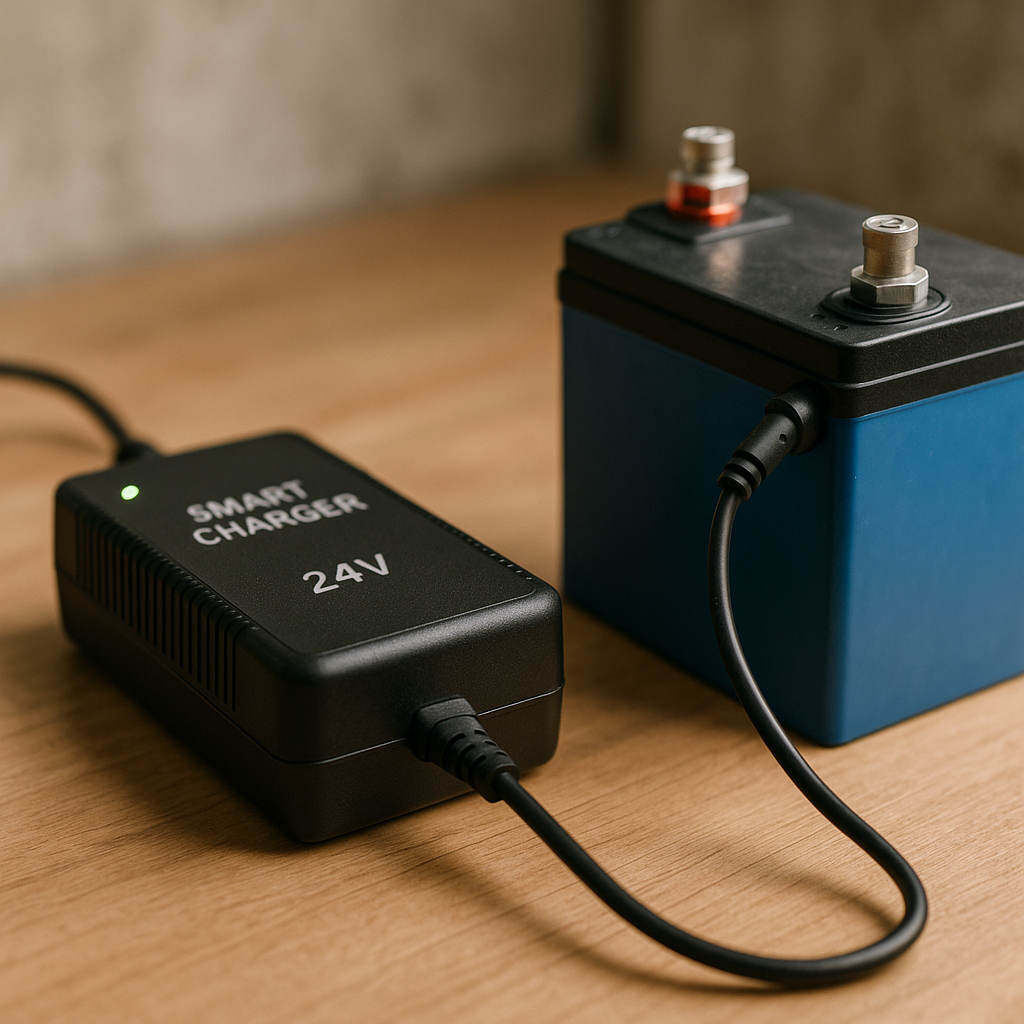
Lead-acid technology is a cornerstone of electrical storage, a technology refined over more than a century. Its persistence is a testament to its reliability and cost-effectiveness. When we speak of lead-acid in the context of 24V systems, we are generally referring to a battery bank composed of two 12V batteries in series or a single, large 24V unit. These batteries operate through a reversible chemical reaction between lead plates and a sulfuric acid electrolyte. However, not all lead-acid batteries are the same, and their charging requirements reflect their internal differences.
A flooded lead-acid (FLA) battery is the most traditional form. It contains plates submerged in a liquid electrolyte. These batteries are robust and inexpensive, but they require regular maintenance, including topping off the distilled water that is lost during the charging process. This water loss occurs due to gassing, a process where hydrogen and oxygen are released, particularly during the later stages of charging. Consequently, a 24V charger for FLA batteries must follow a precise multi-stage process.
The process begins with the Bulk stage, where the charger delivers its maximum rated current, raising the battery's state of charge significantly. It is a brute-force phase, rapidly replenishing the majority of the battery's energy. As the battery’s voltage reaches a predetermined point (typically around 28.2 to 28.8 volts for a 24V system), the charger transitions to the Absorption stage. Here, the charger holds the voltage constant while the current gradually tapers off. You can think of this as a saturation phase, allowing the battery to absorb the final 20% of its charge and ensuring the cells are uniformly powered. The final primary stage is Float, where the voltage is reduced to a lower level (around 26.8 to 27.0 volts) to maintain the battery at a full charge without overcharging it. This maintenance charge compensates for self-discharge, keeping the battery ready for use.
Sealed lead-acid (SLA) batteries, which include Absorbent Glass Mat (AGM) and Gel types, were developed to overcome the maintenance needs of FLA batteries. In an AGM battery, the electrolyte is held within fine fiberglass mats, preventing spillage. Gel batteries use a silica agent to turn the electrolyte into a thick, putty-like substance. While both are "maintenance-free," their charging profiles are even more sensitive. A 24V charger designed for these chemistries must be precise, as over-voltage can cause permanent damage. Gassing still occurs, but internal channels are designed to recombine most of the hydrogen and oxygen back into water. Excessive voltage, however, can overwhelm this process, venting precious gas and drying out the battery.
Lithium-ion batteries, especially the Lithium Iron Phosphate (LiFePO4) chemistry, have revolutionized the 24V deep-cycle market. Their appeal lies in their high energy density, exceptionally long cycle life, and inherent safety compared to other lithium chemistries. A LiFePO4 battery can often endure 3,000 to 7,000 charge cycles, whereas a lead-acid battery might only last for a few hundred cycles under similar conditions (Outbound Power, 2024).
The charging process for a LiFePO4 battery is fundamentally different and simpler than that of its lead-acid counterpart. It primarily involves a two-stage algorithm: Constant Current (CC) and Constant Voltage (CV).
In the Constant Current stage, the 24V charger supplies a steady current, and the battery's voltage rises gradually. This phase is analogous to the bulk stage in lead-acid charging. Once the battery voltage reaches its peak (typically 29.2V for a 24V LiFePO4 battery), the charger enters the Constant Voltage stage. The charger holds the voltage at this peak level, and the current drawn by the battery begins to fall. When the current drops to a very low level (e.g., 5% of the battery's Ah rating), the battery is considered fully charged, and the charger should shut off completely.
A LiFePO4 battery does not require a float charge. In fact, maintaining a constant float voltage can be detrimental over the long term. A quality 24V charger designed for LiFePO4 will turn off after the CV stage is complete. It may monitor the battery and re-initiate a charge only after the voltage drops below a certain threshold. Furthermore, LiFePO4 batteries do not need an "equalization" charge, which is a controlled overcharge used on flooded lead-acid batteries to balance cells and reverse sulfation. Applying an equalization charge to a LiFePO4 battery is dangerous and will cause irreversible damage.
This stark difference in charging philosophy underscores the necessity of selecting a charger explicitly designed for your battery's chemistry. Using a lead-acid charger on a LiFePO4 battery, even one with an AGM setting, can lead to undercharging or, more dangerously, overcharging, compromising the battery's health and your safety.
| Feature | Lead-Acid Charger Profile (FLA/AGM/Gel) | LiFePO4 Charger Profile |
|---|---|---|
| Charging Stages | 3-stage: Bulk, Absorption, Float (plus optional Equalization) | 2-stage: Constant Current (CC), Constant Voltage (CV) |
| Full Charge Voltage (24V System) | ~28.8V (Absorption), ~27.0V (Float) | ~29.2V (CV Stage) |
| Float Charge | Required to maintain full charge and prevent sulfation. | Not required; can be harmful if continuously applied. |
| Equalization | Sometimes necessary for flooded lead-acid to balance cells. | Never use; extremely dangerous and damaging. |
| Termination | Transitions to Float stage. | Charger should shut off after CV stage is complete. |
| Management System | Relies entirely on the external charger's intelligence. | Often works with an internal Battery Management System (BMS). |
Once you have navigated the foundational choice of battery chemistry, the next intellectual puzzle concerns the rate at which energy is delivered. This rate is quantified by amperage (A), a measure of electrical current. To grasp the concept of amperage in a 24V charger is to understand the dynamic relationship between charging speed, battery capacity, and long-term battery wellness. Choosing the correct amperage is not a matter of selecting the highest number; it is a deliberate calculation, a balancing act between the desire for rapid replenishment and the physical limits of the battery's ability to accept a charge.
Imagine your battery is a large bucket, and the charger is a hose filling it with water. The battery's capacity, measured in Amp-hours (Ah), represents the size of the bucket. The charger's amperage is the diameter of the hose—a wider hose (higher amperage) fills the bucket faster than a narrow one (lower amperage). A 20-Amp 24V charger delivers energy at twice the rate of a 10-Amp 24V charger. While a faster charge seems universally desirable, the bucket itself—the battery—has structural limits. Forcing water in too quickly can stress the container, just as forcing current into a battery too quickly can generate excessive heat and cause internal damage.
To move from metaphor to practical calculation, we must introduce the concept of the C-rate. The C-rate describes the rate of charge or discharge relative to the battery's capacity. A charge rate of 1C means that the charge current is equal to the battery's capacity in Amp-hours. For a 100Ah battery, a 1C charge rate would be 100 Amps. A 0.2C rate would be 20 Amps (100Ah * 0.2).
Different battery chemistries have different recommended C-rates. Lead-acid batteries, with their higher internal resistance, are generally more sensitive to high charge rates. A typical recommendation for a deep-cycle lead-acid battery is to charge at a rate between 0.1C and 0.2C. For a 24V 100Ah lead-acid battery bank, this translates to a 24V charger with an amperage between 10A and 20A. Charging much faster than this can lead to excessive gassing, heat buildup, and a shortened lifespan.
LiFePO4 batteries, in contrast, are electrochemical athletes. Their low internal resistance allows them to accept a charge much more efficiently. It is common for LiFePO4 batteries to support charge rates of 0.5C or even higher. For our 24V 100Ah LiFePO4 battery, a 0.5C rate would mean using a 50A 24V charger, allowing for a full charge in approximately two hours. Some high-performance cells can even handle a 1C rate, enabling a one-hour charge. This capability is a significant advantage in applications where downtime is costly, such as in commercial vehicles or competitive marine settings.
The formula to estimate charge time is straightforward: Charge Time (in hours) = Battery Capacity (Ah) / Charger Current (A)
This calculation provides a baseline. The actual time will be slightly longer due to the tapering current in the absorption (for lead-acid) or constant voltage (for lithium) stage.
| Battery Capacity (24V System) | Charger Amperage | C-Rate | Estimated Charge Time (from empty) | Recommended For |
|---|---|---|---|---|
| 50Ah | 10A | 0.2C | ~5-6 hours | Small systems, trolling motors, mobility scooters. |
| 50Ah | 20A | 0.4C | ~2.5-3 hours | LiFePO4 systems needing a faster charge. |
| 100Ah | 10A | 0.1C | ~10-12 hours | Overnight charging for lead-acid or gentle charging for lithium. |
| 100Ah | 20A | 0.2C | ~5-6 hours | Standard, healthy charging for most 100Ah systems. |
| 100Ah | 40A | 0.4C | ~2.5-3 hours | Fast charging for LiFePO4 batteries in RV or off-grid use. |
| 200Ah | 20A | 0.1C | ~10-12 hours | Maintenance or overnight charging for large battery banks. |
| 200Ah | 40A | 0.2C | ~5-6 hours | Good balance of speed and health for large LiFePO4 banks. |
The decision of what amperage to choose is an exercise in balancing competing values. While a high-amperage 24V charger can rapidly service a depleted battery, this speed comes at a potential cost. The primary byproduct of charging is heat. The faster the charge, the more heat is generated within the battery. For lead-acid batteries, excessive heat can warp the lead plates and accelerate the degradation of the electrolyte.
For LiFePO4 batteries, while they are far more thermally stable, heat remains an enemy of longevity. The battery's internal Battery Management System (BMS) will typically have a high-temperature cutoff to prevent damage, but consistently charging at the maximum C-rate can contribute to long-term capacity fade more than a gentler charge would.
Therefore, a thoughtful approach is required. For general use in an RV or a small solar setup, where the battery can charge overnight or throughout a sunny day, a moderate charge rate of 0.2C is often ideal. It is fast enough for practical purposes but gentle enough to maximize the battery's prodigious cycle life. For applications requiring rapid turnaround, such as a commercial utility vehicle that operates in shifts, investing in a larger LiFePO4 battery bank and a higher-amperage 24V charger is a sound strategy, as the chemistry is designed to handle it. The key is to operate within the manufacturer's specified limits, treating the recommended C-rate not as a challenge but as a guideline for responsible stewardship of your power system.
To characterize a contemporary battery charger merely by its voltage and amperage is to overlook its most profound evolution: the development of its internal intelligence. A modern "smart" 24V charger is not a blunt instrument that force-feeds electricity into a battery. It is a sophisticated, microprocessor-controlled device that engages in a dynamic, responsive process tailored to the battery's specific needs at every moment. This intelligence transforms the charger from a simple power converter into an active guardian of the battery's health, capable of executing complex charging algorithms, adapting to environmental conditions, and preventing a host of potential damages. To choose a charger in 2025 without considering its intelligence is to ignore the most significant advancements in the field of battery maintenance.
At its core, a smart charger is defined by its ability to monitor the battery's state and adjust its output accordingly. It uses its microprocessor to execute a pre-programmed charging profile, such as the multi-stage algorithm for lead-acid or the CC/CV profile for lithium. Unlike a "dumb" charger, which might supply a constant voltage or current indefinitely, a smart charger knows when to transition between stages and, crucially, when to stop.
This monitoring is achieved by constantly measuring the battery's voltage and the amount of current it is accepting. For instance, during the absorption stage for a lead-acid battery, the smart charger holds the voltage steady and watches as the current tapers off. When the current falls below a specific threshold, the charger knows the battery is nearing full capacity and it is time to switch to the float stage. This prevents the continuous overcharging that boils electrolyte and damages lead-acid plates. Similarly, for a LiFePO4 battery, the charger's ability to terminate the charge completely after the CV stage is a hallmark of its intelligence, protecting the battery from the stress of a constant float voltage.
The intelligence of a premium 24V charger extends beyond basic multi-stage profiles. It often incorporates advanced features that provide a level of care analogous to that of a dedicated battery technician.
Temperature Compensation is one such feature. The electrochemical reactions inside a battery are highly sensitive to temperature. A battery's acceptance of a charge changes with its temperature. In cold conditions, a higher charging voltage is needed to fully replenish the battery. In hot conditions, the charging voltage must be lowered to prevent overcharging and excessive gassing. A smart charger with an external temperature sensor, typically a probe attached directly to the battery casing, can measure the battery's temperature in real-time. It then adjusts the charging voltage—up or down—based on a predefined compensation factor (e.g., -3mV per degree Celsius per cell). This ensures the battery receives the precise voltage it needs, regardless of the ambient temperature, dramatically improving both performance and lifespan, especially in environments with wide temperature swings like an RV or a boat.
Equalization is another intelligent, though chemistry-specific, function. Over time, the individual cells within a flooded lead-acid battery bank can become imbalanced, and sulfate crystals can build up on the plates (a process called sulfation), which reduces capacity. An equalization charge is a deliberate, controlled overcharge at a higher voltage for a short period. This process stirs the electrolyte, breaks down sulfate crystals, and helps to balance the voltage across all cells. A smart 24V charger with an equalization mode will perform this function automatically, but it is a powerful tool that must be used judiciously and only on compatible FLA batteries. As stressed before, this function must never be used on AGM, Gel, or any Lithium battery.
The latest evolution in smart charger technology is the integration of connectivity, most commonly through Bluetooth. A 24V charger equipped with Bluetooth allows the user to connect to the device via a smartphone app. This opens a window into the charging process, providing a level of monitoring and control previously unavailable.
Through a dedicated app, a user can:
This level of interactivity empowers the user, transforming them from a passive observer into an informed manager of their power system. It allows for a deeper understanding of the system's behavior and facilitates proactive maintenance, ensuring the 24V charger is not just working, but working optimally for the specific battery it supports.
The act of charging a battery is an act of managed risk. You are directing a significant amount of electrical energy into a dense chemical storage device. While modern batteries and chargers are remarkably safe, this safety is not accidental. It is the result of deliberate engineering, redundant protection systems, and adherence to rigorous standards. When selecting a 24V charger, it is not enough to consider its performance; one must also scrutinize its capacity to protect the entire system—the battery, the connected electronics, and the user—from potential harm. A well-chosen charger functions as the gatekeeper of the system, a vigilant sentinel that ensures the flow of power is always safe and controlled.
The most basic tenet of charger selection is matching the charger's nominal voltage to the battery system's nominal voltage. A 24V charger is designed for a 24V battery bank. This may seem self-evident, but the subtlety lies in understanding what "nominal" voltage means. A 24V lead-acid battery bank, for instance, will rest at about 25.6V when fully charged and may reach 28.8V during the absorption stage. A 24V LiFePO4 battery rests at about 26.4V and charges up to 29.2V. The 24V charger is engineered to operate within this specific voltage range.
Attempting to use a charger of a different voltage is a recipe for failure. Using a 12V charger on a 24V battery bank will simply not work, as the charger's voltage is insufficient to overcome the battery's own voltage and push current into it. Conversely, attempting to use a 48V charger on a 24V battery is exceptionally dangerous. The voltage differential is so great that the charger would force an enormous and uncontrolled current into the battery, overwhelming its ability to accept the charge. This would lead to rapid overheating, boiling of electrolyte in lead-acid batteries, and almost certain thermal runaway in lithium batteries, resulting in fire or explosion. The charger’s voltage is its fundamental language; speaking the wrong one invites chaos.
A quality 24V charger is a fortress of electronic protections, designed to anticipate and neutralize common failure scenarios. These features are not luxuries; they are fundamental requirements for safe operation.
In the world of electronics, certifications are the impartial arbiters of safety and quality. They signify that a product has been independently tested by a recognized third-party laboratory and found to meet specific safety standards. For a 24V charger, seeing logos from organizations like Underwriters Laboratories (UL), the European Commission (CE), or the Federal Communications Commission (FCC) provides a significant measure of confidence.
While uncertified chargers are widely available at lower prices, they come with no guarantee of their safety or performance. Investing in a certified 24V charger is an investment in peace of mind.
For chargers used in non-climate-controlled environments—such as on a boat, in an RV's external bay, or in a dusty workshop—protection against environmental ingress is vital. The Ingress Protection (IP) rating system classifies the degree of protection a device's enclosure provides against solids (like dust) and liquids (like water).
An IP rating is given as "IP" followed by two digits. The first digit (0-6) indicates protection against solids, with 6 being completely dust-tight. The second digit (0-9) indicates protection against liquids. For example:
Choosing a 24V charger with an appropriate IP rating ensures it will survive and continue to function reliably in its intended environment, protecting your investment from the slow decay of dust and moisture.
The theoretical understanding of a 24V charger—its chemistry profiles, amperage calculations, and safety protocols—finds its true meaning when applied to the specific context of its use. The ideal charger for a trolling motor on a fishing boat is not necessarily the ideal charger for a large off-grid solar installation. The demands of the application shape the necessary features, creating specialized categories of chargers designed to excel in particular environments. A discerning choice requires not only knowing how a charger works but also understanding the world in which it will operate.
Recreational vehicles and boats are self-contained ecosystems, often with complex electrical needs. They typically have at least two separate battery banks: a "starting" or "cranking" battery for the main engine and a "house" or "deep-cycle" bank to power lights, refrigerators, navigation equipment, and other amenities. This duality presents a unique charging challenge.
A multi-bank marine charger is purpose-built for this scenario. It is essentially multiple chargers housed in a single chassis, with each bank of output leads capable of charging a battery independently. A two-bank 24V charger, for example, could charge a 24V trolling motor battery bank while a separate 12V output charges the 12V engine starting battery. Each bank can have its own charging profile, allowing you to charge a LiFePO4 house bank and a lead-acid starting battery simultaneously and correctly.
For marine applications, ignition protection is a non-negotiable safety standard (often required by ABYC standards). This means the charger is designed to not emit sparks that could ignite gasoline fumes in an engine compartment. Furthermore, marine-grade chargers are built to withstand the harsh realities of the water: high humidity, salt spray, and vibration. They often feature robust IP ratings (like IP67), corrosion-resistant materials, and potted electronics sealed in epoxy. These are not just chargers; they are survival tools for an aquatic environment.
In an off-grid solar power system, the battery charger is the heart of the energy conversion process, translating the variable power from solar panels into a stable, usable form for the battery bank. In this context, the "charger" is known as a solar charge controller. There are two primary types: Pulse Width Modulation (PWM) and Maximum Power Point Tracking (MPPT).
A PWM charge controller is a simpler, switch-based device. It connects the solar panel directly to the battery and uses rapid switching to modulate the voltage. It is an effective and inexpensive solution for smaller systems.
An MPPT charge controller, however, is a far more sophisticated device. It is a DC-to-DC converter that can take a higher voltage from the solar panels and convert it down to the proper charging voltage for the 24V battery bank, increasing the current in the process. This allows it to "track" and harvest the maximum possible power from the panels, especially in cold weather or low-light conditions. An MPPT controller can be 15-30% more efficient than a PWM controller, a massive gain in a system where every watt counts. For any serious 24V off-grid system, an MPPT charge controller is the superior choice, acting as an intelligent 24V charger that maximizes the solar harvest.
Applications like electric trolling motors and mobility scooters rely on deep-cycle 24V battery systems that are regularly discharged and recharged. For these uses, the quality of the 24V charger directly impacts the daily performance and long-term health of the batteries.
Using a simple, unregulated "trickle charger" on these batteries is a false economy. Such chargers can easily overcharge the batteries, leading to a drastically shortened life. A proper multi-stage smart charger is essential. For LiFePO4 batteries in these applications, the fast-charging capability is a major benefit. A powerful 24V charger can replenish the batteries during a lunch break, extending the usable time on the water or the operational range of a scooter. Onboard chargers, which are permanently mounted in the boat or scooter, offer convenience and ensure the charging system is always available.
In a workshop or garage setting, you might find a mix of power systems. While your main project might use a 24V system, you will undoubtedly have smaller cordless tools. Maintaining these devices is also part of a holistic approach to power management. For example, ensuring you have a compatible replacement battery pack and its correct charger for your 12V tools is just as important as selecting the right 24V charger for your heavy-duty equipment. This attention to detail across all voltage platforms reflects a true understanding of system readiness. DC-to-DC chargers also play a role, for example, by using your vehicle's 12V alternator to properly charge a 24V auxiliary battery bank while driving, ensuring your secondary system arrives at its destination fully energized.
No, you cannot use a single 12V charger to charge a 24V battery system directly. The charger's voltage is insufficient to overcome the battery's voltage, so no current will flow. While it is technically possible to charge the two 12V batteries that make up a 24V bank separately, this practice is not recommended. It is inefficient, time-consuming, and can easily lead to an imbalance between the two batteries, which will degrade the performance and lifespan of the entire 24V bank. The proper solution is to use a dedicated 24V charger.
If your 24V charger has too few amps for your battery bank's capacity (a very low C-rate), it will simply take a very long time to charge. This is generally not harmful to the battery, but it may be impractical. If the charger's amperage is too high for the battery's chemistry (an excessive C-rate), it can cause significant problems. For lead-acid batteries, it will lead to excessive heat and gassing, damaging the plates. For LiFePO4 batteries, while they can handle higher rates, exceeding the manufacturer's maximum recommended current can cause stress and reduce cycle life. A quality lithium battery's internal BMS should prevent damage by cutting off the charge, but relying on this is not a good practice.
Most smart chargers have indicator lights (LEDs) that show the power status and the current charging stage (e.g., bulk, absorption, float, or fully charged). The most reliable way to check is to use a multimeter. You can measure the voltage at the battery terminals while the charger is connected. The voltage should correspond to the appropriate level for the current charging stage (e.g., ~28.8V for absorption on a lead-acid battery, or ~29.2V for the CV stage on a LiFePO4 battery). You can also use a clamp meter to measure the DC amperage flowing from the charger to verify its output.
For lead-acid batteries, the answer is generally yes. A smart charger will automatically switch to a low-voltage float stage, which is designed to maintain the battery's charge over long periods without overcharging. This is ideal for winter storage. For LiFePO4 batteries, it is best not to leave the charger connected indefinitely. LiFePO4 batteries do not require a float charge and have a very low self-discharge rate. A quality lithium charger will shut off completely once the battery is full. If you plan to store the battery for an extended period, the best practice is to charge it to 50-70%, disconnect the charger, and store it in a cool, dry place.
A 24V charger is a specialized device designed to charge a battery using a specific, often multi-stage, algorithm. Its voltage and current output are dynamic and change based on the battery's needs. A 24V power supply, on the other hand, is designed to provide a constant, stable 24V output to run electronic devices directly. You should not use a standard power supply to charge a battery. It lacks the necessary intelligence to monitor the battery's state of charge and will likely overcharge and damage it.
The journey to select the correct 24V charger is an exercise in appreciating nuance over raw power. It is a recognition that the health of a battery system is not preserved by brute force but by a delicate and intelligent dialogue between the charger and the battery. From the foundational decision of matching the charger's algorithm to the battery's internal chemistry to the calculated choice of amperage that balances speed with longevity, each step is a critical judgment. A modern smart charger is a marvel of microprocessor-controlled precision, adapting to temperature, protecting against human error, and safeguarding the entire electrical ecosystem.
By investing in a charger that is not just powerful but also intelligent, certified, and appropriate for its specific application, you are doing more than just buying a piece of hardware. You are embracing a philosophy of stewardship. You are choosing to preserve the life and capacity of your expensive batteries, ensuring they deliver reliable power for years, not just months. This decision reflects a deeper understanding—the wisdom to see the charger not as an accessory, but as the essential guardian of your entire power system.
BatteryStuff.com. (2025). Tutorials. Retrieved from
ExpertPower.us. (2023). LiFePO4 series. Retrieved from
Fleet Lithium. (2024). How to pick the right battery: A guide to choosing the best power source for your needs. Retrieved from
iPowerQueen. (2025). Products. Retrieved from
Outbound Power. (2024). Understanding lithium battery types: A guide for portable power users. Retrieved from
tools.com. (2025). Power lithium. Retrieved from
{"one"=>"Select 2 or 3 items to compare", "other"=>"{{ count }} of 3 items selected"}