

CONTACT
Please contact us for shipping details.
This document provides a comprehensive examination of the selection, use, and maintenance of a 12v marine battery, a critical component for vessel operation and safety. It investigates the fundamental distinctions between battery types, primarily focusing on starting, dual-purpose, and deep-cycle models, and analyzes the chemical and structural differences among flooded lead-acid, Absorbed Glass Mat (AGM), and Lithium Iron Phosphate (LiFePO4) technologies. The analysis extends to the interpretation of key performance metrics, including Cold Cranking Amps (CCA), Amp-hours (Ah), and Reserve Capacity (RC), clarifying their relevance to specific marine applications. A central theme is the avoidance of common yet costly errors, such as miscalculating power needs, selecting improper battery chemistry, and neglecting maintenance protocols like correct charging and equalization. The objective is to equip boat owners with the necessary knowledge to make an informed, data-driven decision that optimizes performance, ensures reliability, and maximizes the long-term value of their power system.
To embark on a discussion of marine electrical systems is to engage with the very heart of a vessel's autonomy and safety. The 12v marine battery is not merely another piece of equipment stowed away in a compartment; it is the lifeblood of your craft when it is untethered from shore power. It is the silent, steadfast partner that ignites the engine, illuminates the cabin on a moonless night, powers the navigation instruments that guide you through fog, and runs the bilge pump that keeps you afloat in a crisis. To treat its selection as a trivial matter of convenience or cost is to fundamentally misunderstand its role. It is an exercise in risk management and a testament to one's commitment to preparedness. A thoughtful approach to this component reflects a deeper understanding of the vessel as an integrated system, where each part contributes to the whole's function and resilience.
Imagine you are miles from shore as the sun begins to set. The hum of the engine is your only companion in the vast quiet of the open water. Now, imagine that hum ceases. In that moment of profound silence, your reliance shifts entirely to a stored form of energy. Will your radio call for help? Will your navigation lights keep you visible to other vessels? Will your bilge pump manage the water from a leaky through-hull fitting? The answers to these pressing questions are determined by the health, capacity, and suitability of your 12v marine battery. It is, in the most literal sense, the vessel's source of resilience. Its quiet presence belies a tremendous responsibility. Therefore, developing a nuanced understanding of its function is not a task for the mechanically inclined alone; it is a fundamental duty for any responsible mariner.
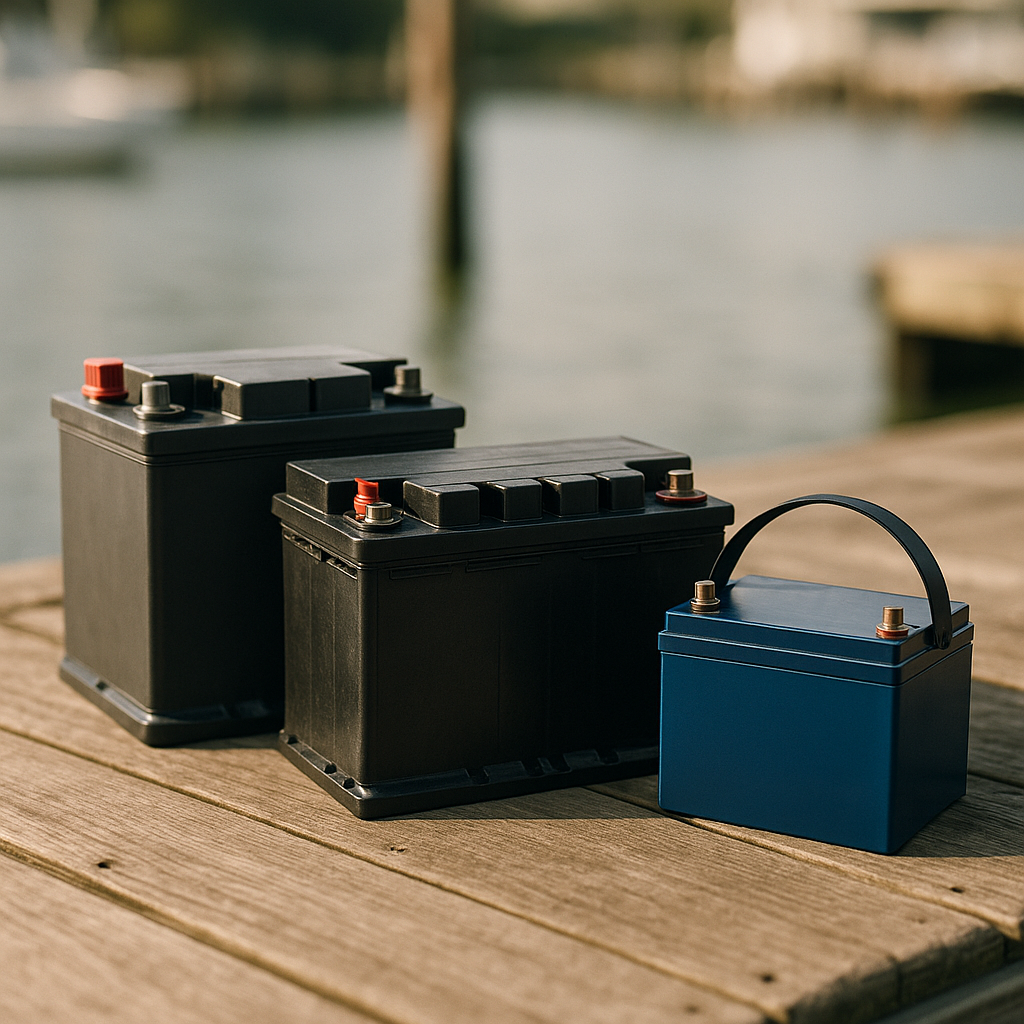
The world of marine batteries is primarily divided into two functional categories, and confusing them is a frequent and perilous error. The distinction is best understood through an analogy to human athletes.
First, we have the starting battery, which is the sprinter. Its design is optimized for delivering an immense burst of power for a very short duration—just a few seconds—to crank a heavy internal combustion engine. Internally, it achieves this with a multitude of thin lead plates, creating a vast surface area for a rapid chemical reaction. Once the engine starts, the alternator takes over, quickly replenishing the small amount of energy the battery expended. It is designed for this specific, high-intensity, short-duration task. Subjecting it to slow, sustained drains is akin to asking a sprinter to run a marathon; it will falter quickly and suffer lasting damage.
Second, we have the deep-cycle battery, which is the marathon runner. Its purpose is to provide a steady, reliable stream of power over many hours to run "house" loads like lights, refrigerators, pumps, and electronics. Its construction reflects this different duty, featuring fewer, but much thicker, lead plates. This robust design allows the battery to be discharged to a significant degree—often 50% or more of its total capacity—and then recharged, a process it can endure for hundreds or even thousands of cycles. It provides the endurance needed for extended periods away from the dock.
A third category, the dual-purpose battery, attempts to bridge this gap. It offers a compromise, providing adequate cranking amps for starting an engine while also tolerating a moderate level of deep cycling. While a viable option for smaller boats with limited space for two separate battery banks, it is a master of neither domain. It will not provide the same starting punch as a dedicated starting battery nor the same long-term endurance as a true deep-cycle battery.
Before delving into the mistakes to avoid, we must establish a common vocabulary. The electrical concepts of volts, amps, and watts are not abstract scientific terms but practical measures of the work your battery can do.
Voltage (V): Think of voltage as electrical pressure. It is the force that pushes electrons through a circuit. For the systems we are discussing, the nominal pressure is 12 volts. A fully charged 12v marine battery will actually rest at a higher voltage, typically around 12.7 to 12.9 volts, depending on its chemistry (Jackery, 2024).
Amperage (A), or "amps," measures the flow rate of electrons. It is the volume of electricity moving through the wire at any given moment. A small navigation light might draw less than one amp, while an engine starter can draw several hundred amps for a few seconds.
Amp-Hours (Ah): This is a critical measure of a deep-cycle battery's capacity. It quantifies how much energy the battery can store. A battery rated at 100 Ah can, in theory, deliver 1 amp of current for 100 hours, or 5 amps for 20 hours, before it is depleted . This is the fundamental metric for determining how long you can run your house loads.
Watts (W): Watts represent the rate of power consumption, or the actual work being done. It is the product of pressure and flow rate. The formula is simple yet powerful: Watts = Volts × Amps. A 12-volt refrigerator that draws 4 amps is consuming 48 watts of power. This calculation is the cornerstone of conducting a power audit for your vessel.
Grasping these terms is the first step toward making an empowered and logical decision about the 12v marine battery that will serve as the reliable heart of your boat.
The most fundamental and often most damaging mistake a boat owner can make is failing to distinguish between the requirements of starting an engine and powering house electronics. This misunderstanding often leads to the installation of an improper battery type, resulting in poor performance, a drastically shortened service life, and potentially hazardous situations on the water. The specifications printed on a battery's label are not interchangeable marketing terms; they are precise descriptors of its intended function.
As we introduced, the roles of starting and deep-cycle batteries are profoundly different. This difference is quantified by two primary, and mutually exclusive, metrics: Cold Cranking Amps (CCA) and Amp-hours (Ah).
Cold Cranking Amps (CCA) is the defining metric for a starting battery. It measures the number of amperes a 12-volt battery can deliver for 30 seconds at 0°F (-18°C) while maintaining a voltage of at least 7.2 volts (or 1.2 volts per cell). This specification speaks directly to the battery's ability to perform its one crucial job: turning over a cold, sluggish engine. A high CCA rating is paramount for boaters in colder climates or for those with large, high-compression engines that demand a significant initial jolt of energy.
Amp-hours (Ah), conversely, is the defining metric for a deep-cycle battery. It measures the battery's total energy storage capacity. The standard rating is typically given over a 20-hour discharge period. For example, a 100 Ah battery is expected to deliver a continuous 5-amp load for 20 hours before its voltage drops to a predetermined cut-off point (usually 10.5 volts for a 12V battery) (ChargingChargers.com, 2025). This rating tells you nothing about the battery's ability to start an engine but everything about its capacity to run your lights, fridge, and electronics through the night.
The internal construction that excels at one of these tasks inherently compromises its ability to perform the other. The thin, numerous plates of a starting battery provide a massive surface area for the rapid chemical reaction needed for high CCA, but they are fragile and will quickly warp, shed material, and fail if subjected to the repeated deep discharges that a deep-cycle battery is built to handle. Conversely, the thick, dense plates of a deep-cycle battery are robust and can withstand deep discharges, but their reduced surface area means they cannot release energy quickly enough to generate the high CCA required for reliable engine starting.
| Metric | Primary Function | Internal Construction | Analogy |
|---|---|---|---|
| Cold Cranking Amps (CCA) | Engine Starting | Many thin plates for maximum surface area | Sprinter (High power, short duration) |
| Amp-Hours (Ah) | Powering House Loads | Fewer, thicker plates for durability | Marathon Runner (Sustained endurance) |
Tempted by the lower price and ready availability of a standard automotive battery, some boat owners install them to power their marine house loads. This is a classic example of a false economy. A car battery is, by its very nature, a starting, lighting, and ignition (SLI) battery. It is designed to be discharged by a mere 2-3% of its capacity to start the vehicle, after which it is immediately and fully recharged by the alternator (Powertron Battery Co., 2024).
When you press this type of battery into service as a deep-cycle source on a boat—running lights, a stereo, or a small fridge—you are subjecting it to a discharge pattern it was never designed to withstand. Draining a car battery to 50% of its capacity just a few dozen times can be enough to cause irreversible damage through plate sulfation and warping. Its voltage will begin to sag under load, its ability to accept a full charge will diminish, and its usable capacity will plummet. What seemed like a bargain purchase will quickly lead to a frustrating and premature replacement, likely at an inconvenient time. A proper 12v marine battery, specifically a deep-cycle model, is designed and warrantied for this exact type of use, ensuring hundreds of reliable cycles and a much lower total cost of ownership over its lifespan.
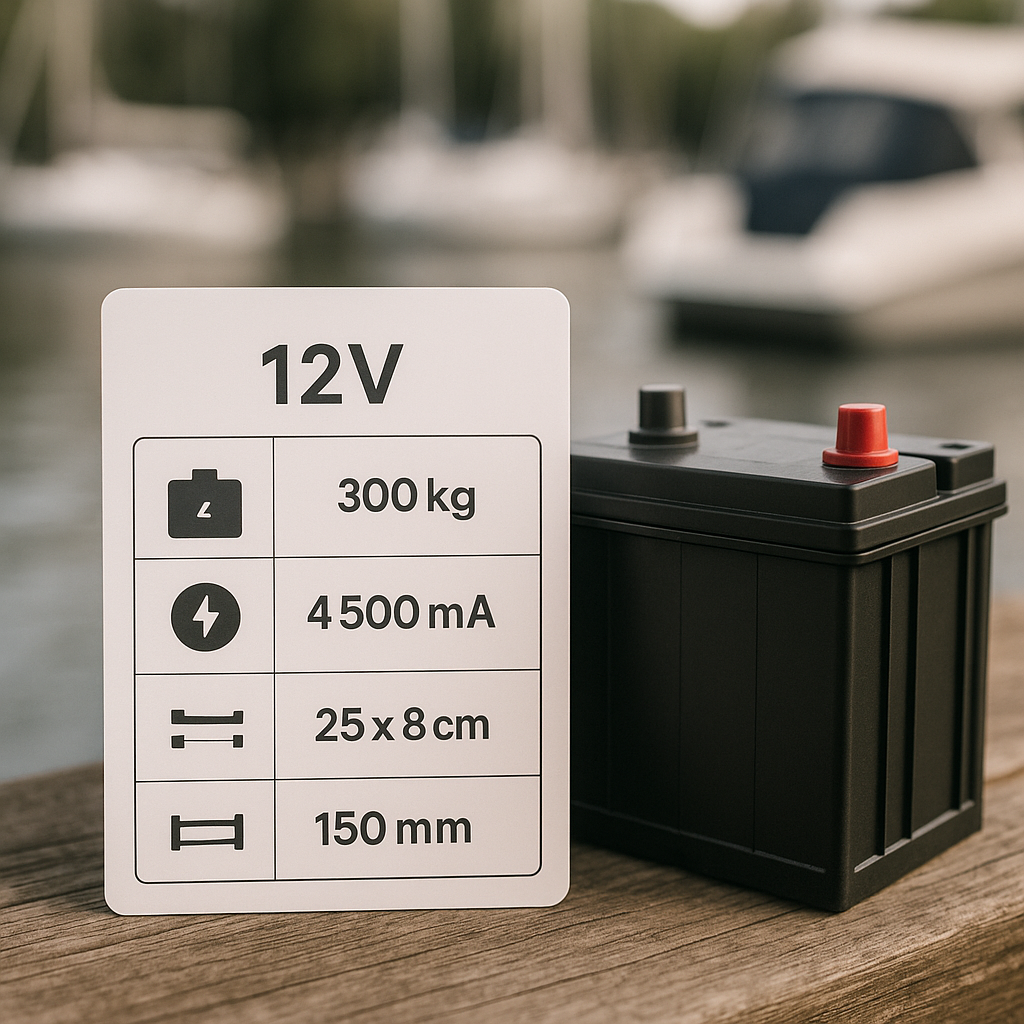
When you examine a 12v marine battery, you will encounter several ratings. Understanding what they mean is crucial for making a correct choice. Let's look at a typical label.
By learning to read this language, you move from being a passive consumer to an informed operator, capable of selecting the right tool for the right job and ensuring the electrical heart of your vessel is strong and dependable.
Beyond the functional distinction between starting and deep-cycle batteries lies a second, equally important layer of choice: the battery's internal chemistry. The three predominant technologies available for a 12v marine battery are Flooded Lead-Acid (FLA), Absorbed Glass Mat (AGM), and Lithium Iron Phosphate (LiFePO4). Each possesses a unique set of characteristics, and selecting the wrong one for your application, budget, and maintenance tolerance can lead to frustration, poor performance, and wasted expense. This is not a simple choice of "good, better, best," but a nuanced decision of matching the right technology to the specific demands of the user.
Flooded lead-acid batteries are the oldest, most traditional, and most affordable of the options. They consist of thick lead plates suspended in a liquid electrolyte of sulfuric acid and water. Their primary appeal is their low upfront cost, making them an accessible entry point for many boaters. They are also relatively tolerant of some overcharging, though this is never a recommended practice.
However, their economy comes with significant trade-offs. FLAs require regular maintenance. They must be installed in a well-ventilated compartment, as they release hydrogen and oxygen gas during charging, which is explosive. The electrolyte levels must be checked periodically, and the cells must be topped off with distilled water to compensate for loss during gassing. The terminals are prone to corrosion, requiring regular cleaning. They are also susceptible to damage from heavy vibration and can spill corrosive acid if not kept upright. Their self-discharge rate is the highest of the three types, meaning they lose their charge relatively quickly when left in storage and require more frequent maintenance charging to prevent permanent sulfation (ChargingChargers.com, 2025).
AGM batteries represent a significant evolution of the lead-acid design. Instead of a liquid electrolyte, the acid is absorbed into and suspended within fine fiberglass mats situated between the lead plates. This construction makes the battery completely sealed, spill-proof, and maintenance-free. There is no need to check water levels, and they can be mounted in any orientation (except upside down).
This sealed design provides several key advantages for marine use. AGM batteries are highly resistant to vibration, a constant force on any vessel. They have a much lower self-discharge rate than flooded batteries, making them better suited for seasonal storage. They also charge faster than their flooded counterparts. While their initial cost is higher than FLAs, their maintenance-free nature and enhanced durability offer a compelling value proposition for many boaters. One must be careful, however, not to use a charger designed for flooded batteries, as the higher charging voltages can permanently damage a sealed AGM battery by causing gas to vent from the safety valves.
Lithium Iron Phosphate (LiFePO4) is the newest and most technologically advanced option for a 12v marine battery. While several lithium chemistries exist, LiFePO4 has become the standard for deep-cycle applications due to its superior safety, stability, and longevity. These batteries are fundamentally different from lead-acid types. They are significantly lighter—often less than half the weight of a lead-acid battery of similar capacity—which can be a major benefit for performance-oriented boats.
Their performance advantages are profound. A LiFePO4 battery can be safely discharged to 80% or even 100% of its capacity without damage, whereas lead-acid batteries should generally not be discharged below 50% to preserve their lifespan (ExpertPower, n.d.). This means a 100Ah lithium battery offers nearly double the usable energy of a 100Ah lead-acid battery. They also maintain a much more stable voltage throughout their discharge cycle, providing consistent power to sensitive electronics. Their cycle life is extraordinary, often rated for 2,500 to 5,000 cycles or more, compared to the 300-1,000 cycles typical of lead-acid batteries. The primary barrier to entry is their significantly higher upfront cost. However, when viewed through the lens of total cost of ownership—factoring in their vastly superior cycle life, lighter weight, and zero maintenance—they often prove to be the most economical choice over the long term.
To clarify the decision-making process, the following table provides a direct comparison of the key attributes of each battery chemistry.
| Feature | Flooded Lead-Acid (FLA) | Absorbed Glass Mat (AGM) | Lithium Iron Phosphate (LiFePO4) |
|---|---|---|---|
| Upfront Cost | Low | Medium | High |
| Cycle Life | Low (300-700 cycles) | Medium (500-1,300 cycles) | Very High (2,500-5,000+ cycles) |
| Usable Capacity (DoD) | 50% | 50% | 80-100% |
| Maintenance | High (Requires watering, cleaning) | None | None |
| Weight | Heavy | Heavy | Light (approx. 50% of lead-acid) |
| Charging Speed | Slow | Medium | Very Fast |
| Self-Discharge Rate | High (5-15% per month) | Low (1-3% per month) | Very Low (<1% per month) |
| Vibration Resistance | Low | High | High |
| Safety | Requires ventilation (gassing) | Sealed, no gassing | Very stable, requires a BMS |
Choosing the correct chemistry is an exercise in balancing your budget, performance needs, and willingness to perform maintenance. For the budget-conscious boater who doesn't mind regular upkeep, FLA remains a viable option. For those seeking a maintenance-free, robust, and reliable "fit-and-forget" solution, AGM presents an excellent middle ground. For the serious cruiser, racer, or angler who demands the lightest weight, longest life, and greatest usable capacity, the long-term value of a LiFePO4 12v marine battery is increasingly difficult to dispute.
In the lexicon of battery specifications, Amp-hours (Ah) and Cold Cranking Amps (CCA) often take center stage. They are, without question, vital metrics for sizing a battery bank and ensuring engine start-up. However, a third, often overlooked specification plays a unique and critical role in on-water safety: Reserve Capacity (RC). To ignore RC is to ignore a battery's ability to function as a true emergency power source when all other systems have failed. It is a measure of resilience, and its importance cannot be overstated.
Reserve Capacity is defined by the Battery Council International (BCI) as the number of minutes a fully charged battery, at 80°F (27°C), can discharge a constant 25-amp load before its voltage drops to 10.5 volts. A 25-amp load was chosen as it represents a typical electrical load for a car at night with the engine off (headlights, ignition, etc.). In a marine context, this load is analogous to running essential safety equipment such as VHF radio, navigation lights, a GPS plotter, and perhaps an automatic bilge pump.
Why is this so important? Imagine a scenario where your engine fails at sea, perhaps due to a fuel problem or mechanical breakdown. Your alternator is no longer producing power. The sun has set. You are now entirely dependent on your battery's stored energy to remain visible to other vessels, to communicate your distress, and to keep your boat from taking on water. This is where Reserve Capacity becomes the most important number on your battery's label. A battery with an RC of 120 can sustain that essential 25-amp load for two hours, giving you a crucial window to troubleshoot, call for assistance, or await rescue. A battery with a low RC might last only a fraction of that time, plunging you into darkness and silence when you are most vulnerable.
Let's consider a practical example. Your boat is equipped with the following essential 12-volt equipment:
This is a very light load, far below the 25-amp standard used for the RC rating. However, should you need to transmit on the VHF radio, the draw could spike to 5-6 amps. If another pump or light is activated, the load increases. The RC rating provides a standardized, conservative benchmark of the battery's emergency endurance. It's a "worst-case" baseline that gives you a tangible sense of your safety margin. When choosing a dual-purpose or deep-cycle 12v marine battery, comparing the RC ratings between models of the same group size can be a deciding factor. A higher RC value directly translates to more time and more options in an emergency.
While Ah and RC both measure capacity, they do so under different conditions and for different purposes. Ah is a measure of long-term, low-rate energy storage, while RC is a measure of short-to-medium-term, moderate-rate emergency endurance.
There is a useful rule of thumb for converting between the two, which can help you compare batteries that may only list one of these specifications. As noted by industry resources, a rough approximation is: Amp-hours = Reserve Capacity × 0.6 (ChargingChargers.com, 2025).
For example, a battery with a Reserve Capacity of 180 minutes would have an approximate Amp-hour rating of 108 Ah (180 × 0.6). Conversely, a 100 Ah battery would have an approximate RC of 167 minutes (100 / 0.6).
This conversion is an approximation because of the Peukert effect, which states that a battery's available capacity decreases as the rate of discharge increases. The 25-amp draw of the RC test is a higher rate than the 5-amp draw of a 20-hour Ah test on a 100 Ah battery, so the relationship is not perfectly linear. However, this formula provides a valuable tool for making "apples-to-apples" comparisons when evaluating different batteries. When selecting your house or dual-purpose 12v marine battery, do not let a high Ah rating distract you from also considering the RC. Both are pieces of the same puzzle, and together they provide a more complete picture of the battery's capability and your vessel's overall safety.
In the pursuit of optimal power and longevity, it is easy to focus exclusively on abstract electrical specifications like Amp-hours and cycle life. Yet, some of the most frustrating and potentially unsafe mistakes in battery selection are far more tangible: choosing a battery that simply does not fit or cannot be securely connected. The physical integration of the 12v marine battery into your vessel is not an afterthought; it is a critical aspect of a safe and reliable installation. Overlooking the BCI Group Size and terminal configuration can lead to modifications that compromise safety, cause premature failure due to vibration, or simply make the battery impossible to install.
The Battery Council International (BCI) establishes standardized dimensions for vehicle and marine batteries. This "Group Size" designation ensures a degree of interchangeability between manufacturers. Common marine group sizes include Group 24, 27, 31, 4D, and 8D. The number refers to a specific case size with defined maximum length, width, and height measurements.
For example:
The mistake occurs when a boat owner, seeking more capacity, purchases a Group 31 battery to replace a Group 24 without first measuring the battery box or tray. If the new battery is too large, it will not fit. This may tempt the owner to force the installation or, worse, to discard the battery box altogether, leaving the battery unsecured. An unsecured battery is a significant hazard. It can shift or slide in rough seas, potentially shorting its terminals against a metal component, which could cause a fire or explosion. Furthermore, the constant shock and vibration experienced by an unsecured battery will drastically shorten its life. Always measure your available space and purchase a 12v marine battery with the correct BCI Group Size for your vessel's configuration.
| BCI Group Size | Typical Dimensions (L x W x H) | Typical Weight (Lead-Acid) | Typical Ah Range (Deep Cycle) |
|---|---|---|---|
| Group 24M | 10.8" x 6.8" x 9.5" | 45-55 lbs | 70-85 Ah |
| Group 27M | 12.1" x 6.8" x 9.5" | 55-65 lbs | 85-105 Ah |
| Group 31M | 13.0" x 6.8" x 9.5" | 60-75 lbs | 95-125 Ah |
| Group 4D | 20.8" x 8.7" x 9.9" | 110-140 lbs | 180-220 Ah |
| Group 8D | 20.8" x 11.0" x 9.9" | 130-170 lbs | 225-265 Ah |
Once you have confirmed the correct group size, the next physical detail to consider is the terminal type. Marine batteries feature several common configurations, and choosing the wrong one can make connecting your cables difficult or impossible.
The error here is assuming all batteries are the same. If your boat's cables are fitted with ring terminals for a threaded stud connection, arriving with a battery that only has SAE posts will bring your installation to a halt. Before purchasing, inspect your existing battery and cables to confirm the required terminal type. Ensure the new 12v marine battery has the corresponding terminals for a direct, secure, and safe connection without the need for clumsy, unreliable adapters.
The marine environment is relentlessly harsh. The constant pounding and vibration a boat endures can wreak havoc on an improperly installed battery. A secure fit is not just about convenience; it is about safety and longevity.
A battery box or tray with a hold-down strap is not optional; it is essential. This system prevents the battery from becoming a projectile in rough seas and protects it from the life-shortening effects of shock and vibration. A study of battery failure modes would undoubtedly show a strong correlation between unsecured installations and premature death of the battery.
When installing your new 12v marine battery, ensure the hold-down mechanism is tight and the battery cannot move in any direction. The connections to the terminals must be clean, tight, and protected from corrosion. A light coating of dielectric grease or a dedicated battery terminal protector spray can help seal the connection from the corrosive saltwater environment. Taking these physical installation steps with the same seriousness as you take the electrical specifications will ensure your battery investment is protected and that it will be there for you when you need it most.
Purchasing a high-quality, appropriately sized 12v marine battery is only half the battle. The other, equally important half is implementing a rigorous and correct charging and maintenance regimen. A battery is a consumable item, and its lifespan is a direct function of how it is treated. Neglecting proper care is akin to never changing the oil in a high-performance engine; premature and catastrophic failure is not a possibility, but an inevitability. The most common errors in this domain involve misunderstanding the threat of sulfation, using an improper charger, and failing to store the battery correctly.
To understand battery maintenance, one must first understand the battery's primary enemy: sulfation. In a lead-acid battery (both flooded and AGM), the normal process of discharging involves the sulfuric acid in the electrolyte reacting with the lead plates to form lead sulfate crystals. When the battery is recharged, this chemical process is reversed, and the lead sulfate converts back into lead and sulfuric acid.
The problem arises when a battery is left in a discharged state for an extended period. The soft, small lead sulfate crystals begin to grow, merge, and harden into a stable, crystalline structure. This is sulfation. These hard crystals form an insulating layer on the plates, which reduces the available surface area for the chemical reaction. The consequences are severe:
Prevention is the only effective cure. The cardinal rule is to recharge your deep-cycle battery as soon as possible after use. Never leave your boat sitting for weeks with the batteries in a discharged state. If the boat is in storage, the batteries must be kept on a multi-stage maintenance charger to keep them fully charged and prevent sulfation from taking hold.
Using the wrong charger is another common and costly mistake. A cheap, unregulated "trickle" charger from an automotive parts store is not suitable for a valuable bank of marine batteries. A proper marine battery charger is a "smart" multi-stage charger that tailors the charging process to the battery's needs. The three primary stages are:
Crucially, the voltage setpoints for these stages differ depending on the battery chemistry. A charger must have selectable profiles for Flooded, AGM, and Lithium batteries. Using an AGM setting on a LiFePO4 battery, or a Flooded setting on an AGM battery, will result in improper charging, diminished performance, and a shortened lifespan. Investing in a quality, multi-stage smart marine charger is a non-negotiable part of protecting your 12v marine battery investment.
For flooded lead-acid batteries, an additional maintenance step called equalization is sometimes necessary. Over time, slight variations between the cells can cause the electrolyte to stratify, with heavier acid settling at the bottom and lighter water at the top. This imbalance reduces capacity and promotes sulfation. Equalization is a controlled, deliberate overcharge at a higher voltage for a short period. This process causes the electrolyte to bubble or "gas," which remixes the electrolyte and helps dissolve any soft sulfate crystals that may have formed on the plates (Powertron Battery Co., 2024).
This should only be done on flooded batteries and only with a charger that has a specific, temperature-compensated equalization mode. It should never be performed on sealed AGM or Gel batteries, as the gassing cannot be recombined and will permanently damage the cells. The frequency of equalization depends on usage, but for a boat in regular use, once or twice a year may be sufficient. Always follow the battery manufacturer's specific recommendations.
How you store your batteries during the off-season has a massive impact on their lifespan. Leaving batteries in the boat all winter without any attention is a recipe for disaster.
By adopting these maintenance protocols, you transform your 12v marine battery from a disposable commodity into a long-term, reliable asset.
Perhaps the most mathematically-driven error in selecting a 12v marine battery is the simple failure to do the math. Many boat owners purchase a battery based on its group size, its price, or a vague recommendation, without ever conducting a systematic audit of their vessel's actual energy consumption. This oversight almost inevitably leads to a battery bank that is undersized for the task. An undersized bank not only results in frustratingly short run times but also forces the batteries into deeper-than-ideal discharge cycles, which dramatically shortens their expensive lifespan. Sizing your battery bank is not guesswork; it is a straightforward calculation that is fundamental to building a reliable electrical system.
The first step is to create a comprehensive list of every single 12-volt device on your boat that will be powered by your house battery bank. This is your power budget worksheet. For each device, you need to determine its power draw in amps. This information can typically be found on the device's label, in its owner's manual, or through an online search of its specifications. If you cannot find the amp draw but know the wattage, you can calculate it using the formula: Amps = Watts / Volts. For your 12V system, you would divide the wattage by 12.
Your list should be exhaustive:
Once you have your list of devices and their amp draw, the next step is to estimate the number of hours each device will run in a typical 24-hour period. This is the most subjective part of the calculation, but a realistic estimate is crucial. For example, your navigation lights might run for 8 hours overnight, while your freshwater pump might only run for a total of 0.5 hours per day.
Now, you multiply the amp draw of each device by its estimated daily run time to get its daily Amp-hour (Ah) consumption.
Let's create a sample worksheet:
| Device | Amp Draw (A) | Daily Hours of Use (h) | Daily Consumption (Ah) |
|---|---|---|---|
| Cabin Lights (2) | 1.5 | 4 | 6.0 |
| Navigation Lights | 1.0 | 8 | 8.0 |
| Refrigerator | 4.0 (cycles 30% of the time) | 24 | 28.8 (4A × 24h × 0.3) |
| VHF (standby) | 0.5 | 24 | 12.0 |
| Chartplotter | 1.5 | 8 | 12.0 |
| Stereo | 2.0 | 3 | 6.0 |
| Water Pump | 3.0 | 0.5 | 1.5 |
| Total Daily Need | 74.3 Ah |
In this example, the total daily energy requirement is approximately 74.3 Amp-hours.
With your daily need calculated, you can now properly size your battery bank. A critical rule for lead-acid batteries (both Flooded and AGM) is the 50% rule: to maximize their cycle life, you should not routinely discharge them below 50% of their capacity. This means your total battery bank capacity should be at least double your daily energy needs.
In this case, you would need a battery bank with a total rated capacity of at least 149 Ah. This could be a single Group 8D battery or two Group 27 batteries connected in parallel. It is also wise to add a safety margin of 20-25% to account for battery aging, lower efficiency in cold weather, and unexpected needs. So, a more conservative target would be around 180-200 Ah.
For LiFePO4 batteries, the calculation is different because they can be safely discharged to 80-100%. Using an 80% depth of discharge (DoD) limit:
Here, a single 100 Ah LiFePO4 12v marine battery would comfortably meet the daily demand while being significantly smaller and lighter than the equivalent lead-acid bank.
By taking the time to perform this power audit, you replace guesswork with data. You ensure that the battery bank you purchase is not just a random component but a thoughtfully engineered solution tailored to your specific needs, leading to greater reliability, longer life, and more peace of mind on the water.
The final, and perhaps most financially significant, mistake is focusing solely on the initial purchase price of a 12v marine battery while ignoring its Total Cost of Ownership (TCO). A cheap battery is rarely an inexpensive one in the long run. TCO is a more holistic financial concept that considers not just the upfront cost, but also the battery's service life, maintenance requirements, and performance characteristics over its entire operational window. A proper TCO analysis often reveals that a more expensive, higher-quality battery is the most economical choice.
The single most important factor in TCO is cycle life. A battery's cycle life is the number of charge-discharge cycles it can endure before its capacity drops to a certain percentage (usually 80%) of its original rating. This metric varies dramatically with battery chemistry and depth of discharge (DoD).
As a general guide (ChargingChargers.com, 2025; ExpertPower, n.d.):
Let's imagine you need a 100 Ah house bank and you use your boat frequently, cycling the battery bank 50 times per year.
In this simplified view, the cost per year of the FLA is $18.75, the AGM is also $18.75, and the Lithium battery's cost becomes effectively negligible over a typical boat ownership period. The initial sticker price is deceptive; the true measure of value is cost per usable cycle.
TCO goes beyond just cycle life. Consider these additional factors:
| Battery Type | Initial Cost (100Ah Usable) | Weight (100Ah Usable) | Cycle Life (at proper DoD) | 10-Year TCO (Simplified) |
|---|---|---|---|---|
| Flooded Lead-Acid | ~$300 (200Ah Bank) | ~130 lbs | ~400 Cycles | $375 (1 replacement) |
| AGM | ~$600 (200Ah Bank) | ~135 lbs | ~800 Cycles | $600 (No replacements) |
| LiFePO4 | ~$650 (125Ah Battery) | ~40 lbs | ~3000+ Cycles | $650 (No replacements) |
Note: TCO is simplified and does not include maintenance or performance benefits.
Finally, do not be misled by a simple warranty duration. A "3-Year Warranty" can mean many different things. Read the fine print. Many lead-acid battery warranties are pro-rated, meaning you only get a partial credit toward a new battery after the first year. Furthermore, a warranty may be voided if the manufacturer determines the battery was improperly charged, deeply discharged too often, or left to sulfate. A warranty is not a substitute for quality construction and proper care. Look for a full, non-prorated replacement period and clear terms. A longer, more comprehensive warranty from a reputable manufacturer is often an indicator of a higher-quality product and a lower long-term risk for you, the owner. Making a decision on your next 12v marine battery based on TCO ensures you are investing not just in a product, but in years of reliable, worry-free power.
The lifespan of a 12v marine battery depends heavily on its type, usage patterns, and how well it is maintained. A conventional flooded lead-acid battery might last 2 to 5 years with diligent maintenance. An AGM battery, which is more robust and maintenance-free, often lasts 4 to 8 years. A LiFePO4 battery represents the longest-lasting technology, with a potential lifespan of 10 years or more, capable of thousands of discharge cycles.
It is strongly discouraged. Standard car chargers are typically unregulated and designed to quickly charge a starting battery. Using one on a deep-cycle marine battery, especially an AGM or Lithium model, can lead to severe overcharging, gassing, and permanent damage. A multi-stage "smart" marine charger with selectable profiles for your specific battery chemistry is the only proper tool for the job.
Trolling motors place a heavy, sustained demand on a battery, requiring a true deep-cycle design. For this application, a LiFePO4 battery is the superior choice due to its light weight, high usable capacity, and ability to maintain strong voltage under load, ensuring consistent motor performance. A high-quality, deep-cycle AGM battery is a viable second option, offering good performance and vibration resistance, though it will be significantly heavier for the same usable energy.
Signs of a failing battery include a noticeable decrease in how long it can power your electronics, taking much longer to charge, or the resting voltage being consistently low (e.g., below 12.4V for a lead-acid battery after a full charge and rest period). Other indicators are physical swelling or cracking of the battery case, or a rotten-egg smell during charging, which indicates severe overcharging and gassing.
No, this should always be avoided. When batteries of different ages, capacities, or chemistries are connected in parallel, they will never charge or discharge evenly. The stronger, newer battery will constantly be overcharging the weaker, older one, leading to premature failure for both. Always build or replace a battery bank with identical batteries of the same type, capacity, and age.
The selection of a 12v marine battery transcends a simple transaction. It is an act of foresight and a commitment to the integrity of your vessel. The preceding examination of common mistakes—from misinterpreting fundamental specifications to underestimating long-term costs—serves to illuminate a path toward a more reasoned and resilient approach. The power system is the silent infrastructure that underpins every moment of safety, convenience, and enjoyment on the water. By engaging with the complexities of battery chemistry, charging dynamics, and power auditing, a boat owner moves from being a mere consumer to a knowledgeable and prepared mariner. The right battery, properly maintained, does not just start an engine or power a light; it provides the quiet confidence to venture farther, stay longer, and return safely, secure in the knowledge that the heart of the vessel is strong.
Chargingchargers.com. (2025). Battery tutorial.
ExpertPower. (n.d.). LiFePO4 series. Retrieved from
Jackery. (2024, May 16). Battery voltage chart (Lead-Acid, Lithium-ion, Deep Cycle, AGM). https://www.jackery.com/blogs/knowledge/battery-voltage-chart
Power-Sonic Corporation. (n.d.). Battery and energy solutions. Retrieved from
Powertron Battery Co. (2024, October 3). 8 tips for maintaining your deep-cycle battery. https://powertronbatteryco.com/blog/maintaining-deep-cycle-batteries/
{"one"=>"Select 2 or 3 items to compare", "other"=>"{{ count }} of 3 items selected"}