

CONTACT
Please contact us for shipping details.
This document provides a comprehensive examination of the selection process for a small 12V battery, focusing on modern chemistries and practical applications for 2025. It presents a structured, five-step methodology designed to guide users from initial power assessment to final product choice. The analysis begins with fundamental principles of electrical power, detailing how to accurately calculate energy requirements in watt-hours and convert them to amp-hours. It then offers a comparative analysis of the two dominant rechargeable battery chemistries: Lithium Iron Phosphate (LiFePO4) and Absorbent Glass Mat (AGM). Key performance metrics such as cycle life, depth of discharge, weight, efficiency, and total cost of ownership are evaluated. The guide further explores the significance of battery capacity, physical dimensions (including BCI group sizes), and terminal types. Finally, it addresses the necessity of pairing the battery with a compatible charging system and the protective role of a Battery Management System (BMS). The objective is to equip both novices and professionals with the necessary knowledge to make an informed, application-specific decision.

Before we can even begin to look at batteries, we must first understand what we are asking them to do. Think of it like packing for a trip; you cannot know which suitcase to bring until you have laid out all the clothes you intend to take. In the world of electricity, our "clothes" are the devices we want to power, and the "suitcase" is our small 12V battery. The goal of this first step is to create a precise inventory of our energy needs, a process often called a power audit. This is arguably the most foundational step, as a miscalculation here will cascade through all subsequent decisions, potentially leaving you with a battery that is either insufficient for your needs or excessively large and expensive. We will approach this not with opaque formulas, but with clear concepts and simple arithmetic.
To begin, let's demystify the three most fundamental terms in our electrical vocabulary: Volts (V), Amps (A), and Watts (W). Imagine a water pipe.
Every electronic device you own should have a label that specifies its power consumption, either in watts or amps. If it gives you amps, you can calculate watts by multiplying that number by 12 (since we are in a 12V system). This wattage rating is the cornerstone of our power audit.
A watt is a measure of power at a single moment in time. A battery, however, stores energy to be used over time. This is where the concept of watt-hours (Wh) becomes our primary unit of measurement. A watt-hour is the energy equivalent of one watt of power being consumed for one hour. A 10-watt light bulb running for 3 hours consumes 30 watt-hours (10W × 3h = 30Wh).
To conduct your power audit, create a simple list of every 12V device you plan to use. For each device, estimate how many hours per day you will run it. Then, multiply its wattage by its daily runtime to find its daily watt-hour consumption.
Let’s create a hypothetical example for a simple weekend camping setup:
Now, we simply sum the daily energy consumption of all devices: Total Daily Watt-Hours = 48 Wh + 15 Wh + 40 Wh + 45 Wh = 148 Wh
This number, 148 Wh, is the total amount of energy your small 12V battery must be able to deliver each day to meet your needs.
Our calculation so far assumes a perfect world, but reality introduces inefficiencies. If you plan to power any standard household devices (like a laptop charger or a small appliance with a regular wall plug), you will need an inverter. An inverter converts the 12V Direct Current (DC) from your battery into 120V Alternating Current (AC). This conversion process is not 100% efficient; some energy is lost as heat.
Most modern pure sine wave inverters are about 85-95% efficient. To be safe, it is wise to assume an efficiency of 85%. This means for every 100 watts of AC power you need, the inverter will actually draw about 118 watts from your battery (100W / 0.85 ≈ 118W). If any of your devices are AC, you must adjust their watt-hour calculation accordingly.
Finally, it is prudent to add a safety margin to your total daily watt-hours. Life is unpredictable. You might need to run a light longer, or charge an extra device. A 20% safety margin is a good starting point.
Let's apply this to our camping example, assuming all devices are 12V DC and we add a 20% safety margin:
With this single, crucial number, we have completed the most important intellectual work. We now know exactly what we are asking of our battery. We can move forward to choosing a battery that can confidently meet this demand.
With our energy needs quantified, we now face one of the most significant decisions in selecting a small 12V battery: the chemistry. For decades, lead-acid was the undisputed king, but in 2025, the landscape is dominated by two primary contenders for deep-cycle applications: Absorbent Glass Mat (AGM), a sophisticated type of lead-acid battery, and Lithium Iron Phosphate (LiFePO4), a specific and very safe type of lithium-ion battery.
Choosing between them is not about which is "better" in an absolute sense, but about which is better suited to your specific application, budget, and priorities. It is a nuanced decision that involves weighing upfront cost against long-term value, and weight against resilience. Let's examine the character of each.
| Feature | Lithium Iron Phosphate (LiFePO4) | Absorbent Glass Mat (AGM) |
|---|---|---|
| Average Lifespan (Cycles) | 3,000 - 5,000+ cycles | 300 - 700 cycles |
| Usable Capacity (DoD) | 80% - 100% | 50% (recommended) |
| Weight | Significantly lighter (approx. 50-60% lighter) | Heavy |
| Charging Efficiency | ~99% | ~85% |
| Voltage Stability | Very stable, holds voltage until nearly empty | Voltage drops steadily as it discharges |
| Upfront Cost | Higher | Lower |
| Maintenance | None | None (but sensitive to overcharging) |
| Cold Weather Performance | Reduced performance below freezing without heating | Performs better than lithium in cold |
LiFePO4 batteries represent a significant technological leap. Their primary appeal lies in their exceptional cycle life and deep depth of discharge (DoD). A LiFePO4 battery can often be discharged to 100% of its capacity without significant harm and can endure thousands of such cycles. In contrast, an AGM battery's life is drastically shortened if it is regularly discharged beyond 50%. This means a 100Ah LiFePO4 battery provides nearly double the usable energy of a 100Ah AGM battery (Buchmann, 2021).
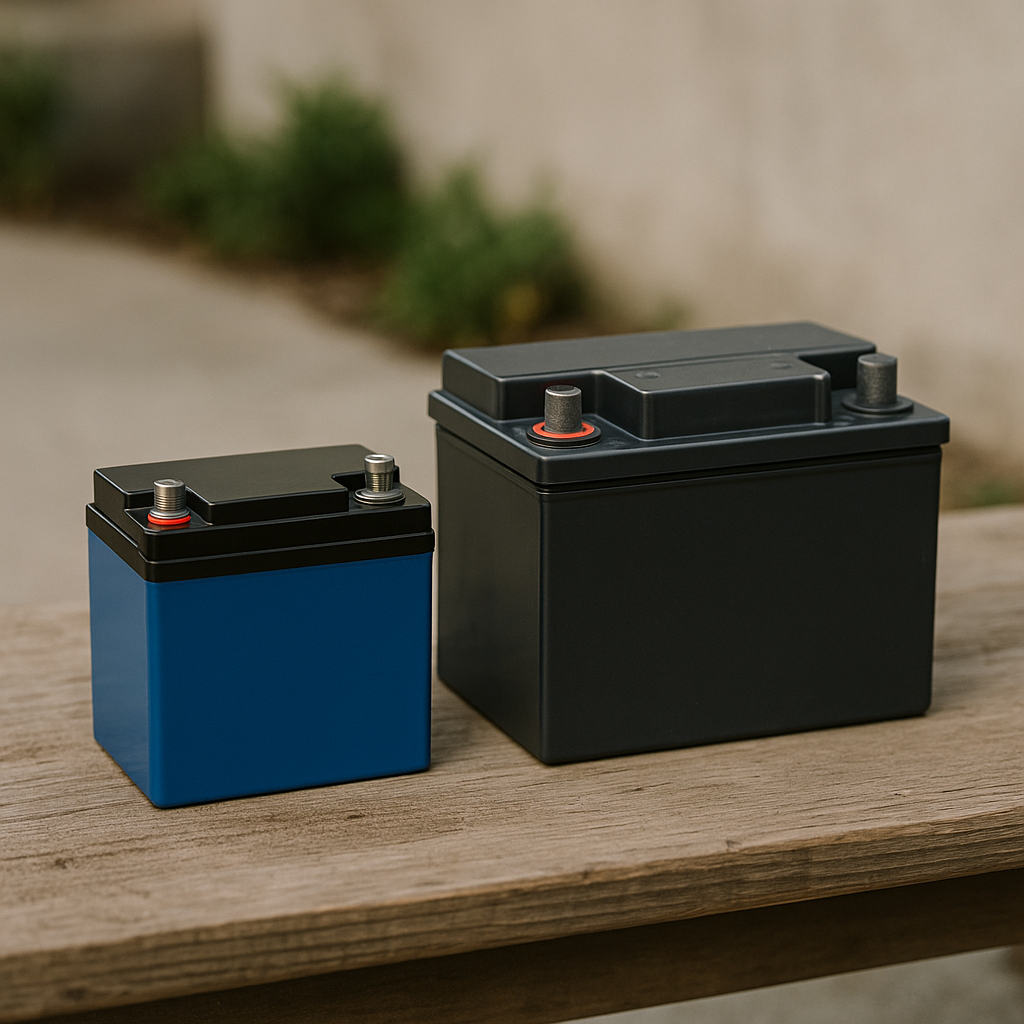
Think of it this way: the LiFePO4 is a modern marathon runner—lightweight, efficient, and capable of maintaining a strong pace for the entire race. Its weight, often less than half that of an equivalent AGM, is a game-changer for applications where portability is key, such as in kayaks, small RVs, or portable solar generator projects . The voltage output of a LiFePO4 battery is also remarkably stable. It will provide a consistent voltage for most of its discharge cycle, only dropping off sharply when it is nearly empty. This is beneficial for sensitive electronics that require stable voltage to operate correctly.
The main barrier to entry for LiFePO4 has historically been its cost. While the upfront price is higher, it is essential to consider the total cost of ownership. Because a LiFePO4 battery can last 5 to 10 times longer than an AGM, a single lithium battery can outlive multiple sets of AGM batteries, often making it the more economical choice over the long term.
AGM batteries are the workhorses of the modern lead-acid world. They are a type of Valve Regulated Lead-Acid (VRLA) battery, which means they are sealed and maintenance-free. The electrolyte is absorbed in fine fiberglass mats, which makes them spill-proof and highly resistant to vibration—a significant advantage in vehicles or marine applications .
The AGM is the seasoned veteran—reliable, tough, and more affordable upfront. Its most notable advantage over LiFePO4 is its performance in cold weather. While standard LiFePO4 batteries can be damaged if charged at temperatures below freezing (32°F or 0°C), AGM batteries can be charged and discharged in much colder conditions, albeit with some capacity reduction. This makes them a more straightforward choice for users in consistently cold climates who do not want to invest in heated lithium batteries.
Their lower price point makes them attractive for users with smaller budgets or for applications where the battery is not cycled daily. For a weekend-use cabin or an emergency backup system that is rarely used, the longevity of a LiFePO4 battery may be unnecessary, and the cost savings of an AGM can be a deciding factor.
The choice hinges on your usage patterns and priorities.
Choose LiFePO4 if:
Choose AGM if:
Considering our camping example from Step 1, where the battery will be used for weekend trips, both could work. However, the lighter weight and greater usable capacity of a small 12V battery with LiFePO4 chemistry would make packing and setup much easier and provide a larger buffer of usable power.
Now that we have established our daily energy consumption in watt-hours (Wh) and have considered the two primary battery chemistries, we can determine the appropriate "size" of our battery. The size of a battery's energy reservoir is measured in Amp-Hours (Ah). This rating tells us how many amps a battery can deliver for a certain number of hours.
The process of converting our watt-hour needs into an amp-hour rating is simple, but it must be done with a clear understanding of the concept of Depth of Discharge (DoD), which varies dramatically between LiFePO4 and AGM chemistries. This is a common point of confusion, and clarifying it is essential to selecting a battery that truly meets your needs.
The relationship between watt-hours and amp-hours is governed by the battery's nominal voltage. Since we are working with a 12V system, the conversion is straightforward:
Amp-Hours (Ah) = Watt-Hours (Wh) / Voltage (V)
Using our adjusted daily energy need of 177.6 Wh from Step 1:
Daily Amp-Hour Need = 177.6 Wh / 12V = 14.8 Ah
This means that over a 24-hour period, we need our battery to provide a total of 14.8 amp-hours of energy. It seems simple enough to just go out and buy a 15Ah battery, but this would be a critical mistake. This calculation only tells us what we need to take out of the battery; it does not account for how the battery chemistry handles being discharged.
Depth of Discharge refers to the percentage of a battery's total capacity that has been used. A battery that is 80% discharged has a DoD of 80%. This is where the paths of LiFePO4 and AGM diverge significantly.
AGM Batteries: For a long and healthy life, it is widely recommended that you do not discharge an AGM battery beyond 50% of its rated capacity. Regularly discharging it to 80% or 90% will drastically reduce its cycle life from several hundred cycles to perhaps less than a hundred. Therefore, the usable capacity of an AGM battery is only half of what is written on its label.
LiFePO4 Batteries: These batteries are far more resilient to deep discharging. They can be regularly discharged to 80-100% DoD while still achieving thousands of cycles. For practical purposes, you can consider at least 90% of a LiFePO4 battery's capacity to be usable.
Let's see how this impacts our choice. We need 14.8 Ah of usable energy per day.
Required AGM Capacity: To get 14.8 usable Ah, we need a battery twice that size.
Required LiFePO4 Capacity: To get 14.8 usable Ah, we only need a slightly larger battery.
This illustrates a vital point: a 20Ah LiFePO4 battery can perform the same daily work as a 30-35Ah AGM battery, and it will do so while being significantly lighter and lasting many times longer.
The following table shows the usable amp-hours for common small 12V battery sizes, highlighting this crucial difference.
| Rated Capacity (Ah) | Usable AGM Capacity (at 50% DoD) | Usable LiFePO4 Capacity (at 90% DoD) |
|---|---|---|
| 20 Ah | 10 Ah | 18 Ah |
| 35 Ah | 17.5 Ah | 31.5 Ah |
| 50 Ah | 25 Ah | 45 Ah |
| 75 Ah | 37.5 Ah | 67.5 Ah |
| 100 Ah | 50 Ah | 90 Ah |
Our calculation so far provides enough power for a single day. What if you plan to camp for three days and the weather is cloudy, preventing your solar panel from recharging the battery? This is where the concept of autonomy comes in. You must decide how many days of "off-grid" power you want to have in reserve.
To do this, you simply multiply your daily amp-hour need by the number of days of autonomy you desire.
Let's say you want three days of autonomy for our camping trip:
Now, we apply our DoD calculations to find the necessary battery bank size:
Again, the difference is stark. A 50Ah LiFePO4 battery provides the same three-day autonomy as a 100Ah AGM battery, but in a much smaller and lighter package. This calculation is the final step in ensuring the battery you choose has the raw energy storage to meet not just your daily needs, but your overall trip or project requirements.
Beyond the electrical specifications, a battery is a physical object that must integrate into your system. It has to fit in a specific compartment, its weight must be manageable for your application, and its terminals must connect to your wiring. Overlooking these practical, physical attributes is a common mistake that can lead to significant frustration. A battery with the perfect capacity is useless if it is too large for the battery box in your RV or too heavy to carry to your fishing spot.
To standardize battery dimensions, the Battery Council International (BCI) established a system of group sizes. A BCI group number, such as "Group 24," "Group 27," or "Group 31," defines the maximum length, width, and height of a battery, as well as its terminal placement (Shorai, n.d.). This system is incredibly helpful, especially when replacing an existing battery.
If your RV, boat, or battery box is designed for a Group 27 battery, you can be confident that any new battery designated as Group 27 will fit perfectly. Many battery manufacturers, especially in the LiFePO4 space, now design their batteries to conform to这些 common BCI group sizes to make upgrading from lead-acid as simple as possible .
Before purchasing any small 12V battery, your first action should be to measure the space you have available. Grab a tape measure and find the maximum length, width, and height your battery compartment can accommodate. Compare these measurements to the specifications of the battery you are considering. Do not "eyeball" it; an extra quarter-inch can be the difference between a perfect fit and a battery that will not go in.
As we discussed in Step 2, the weight difference between AGM and LiFePO4 is one of the most compelling reasons to choose lithium. This is not just a matter of convenience; it can fundamentally impact the performance and feasibility of your project.
Consider these scenarios:
The adage "ounces make pounds" is especially true in mobile applications. Do not underestimate the impact that a lighter small 12V battery can have on the overall usability and enjoyment of your system.
The terminals are the contact points where you connect your wires to the battery. While it may seem like a minor detail, choosing the wrong terminal type can require you to buy adapters or even modify your cables. Getting it right from the start ensures a secure and low-resistance connection.
For a small 12V battery, you will most commonly encounter these types:
When replacing an existing battery, the easiest path is to choose a new battery with the same terminal type. When building a new system, M-series bolt terminals are often the most versatile and reliable choice for deep-cycle applications.
Acquiring the right battery is only half the battle; ensuring it has a long and productive life depends entirely on how you charge and care for it. A common and costly mistake is assuming that any "12V charger" will work for any 12V battery. Different battery chemistries have unique charging requirements, and using the wrong charger can, at best, fail to fully charge your battery, and at worst, permanently damage it. Proper charging is not just a recommendation; it is a prerequisite for getting the performance and longevity you paid for.
A battery charger is more than just a power supply; it is an intelligent device that follows a specific algorithm to safely and efficiently replenish a battery's energy. The charging profiles for AGM and LiFePO4 are fundamentally different.
AGM Chargers: These typically use a multi-stage algorithm (e.g., Bulk, Absorption, Float). The "float" stage is a key feature, where the charger maintains a low, constant voltage (around 13.5V-13.8V) to keep the battery topped off and combat self-discharge. Leaving an AGM battery on a float charger is standard practice.
LiFePO4 Chargers: These use a simpler two-stage algorithm called CC/CV (Constant Current / Constant Voltage). The charger provides a constant current until the battery reaches a target voltage (typically 14.4V-14.6V), then holds that constant voltage until the current tapers off, indicating a full charge. Critically, LiFePO4 batteries do not require and should not be float charged. A continuous float voltage can stress the cells and reduce their lifespan. A proper LiFePO4 charger will shut off completely once the battery is full.
Using an AGM charger on a LiFePO4 battery can lead to undercharging (if the voltage is too low) or, if it has an "equalization" mode (a controlled overcharge for lead-acid), it can severely damage the lithium cells. Conversely, using a LiFePO4 charger on an AGM battery may not provide the necessary float charge, allowing it to slowly self-discharge over time. The takeaway is simple and non-negotiable: use a charger that explicitly states it is compatible with your battery's chemistry ().
The "size" of a charger is measured in amps—the rate at which it can deliver current. A 20A charger will charge a battery twice as fast as a 10A charger. While faster seems better, there are trade-offs.
A battery's recommended charge rate is often expressed as a "C-rate." A 1C charge rate for a 100Ah battery would be 100A, while a 0.2C rate would be 20A.
Choosing a charger is a balance. A larger, faster charger is convenient but more expensive and may generate more heat. A smaller, slower charger is more economical and can be gentler on the battery, but requires more patience. For most small 12V battery applications, a charger sized for a 0.2C rate (e.g., a 10A charger for a 50Ah battery) offers a great balance of speed and health.
If you choose a LiFePO4 battery, you will constantly see the term "BMS" or Battery Management System. This is not a marketing gimmick; it is the single most important safety and longevity feature of a lithium battery pack. The BMS is an onboard electronic circuit board that acts as the battery's brain and bodyguard.
Individual lithium cells are sensitive to their operating conditions. A quality BMS protects them by constantly monitoring and preventing:
A LiFePO4 battery without a BMS is unsafe and should never be used. When comparing different brands of a small 12V battery, the quality and features of the BMS are a key differentiator. Look for batteries that advertise a robust BMS with a full suite of protections, including low-temperature charging cutoff if you plan to use it in colder climates .
1. Can I use a regular car battery for my deep-cycle application?
It is strongly discouraged. A car battery, or starting battery, is designed to deliver a massive burst of power for a few seconds to start an engine. Its plates are thin and numerous to maximize surface area for high current. A deep-cycle battery is designed to deliver a steady amount of power over a long period. Its plates are thick and robust to withstand repeated deep discharges. Using a car battery in a deep-cycle application will destroy it very quickly.
2. Is it possible to connect multiple small 12V batteries together?
Yes, you can connect batteries to increase either voltage or capacity. Connecting them in series (positive of one to negative of the next) increases voltage while keeping the amp-hour rating the same (two 12V 100Ah batteries in series become one 24V 100Ah bank). Connecting them in parallel (positive to positive, negative to negative) increases amp-hour capacity while keeping the voltage the same (two 12V 100Ah batteries in parallel become one 12V 200Ah bank). It is critical to only connect identical batteries (same chemistry, capacity, age, and brand) to avoid imbalances that can damage the batteries (BatteryStuff.com, n.d.).
3. How long will my small 12V battery last on a single charge?
This depends entirely on two factors: the battery's usable capacity (in amp-hours) and the load you are placing on it (in amps). The formula is: Runtime (in hours) = Usable Amp-Hours / Load (in Amps). For example, a 50Ah LiFePO4 battery (with ~45 usable Ah) powering a 2-amp load will last approximately 22.5 hours (45 Ah / 2A = 22.5h).
4. What does "Cold Cranking Amps" (CCA) mean, and is it important for a deep-cycle battery?
Cold Cranking Amps (CCA) is a rating that measures a battery's ability to start an engine in cold temperatures (0°F / -18°C). It is a crucial metric for starting batteries (Buchmann, 2021). For a pure deep-cycle small 12V battery used to power electronics, lights, or trolling motors, the CCA rating is largely irrelevant. Your focus should be on the amp-hour (Ah) capacity, which measures energy storage, not starting power. Some "dual-purpose" marine batteries will have both a CCA and an Ah rating.
5. Is it safe to use a battery with a higher Amp-Hour (Ah) rating than the original one?
Absolutely. As long as the voltage (12V) and chemistry (e.g., AGM or LiFePO4) are the same, using a battery with a higher Ah rating is perfectly safe and simply means you will get a longer runtime between charges. For example, replacing a 75Ah battery with a 100Ah battery will give you roughly 33% more runtime. Just be aware that the larger capacity battery may be physically larger and heavier, and will take longer to recharge with the same charger.
The journey to select the right small 12V battery is one of clarification and careful consideration. It moves from the abstract world of watts and amps to the tangible reality of weight, dimensions, and connectors. By following a structured approach—auditing your needs, comparing the character of different chemistries, sizing your capacity with an honest look at depth-of-discharge, verifying the physical fit, and committing to a proper charging strategy—you transform a potentially confusing purchase into an informed and empowering decision. The choice is no longer about just buying a box that holds electricity; it is about investing in a reliable partner for your adventures and projects. A well-chosen battery fades into the background, silently and dependably doing its job, allowing you to focus on the task at hand, whether that is landing the perfect fish, enjoying a quiet evening at a remote campsite, or finishing a critical project.
BatteryStuff.com. (n.d.). How to connect batteries in series and parallel. Retrieved from https://www.batterystuff.com/kb/articles/battery-articles/battery-bank-tutorial.html
Buchmann, I. (2021, October 21). BU-105: Battery definitions and what they mean. Battery University. Retrieved from https://batteryuniversity.com/article/bu-105-battery-definitions-and-what-they-mean
Green Cell. (2024). Manuals. Retrieved from
Keeppower. (2023). New products. Retrieved from
OutBack Power Inc. (2023). EnergyCell™ TT. Retrieved from
Power Lithium. (2025). Power Lithium. Tools.com. Retrieved from
Power Queen. (2025). Products. iPowerQueen. Retrieved from
Shorai. (n.d.). Lithium iron FAQ. BatteryStuff.com. Retrieved from https://www.batterystuff.com/kb/frequently-asked-questions/powersports-batteries-faq/lithium-iron-faq.html
{"one"=>"Select 2 or 3 items to compare", "other"=>"{{ count }} of 3 items selected"}