

CONTACT
Please contact us for shipping details.
A 36 volt battery charger is a fundamental component for maintaining the health and performance of 36V battery systems, which are prevalent in applications like golf carts, trolling motors, and light industrial equipment. Selecting an appropriate charger requires a nuanced understanding of battery chemistry, electrical specifications, and modern charging technologies. This guide examines the critical parameters for choosing a charger in 2025, focusing on the distinct charging requirements of lead-acid (Flooded, AGM, Gel) and lithium-ion (specifically LiFePO4) batteries. It analyzes the role of amperage in determining charge speed against battery longevity, the functional importance of multi-stage smart charging algorithms, and the necessity of physical and environmental compatibility, including connectors and ingress protection ratings. Furthermore, the significance of safety certifications (such as UL) and built-in protection circuits is evaluated to ensure safe, reliable operation. The objective is to provide a comprehensive framework for users to make an informed decision, thereby optimizing battery lifespan and system performance.
To begin a thoughtful inquiry into the world of 36-volt power systems is to appreciate that we are not merely dealing with inanimate objects, but with a dynamic relationship between a battery and its charger. A 36-volt battery system, often the unsung hero powering a day on the golf course or a quiet morning of fishing, represents a significant investment. Yet, the longevity and vitality of that investment hinge almost entirely on the quality and suitability of its charging companion. To view the 36 volt battery charger as a simple accessory, a mere cord and plug, is a profound misunderstanding of its role. It is better understood as a life-support system, a meticulous caretaker responsible for replenishing the battery's energy in a way that promotes health rather than hastens decline. An improper charger does not just fail to charge; it actively causes harm, leading to diminished capacity, premature failure, and even significant safety hazards.
Our task, then, is to cultivate an empathetic understanding of the battery's needs. What does a battery require to thrive? It requires a flow of energy delivered with precision, intelligence, and a deep respect for its internal chemistry. The dialogue between the battery and the charger is one of electrical signals, where voltage and current are the words, and the charging algorithm is the grammar that gives them meaning.
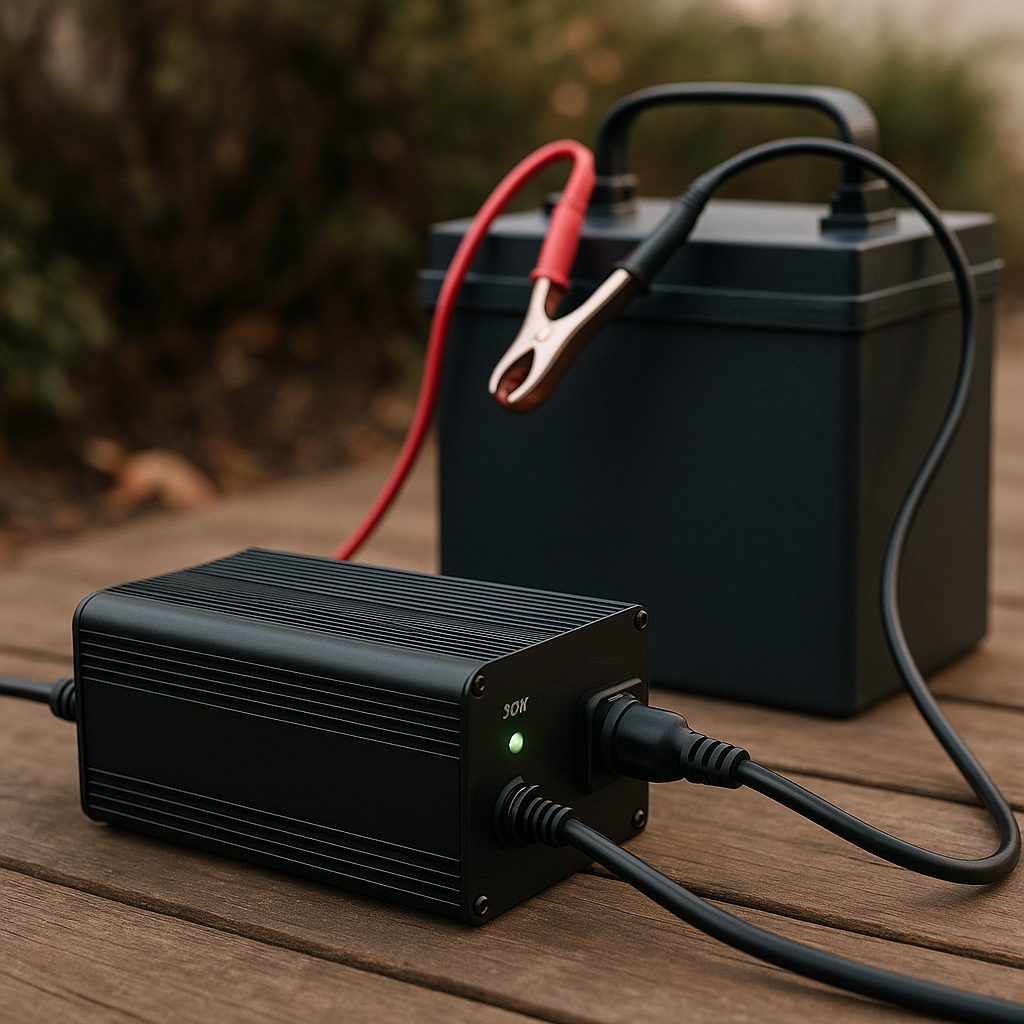
Before we can select a proper caretaker for our battery, we must first become fluent in its native language. The three most fundamental terms are volts (V), amperes (A), and ampere-hours (Ah). Grasping their interplay is the foundation upon which all other knowledge is built.
Imagine a water pipe. The voltage is analogous to the water pressure. It is the electrical potential, the "push" that drives the current through the circuit. A 36-volt system operates at a nominal pressure of 36 volts. A charger must be designed to speak at this specific pressure; using a charger with a different voltage, say 24V or 48V, is like trying to connect pipes of fundamentally different pressure ratings. It simply will not work correctly and is often dangerous.
Amperes, or amps, represent the flow rate of the water. It is the volume of electrical current moving through the circuit at any given moment. A higher amp rating on a charger means it can push more electrical current into the battery per hour, resulting in a faster charge. A 5-amp charger delivers a smaller flow than a 25-amp charger, just as a garden hose delivers less water than a fire hose.
Ampere-hours (Ah) is the measure of the battery's capacity, akin to the size of the water tank. A 100Ah battery can, in theory, supply 1 amp of current for 100 hours, or 10 amps for 10 hours. This capacity dictates how long the battery can power your device. It also informs our choice of charger, as the charger's job is to refill tank of a specific size.
A healthy power system is one where the battery and charger exist in a state of carefully managed harmony. The charger must not only provide the correct voltage but also modulate the current in a sophisticated dance dictated by the battery's chemistry and its current state of charge. A "dumb" charger might apply a constant, brute-force current, which is akin to force-feeding. While it might fill the battery, it does so in a way that causes stress, overheating, and long-term damage.
A proper 36 volt battery charger, particularly a modern smart charger, acts more like a skilled nutritionist. It senses the battery's needs and adjusts the feeding schedule accordingly. It begins with a strong flow of current, then tapers it off as the battery becomes full, and finally, it may provide a gentle trickle to keep it topped off without over-stressing it. This intelligent process, known as multi-stage charging, is central to preserving the battery's state of health (SoH), which is the true measure of its vitality and is far more telling than the simple state of charge (SoC) displayed on a fuel gauge (Battery University, n.d.-a).
The consequences of a mismatched battery and charger are not trivial. They range from disappointing performance to catastrophic failure. Using a charger designed for a different battery chemistry, for instance, is a common and costly mistake. A charger for a lead-acid battery used on a lithium-ion battery can lead to overcharging, as it does not understand the signals from the lithium battery's internal Battery Management System (BMS). This can cause the battery to overheat, swell, and in a worst-case scenario, enter a state of thermal runaway, which is a violent and dangerous chemical fire.
Conversely, using a lithium charger on a lead-acid battery may fail to charge it fully or fail to perform critical maintenance functions like equalization, leading to a condition called sulfation where lead sulfate crystals build up on the battery plates, permanently reducing its capacity (BatteryStuff.com, n.d.-a). The financial cost of replacing a premium 36V battery bank due to improper charging can be substantial, easily exceeding hundreds or even thousands of dollars. The greater cost, however, is the risk to safety and the loss of reliability. When you are miles from shore on a trolling motor or navigating the back nine of a golf course, the last thing you want is a power system you cannot trust. Making an informed choice about your 36 volt battery charger is an act of foresight that pays dividends in performance, longevity, and peace of mind.
The most profound responsibility when selecting a 36 volt battery charger is to honor the unique chemical soul of your battery. Batteries are not monolithic; they are born of different chemistries, each with its own distinct personality, needs, and charging protocol. The two dominant families in the 36V world are lead-acid and lithium-ion. To treat them as interchangeable is to invite failure. The charging profile is not a mere suggestion; it is a strict set of rules dictated by the battery's internal physics. A charger is, in essence, a translator and a manager, converting AC power from the wall into a DC format that the battery can accept, all while respecting the precise voltage and current limits of its specific chemistry.
Think of it as preparing a meal for two very different athletes. One, the lead-acid battery, is a resilient, heavy-duty powerlifter who requires a specific, multi-stage diet to prevent long-term joint problems (sulfation). The other, the lithium-ion battery, is a lightweight, high-endurance marathon runner who needs a highly controlled, precise energy intake and whose health is monitored by an internal computer (the BMS). Feeding them the wrong diet will, without question, impair their performance and health.
Lead-acid batteries are the seasoned veterans of the battery world. They are reliable, relatively inexpensive, and have powered devices for over a century. A 36V lead-acid system is typically composed of three 12V batteries or six 6V batteries connected in series. Within this family, there are three common types, each with slightly different charging needs.
Flooded Lead-Acid (FLA) batteries are the most traditional type. They have liquid electrolyte that requires periodic topping-up with distilled water. Their great virtue is their tolerance for overcharging to some degree, but their great challenge is a susceptibility to sulfation and acid stratification. A proper smart charger for FLA batteries will include a special equalization stage. This is a controlled overcharge performed periodically to reverse stratification (where the acid and water separate into layers) and to knock sulfate crystals off the battery plates, extending the battery's life.
Absorbent Glass Mat (AGM) batteries are a type of sealed lead-acid (SLA) battery where the electrolyte is absorbed into fiberglass mats. They are maintenance-free, spill-proof, and more resistant to vibration than their flooded counterparts. However, they are much more sensitive to overcharging. A charger for an AGM battery must have a precise voltage-controlled algorithm and should not use an equalization stage as aggressively or as often as one for a flooded battery, as it can dry out the electrolyte.
Gel batteries are another SLA type, where the electrolyte is suspended in a silica gel. They are exceptionally good at handling deep discharges but are the most sensitive of the lead-acid family to charging voltage. Even a slight over-voltage can create permanent voids in the gel, irreversibly damaging the battery's capacity. A charger for a Gel battery must have a specific Gel profile with a lower peak charging voltage.
Lithium-ion batteries, particularly the Lithium Iron Phosphate (LiFePO4) variant, have become increasingly popular for 36V applications due to their light weight, long cycle life, and high efficiency. A 36V LiFePO4 battery is a sophisticated piece of technology containing not just the battery cells but also a critical component called the Battery Management System (BMS).
The BMS is the brain of the battery. It monitors the voltage and temperature of each individual cell, protects the battery from over-charging, over-discharging, and short circuits, and performs cell balancing to ensure all cells within the pack are at an equal state of charge. The charger for a LiFePO4 battery must work in concert with the BMS.
The charging profile for LiFePO4 is typically a two-stage process called CC/CV (Constant Current / Constant Voltage).
Unlike lead-acid batteries, LiFePO4 batteries do not want a "float" or "trickle" charge. Continuously applying a voltage after they are full can cause a phenomenon called lithium plating, which degrades the battery. A dedicated 36 volt lithium battery charger understands this; it completes the charge and then turns off, trusting the battery's low self-discharge rate to keep it ready.
The danger of using a lead-acid charger on a lithium battery cannot be overstated. A lead-acid charger's multi-stage algorithm is poison to a lithium battery. Its peak voltage may be incorrect, it will attempt to "float" charge the battery, and it may have an "equalization" mode that would apply a dangerously high voltage. The BMS might protect the battery by shutting down, but repeated attempts to charge with the wrong equipment can stress the BMS and the cells.
Conversely, a lithium charger is a poor choice for a lead-acid battery. It lacks the multi-stage profile needed to properly maintain a lead-acid battery's health. It will not perform equalization on a flooded battery, and its shutdown at the end of the charge cycle prevents the absorption and float stages that are necessary to fully charge and maintain a lead-acid battery, leading to premature sulfation.
The table below starkly illustrates the fundamental differences in charging requirements.
| Feature | 36V Lead-Acid Charger Profile | 36V Lithium (LiFePO4) Charger Profile |
|---|---|---|
| Primary Algorithm | Multi-Stage (Bulk, Absorption, Float) | Two-Stage (Constant Current, Constant Voltage) |
| Peak Voltage | Varies by type (AGM/Gel lower than Flooded) | Precisely controlled, typically higher than lead-acid |
| Float/Maintenance | Essential (Float stage maintains charge) | Harmful (Charger must shut off completely) |
| Equalization Stage | Often included (critical for Flooded) | Never used (Extremely dangerous for lithium) |
| BMS Interaction | None | Essential (Charger works with BMS for safety) |
| Temperature Comp. | Highly recommended for optimal charging | Often managed internally by the BMS |
Before you can even begin to shop for a 36 volt battery charger, you must be certain of your battery's identity. Look for labels on the battery casing. They will almost always state the chemistry: "Lead-Acid," "AGM," "Sealed VRLA," "Gel," or "Lithium," "Li-ion," "LiFePO4." If you have a bank of batteries, check each one. Do not assume. If the labels are missing or unreadable, consult the documentation for your vehicle or device, or contact the battery manufacturer. This first check is the gateway to a healthy power system. Get it right, and you are on the path to reliability. Get it wrong, and you are on the path to disappointment.
Once you have honored the chemical nature of your battery, the next dimension to consider is time. How quickly do you need your battery to be ready for service? The answer to this question lies in the charger's amperage rating. As we established, amperage is the rate of electrical flow. A higher amperage charger will replenish your battery's energy reserves more quickly. However, the relationship between charging speed, amperage, and battery health is not a simple one. It is a delicate balance, a trade-off between convenience and longevity. Choosing the right amperage is an act of practical wisdom, requiring a thoughtful assessment of your usage patterns and a respect for the battery's limits.
Imagine you need to water a delicate orchid. You could blast it with a fire hose and fill the pot in seconds, but you would likely damage the roots and wash away the soil. A gentle, steady watering over a few minutes is far healthier. Batteries are similar. While they can often accept a fast charge, consistently charging at the maximum possible rate can generate excess heat and put stress on the internal components, potentially shortening the battery's overall service life.
The relationship between charger amps and charge time is straightforward. The speed at which you can recharge your battery is determined by its capacity (in Amp-hours) and the charger's output (in Amps). A common rule of thumb for lead-acid batteries is to choose a charger with an amperage rating that is between 10% and 25% of the battery bank's total Ah capacity.
For example, if you have a 36V system made of three 12V, 100Ah batteries in series, your total capacity is 100Ah at 36V. A suitable charger would be in the range of 10 amps (10% of 100Ah) to 25 amps (25% of 100Ah). A 10-amp charger would be a gentle "maintenance" or overnight charger, while a 25-amp charger would be considered a fast charger for that battery size.
For lithium (LiFePO4) batteries, the rules are a bit different. They can typically accept a much higher charge rate, often up to 100% of their capacity (a 1C rate). This means a 100Ah lithium battery could theoretically be charged with a 100-amp charger. However, charging at such high rates consistently can still impact long-term health. A more conservative rate, such as 20% to 50% of the Ah capacity (e.g., a 20A to 50A charger for a 100Ah battery), is often recommended to balance speed with longevity. Always consult the battery manufacturer's specifications for the recommended and maximum charge current.
The choice of amperage depends entirely on your needs.
You can estimate the time it will take to recharge your battery using a simple formula. Remember that charging is not 100% efficient; some energy is lost as heat. Also, the final 20% of the charge (the absorption phase in lead-acid) takes much longer than the initial 80%.
A basic estimation formula is: Charge Time (in hours) ≈ (Amp-hours to be replaced / Charger Amperage) * 1.2
The * 1.2 factor adds 20% to account for inefficiencies and the slower absorption phase.
Let's consider a 100Ah battery that has been discharged by 50%, meaning it needs 50Ah to be replaced.
| Charger Amperage | Calculation | Estimated Charge Time |
|---|---|---|
| 10 Amps | (50 Ah / 10 A) * 1.2 | ~6 hours |
| 25 Amps | (50 Ah / 25 A) * 1.2 | ~2.4 hours |
| 50 Amps (Lithium) | (50 Ah / 50 A) * 1.2 | ~1.2 hours |
This table clearly demonstrates the dramatic impact that the amperage of your 36 volt battery charger has on turnaround time. A commercial user might find the higher amp rating indispensable, while a recreational user might be perfectly content with an overnight charge from a lower-amp model.
The core principle to remember is that heat is the enemy of battery longevity. Charging creates heat, and higher amperage creates more heat. For lead-acid batteries, excessive heat can accelerate grid corrosion and water loss. For lithium batteries, while they handle higher currents better, excessive heat can still accelerate the degradation of the electrolyte and other internal components.
A high-quality smart charger helps mitigate this by monitoring temperature (if it has a sensor) and reducing the current if the battery gets too hot. However, the fundamental physics remain. Opting for a charger with a moderate amperage that aligns with the manufacturer's recommendations for daily use, rather than always choosing the fastest option available, is a prudent strategy for maximizing the return on your battery investment. It is the path of a patient caretaker, not a hurried taskmaster.
In our modern technological landscape, the distinction between a "smart" device and a simple one is profound. It is the difference between a tool that merely performs a function and one that senses, adapts, and optimizes. This distinction is nowhere more important than in the realm of battery charging. A "smart" 36 volt battery charger is not just a power converter; it is an intelligent battery maintenance station. It employs sophisticated microprocessors to execute complex charging algorithms, ensuring that the battery receives not just a charge, but a carefully orchestrated rejuvenation treatment. To forego a smart charger in 2025 is to choose an archaic, inefficient, and ultimately more costly approach to battery care.
A simple, unregulated power supply provides a constant voltage and current. It is a blunt instrument. A smart charger, by contrast, is a surgical tool. It communicates with the battery—either by sensing its voltage and resistance or, in the case of lithium, by listening to its BMS—and tailors the charging process in real-time. This active management is what preserves capacity, extends cycle life, and ensures both safety and performance.
The "brain" of a smart charger is its microprocessor. This tiny computer is programmed with specific charging profiles (algorithms) for different battery chemistries and types. When you connect the charger, it initiates a diagnostic sequence, analyzing the battery's current state. It checks the voltage to determine the depth of discharge and may even test the internal resistance to gauge its overall health. Based on this initial assessment, it selects the appropriate charging strategy.
This intelligence allows the charger to handle various scenarios. If it detects a deeply discharged battery, it might start with a very low current "recovery" phase to gently wake it up before applying the main bulk charge. If it senses the battery is already nearly full, it can skip the initial stages and move directly to the topping-off phase. This adaptability is the hallmark of a smart device.
For lead-acid batteries, the most critical function of a smart charger is its ability to perform a multi-stage charge. This process can be understood as providing a complete, balanced meal for the battery.
Bulk Stage: This is the main course. The charger delivers its maximum rated current (constant current) until the battery's voltage rises to a specific level (typically around 80% state of charge). The goal here is to replace the majority of the battery's depleted energy as quickly as possible.
Absorption Stage: Once the battery reaches its target voltage, the charger switches to the absorption stage. It holds the voltage constant (constant voltage) and the battery's internal resistance begins to increase. As a result, the current the battery accepts gradually tapers off. This stage is like finishing the rest of the food on your plate more slowly. It is crucial for topping the battery off to 100% and ensuring the charge is fully "absorbed" into the plates. Skipping this stage, as a simple charger might, will consistently leave the battery undercharged, leading to sulfation.
Float Stage (or Maintenance Stage): After the absorption stage is complete (indicated by the current dropping to a very low level), the charger reduces the voltage to a lower, safe "float" level. This is like having a coffee after the meal. It provides a very small trickle current that compensates for the battery's natural self-discharge, keeping it at a 100% state of charge indefinitely without overcharging or stressing it. This is ideal for batteries that are left connected for long periods, such as in a boat during the offseason.
Equalization Stage (Primarily for Flooded Lead-Acid): This is a special maintenance cycle that a smart charger can perform. It involves a controlled, timed overcharge at a higher voltage. This process vigorously "bubbles" the electrolyte, which helps to reverse acid stratification and knock loose sulfate crystals from the battery plates. According to experts at BatteryStuff.com, reversing this sulfation is the single most important factor in preventing premature battery failure. This stage is a powerful restorative tool, but it must be used correctly and is generally not recommended for AGM or Gel batteries.
For lithium (LiFePO4) batteries, the concept of "smart" charging is a partnership between the charger and the battery's onboard BMS. The charger's job is to provide a clean, stable CC/CV charge profile. The BMS's job is to act as the ultimate safety guardian.
A smart lithium charger will deliver the constant current, monitor the voltage, and then switch to constant voltage mode as instructed by the battery's needs. However, the BMS is doing much more behind the scenes. It is monitoring the voltage of every individual cell in the pack. If one cell's voltage rises faster than the others, the BMS can use balancing circuits to slow its charge, allowing the other cells to catch up. Most critically, if any cell reaches its maximum safe voltage, the BMS will instruct the charger to stop or will disconnect the charging circuit internally to prevent an overcharge condition. A dedicated 36 volt lithium charger is designed to respect these commands.
When evaluating a smart 36 volt battery charger, several advanced features indicate a higher-quality device:
Choosing a smart charger is an investment in a process, not just a product. It is an acknowledgment that the way a battery is charged is just as important as the charge itself.
Having navigated the complex internal worlds of battery chemistry and charging algorithms, our inquiry must now turn to the external, physical realities of the application. A 36 volt battery charger, no matter how intelligent, is useless if it cannot physically and safely connect to your battery system or survive in its operating environment. This stage of the selection process is grounded in practicalities: plugs, form factors, and durability. It requires a careful examination of the specific context in which the charger will be used. Is it for a golf cart stored in a clean garage? A trolling motor on a boat exposed to salt spray? An industrial scissor lift on a dusty construction site? The answers to these questions will guide your choice of a charger that is not only electrically compatible but also physically robust enough for the task at hand.
The empathy we extend to the battery's chemical needs must now be extended to the user's practical context. A charger that is difficult to connect, cumbersome to handle, or unable to withstand the elements will create frustration and may even be neglected, ultimately leading to the very battery problems we seek to avoid.
The point of contact between the charger and the battery is the plug or connector. A secure, low-resistance connection is vital for a safe and efficient charge. Using the wrong plug, or a poorly fitting one, can lead to arcing, overheating, and a significant fire hazard. There is no universal standard for 36V connectors, so it is imperative that you identify the specific plug required by your equipment.
For golf carts, several common plug types exist. It is crucial to visually inspect the receptacle on your cart and match it to the charger's plug. Common styles include:
For marine trolling motors or other applications where batteries are installed more permanently, the connection is often made directly to the battery terminals using ring terminals. The key here is to ensure the ring terminals on the charger's cables are the correct size for your battery's posts (e.g., 5/16" or 3/8"). A secure, tight connection is paramount in a high-vibration marine environment.
When in doubt, take a clear photo of the charging port on your equipment. Reputable suppliers can help you identify the correct plug. While adapters are available, a charger with the correct native plug is always the most reliable and safest solution.
Chargers come in two primary form factors, each suited to different use cases.
Onboard Chargers are designed to be permanently installed within the vehicle or vessel. They are bolted down and wired directly to the battery bank.
Portable Chargers are standalone units with their own AC cord and DC output cables.
The choice is a matter of lifestyle. For a golf cart used daily at home, an onboard charger is often the superior choice. For someone who has a 36V trolling motor, a 36V scissor lift, and a 36V backup power system, a high-quality portable charger offers far greater value and flexibility.
If your charger will be used in any environment other than a clean, dry garage, you must pay close attention to its Ingress Protection (IP) rating. The IP rating is a two-digit code that defines how well the charger's enclosure protects it against solids (the first digit) and liquids (the second digit).
For a marine 36 volt battery charger on a boat, a high IP rating is not a luxury; it is a necessity.
Even for land-based applications like pressure washers or equipment used outdoors, a charger with at least an IP65 rating provides valuable protection against dust, dirt, and moisture, contributing to a longer service life.
In the United States, the standard household wall outlet provides 120 Volts AC. Nearly all consumer-grade chargers are designed to work with this input voltage. However, some heavy-duty industrial chargers might be designed for 240V AC input, so it is always wise to confirm.
A more advanced feature found on some high-end portable chargers is a universal AC input (e.g., 90-240V AC). This allows the charger to be used in different countries with different power standards, a useful feature for international travelers or equipment that may be shipped globally. For the vast majority of US users, ensuring the charger is specified for a standard 120V AC, 60Hz input is all that is required.
The final stage of our deliberative process involves an assessment of trust. When we connect a powerful electrical device to our valuable battery bank and plug it into our home's wiring, we are placing our trust in the manufacturer. We trust that they have designed the product not just to function, but to function safely. This trust should not be given blindly. It should be earned through transparent adherence to recognized safety standards and demonstrated through high-quality construction. Examining a charger's safety certifications and build quality is the ultimate act of due diligence, protecting your equipment, your property, and yourself.
A charger, at its core, handles significant amounts of energy. A failure can manifest in ways far more serious than simply a battery that won't charge. It can result in electrical shock, fire, or irreparable damage to your electronics. Therefore, scrutinizing these final details is not a matter of pickiness, but of profound responsibility.
You will often see various certification marks on electronic devices. These are not mere decorations; they are symbols representing that the product has been tested by a third-party organization and found to meet specific safety and performance standards. For a consumer in the United States, the most significant of these is the UL mark.
UL (Underwriters Laboratories): This is the gold standard for consumer product safety in the USA. A product that is "UL Listed" or "UL Certified" has undergone rigorous testing for a wide range of potential hazards, including fire risk, electrical shock, and mechanical failure. The testing is specific to the product type; a UL-certified battery charger has been evaluated against standards specifically written for chargers. Seeing the UL logo on a 36 volt battery charger provides a strong assurance that it is a well-engineered and safe product. A similar mark, "ETL Listed," from Intertek is considered legally equivalent to UL as both are Nationally Recognized Testing Laboratories (NRTL).
CE (Conformité Européenne): This mark indicates that a product complies with the health, safety, and environmental protection standards for products sold within the European Economic Area (EEA). While it is a good sign, it is a self-certification mark by the manufacturer and does not hold the same weight in the US as a UL or ETL listing from an NRTL.
FCC (Federal Communications Commission): This certification deals with electromagnetic interference. It ensures that the charger's electronic components do not emit radio frequencies that could interfere with other devices like radios, televisions, or Wi-Fi. While important for preventing electronic "noise," it is not a primary safety certification like UL.
When choosing a charger, prioritizing one that is UL or ETL Listed is the single best way to ensure it has been properly vetted for safety by an independent body.
A well-designed smart charger incorporates multiple layers of internal electronic protection. These are fail-safes that anticipate potential problems and automatically shut the charger down before damage can occur. Look for a charger that explicitly lists these features:
These features are the silent guardians of your charging process, working in the background to ensure every charge is a safe one.
Beyond certifications, you can often gauge the quality of a charger by its physical construction.
Finally, consider the manufacturer behind the product. A reputable company will stand by its products with a clear warranty and accessible customer support.
Choosing a 36 volt battery charger is a holistic process. It begins with an understanding of science and ends with an evaluation of trust. By carefully considering these five checks—chemistry, amperage, intelligence, compatibility, and safety—you empower yourself to select a charger that will serve as a faithful and effective caretaker for your battery system for years to come.
1. Can I use a 48V charger on my 36V battery bank? No, you absolutely should not. The voltage of the charger must match the nominal voltage of the battery system. Using a 48V charger on a 36V battery bank constitutes a severe over-voltage condition. It will force too much voltage into the batteries, leading to dangerous overheating, gassing (in lead-acid batteries), and a high risk of permanent damage or thermal runaway, especially in lithium batteries. The battery's BMS (if it has one) may prevent the charge, but you should never attempt it.
2. Is it safe to leave my 36 volt battery charger connected all the time? For a modern, high-quality smart charger, the answer is generally yes. These chargers are designed with a "float" or "maintenance" mode for lead-acid batteries, which keeps them topped off with a very small, safe current. For lithium batteries, a smart charger will complete the charge and then shut off completely, only re-engaging if the voltage drops after a long period. This prevents overcharging. However, for long-term storage (months), it is always best to consult the battery manufacturer's specific recommendations.
3. Why does my battery charger get hot during use? It is normal for a battery charger to become warm, or even hot to the touch, during operation. The process of converting 120V AC power to 36V DC power is not 100% efficient, and the waste energy is dissipated as heat. Higher amperage chargers will naturally generate more heat. A quality charger is designed with cooling mechanisms (fans or heat sinks) to manage this. However, if the charger becomes too hot to touch or emits a burning smell, you should disconnect it immediately as this could indicate a fault or inadequate ventilation.
4. How do I know what plug my 36V golf cart needs? The best way is to visually inspect the charging port on your golf cart and compare it to pictures of common plug types (e.g., Crowfoot, PowerWise D-plug, SB-50, 3-pin round). The cart's make, model, and year are also important clues. If you are unsure, taking a clear picture of the port and sending it to a knowledgeable supplier is the safest way to ensure you get a charger with the correct, compatible plug.
5. Can I use a single 12V charger to charge my 36V battery bank one battery at a time? While technically possible, it is a very bad practice and is not recommended. A 36V battery bank relies on the batteries being balanced, meaning they are at an equal state of charge. Charging them individually with a 12V charger almost guarantees they will become unbalanced. This imbalance forces some batteries to work harder than others during both charge and discharge, leading to premature failure of the entire bank. A proper 36 volt battery charger charges the entire bank as a single, cohesive unit, which is essential for maintaining balance and longevity.
6. What does "C-rate" mean in relation to charging? The C-rate describes the rate of charge or discharge relative to the battery's capacity. A 1C rate for a 100Ah battery is a charge or discharge current of 100 amps. A 0.5C rate would be 50 amps, and a 0.2C rate would be 20 amps. Battery manufacturers often specify maximum and recommended C-rates for charging to ensure safety and prolong life (Battery University, n.d.-b).
7. My lithium battery won't charge in the cold. Is it broken? Not necessarily. Most lithium-ion batteries, including LiFePO4, have a BMS that will prevent charging at temperatures near or below freezing (32°F or 0°C). Charging a lithium battery at these temperatures can cause lithium plating, which is an irreversible form of damage. The battery must be brought into a warmer environment before it will accept a charge. Some advanced, cold-weather lithium batteries have built-in heaters to overcome this limitation.
The journey to select the right 36 volt battery charger is an exercise in thoughtful inquiry, moving from the scientific principles of electrochemistry to the practical realities of everyday use. It is a process that demands more than a cursory glance at price or power ratings; it requires a deep appreciation for the charger's role as a vital partner in the health and longevity of your battery system. By diligently progressing through the five essential checks—confirming battery chemistry, selecting an appropriate amperage, embracing smart charging technology, verifying physical compatibility, and assessing safety and quality—you transform from a mere consumer into an informed custodian of your power system.
Making the correct choice is an act of foresight. It is an investment that pays dividends not in immediate, flashy returns, but in the quiet, consistent reliability of a battery that performs as expected, day after day. It is the confidence of knowing your golf cart will be ready for your tee time, your trolling motor will last through the fishing trip, and your equipment will operate safely and efficiently. The right charger does not just replenish energy; it preserves potential, safeguarding your investment and ensuring that your power source remains a dependable servant rather than a frustrating liability.
Battery University. (n.d.-a). BU-901: Fundamentals in battery testing. https://batteryuniversity.com/article/bu-901-fundamentals-in-battery-testing
Battery University. (n.d.-b). BU-402: What is C-rate?https://batteryuniversity.com/article/bu-402-what-is-c-rate
BatteryStuff.com. (n.d.-a). Make the bad sulfation go away!https://www.batterystuff.com/kb/articles/charging-articles/make-the-bad-sulfation-go-away.html
BatteryStuff.com. (n.d.-b). How do I know what golf cart battery charger I need?https://www.batterystuff.com/kb/articles/charging-articles/how-do-i-know-what-golf-cart-battery-charger-i-need.html
OutBack Power. (2023). EnergyCell™ TT.
Power-Sonic. (2025). Battery and energy solutions.
Tools.com. (2025). Power lithium.
Xtra Power Batteries. (2023). Battery selector tool.
{"one"=>"Select 2 or 3 items to compare", "other"=>"{{ count }} of 3 items selected"}