

CONTACT
Please contact us for shipping details.
This guide examines the critical considerations for selecting, using, and maintaining a PowerWheel battery and charger. It addresses five prevalent and costly errors that consumers frequently make, which can lead to diminished performance, reduced operational lifespan, and potential safety hazards. The analysis begins by establishing the foundational principles of battery voltage and chemistry, contrasting traditional Sealed Lead-Acid (SLA) batteries with modern Lithium-ion (Li-ion) alternatives. It then explores the nuanced requirements of charger compatibility, emphasizing the importance of intelligent charging systems tailored to specific battery types. The document further investigates the role of amp-hours (Ah) in determining runtime and the direct impact of maintenance and storage protocols on battery longevity. Finally, it evaluates the practical and economic implications of upgrading to advanced battery technologies. By systematically deconstructing these common missteps, this text provides a comprehensive framework for making informed decisions, ensuring optimal safety, durability, and enjoyment from PowerWheel electric ride-on toys in 2026.
The journey into the world of ride-on toy maintenance often begins with a simple problem: the toy stops working. The immediate suspect is almost always the battery. Yet, in the rush to find a replacement, a foundational mistake is often made, one that can have consequences ranging from disappointing performance to permanent damage to the vehicle's electrical system. This error is the failure to appreciate the distinct and non-interchangeable natures of voltage and battery chemistry. To approach this with the necessary care, we must first break down these concepts, not as abstract electrical terms, but as the very heart and soul of your child's vehicle.
Think of the electrical system of a PowerWheel as a carefully balanced ecosystem. The motor, the wiring, and the speed controller are all designed to work in harmony with a specific type of power source. Introducing a battery with the wrong specifications is like introducing a foreign species into that ecosystem; the results are unpredictable and often detrimental.
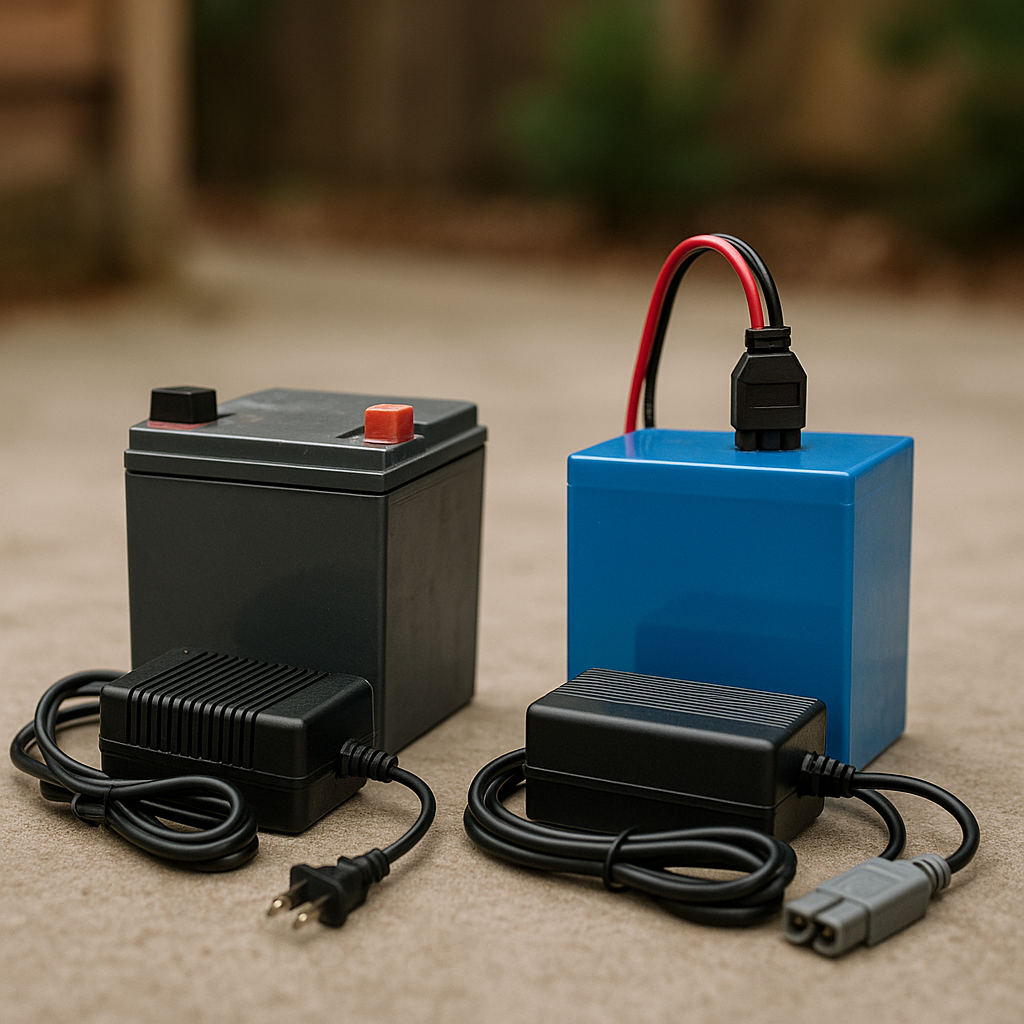
Voltage, measured in volts (V), is best understood as electrical pressure. It is the force that pushes the electric current through the motor, making the wheels turn. A PowerWheel designed for a 6V battery has a motor and internal components engineered for that specific level of electrical pressure. If you were to install a 12V battery, you would be doubling the pressure.
What might happen? For a moment, the toy might seem supercharged, moving faster than ever before. This initial thrill, however, is the prelude to failure. The motor's windings are not thick enough to handle the increased current drawn at the higher voltage, causing them to overheat rapidly. The delicate electronics in the speed controller and wiring can burn out, and plastic components near the motor can melt. It is a classic case of too much of a good thing. The vehicle's system is not robust enough for that level of force (Jackery, 2024).
Conversely, installing a 6V battery in a 12V vehicle will lead to profound disappointment. The electrical pressure is simply insufficient to operate the more powerful 12V motor effectively, if at all. The toy will move sluggishly or may not move whatsoever, and the battery will be strained as the motor attempts to draw more current than the smaller battery can efficiently provide, leading to its premature demise. The key principle is one of correspondence: the battery's voltage must match the vehicle's specified voltage.
Beyond voltage lies the equally important factor of battery chemistry. For decades, the standard for PowerWheels and similar ride-on toys has been the Sealed Lead-Acid (SLA) battery. These are the heavy, blocky batteries you are likely familiar with. They are a mature, reliable, and cost-effective technology. Inside, lead plates are submerged in a sulfuric acid electrolyte gel or absorbed glass mat (AGM), and a chemical reaction generates electricity.
More recently, Lithium-ion (Li-ion) batteries, particularly the very stable Lithium Iron Phosphate (LiFePO4) sub-chemistry, have emerged as a popular upgrade. These are the same types of batteries that power everything from smartphones to electric cars. Their internal workings are fundamentally different, relying on the movement of lithium ions between a graphite anode and a cathode material (Jackery, 2023).
The choice between these two chemistries is not merely a matter of preference; it has deep implications for performance, weight, lifespan, and safety. A direct swap is not always straightforward, as we will explore later, but understanding their intrinsic differences is the first step.
| Feature | Sealed Lead-Acid (SLA) | Lithium Iron Phosphate (LiFePO4) |
|---|---|---|
| Nominal Voltage | Typically 6V or 12V | Typically 12.8V (marketed as 12V) |
| Weight | Heavy (e.g., a 12V 12Ah SLA is ~8 lbs) | Light (e.g., a 12V 12Ah LiFePO4 is ~3 lbs) |
| Cycle Life | 200-500 cycles | 2,000-7,000 cycles |
| Usable Capacity (DoD) | 50-60% recommended | 80-100% recommended |
| Maintenance | Requires periodic full charging | Virtually maintenance-free |
| Upfront Cost | Lower | Higher |
| Long-Term Cost | Higher (due to more frequent replacements) | Lower (due to longevity) |
As the table illustrates, the differences are stark. A LiFePO4 battery can be discharged more deeply without damage, meaning you get to use more of its stored energy. It can last many times longer than an SLA battery and weighs significantly less, which can even improve the vehicle's handling and acceleration. However, these chemistries have different charging needs, which leads us directly to the next common and costly error.
If the battery is the heart of the PowerWheel, the charger is its life support system. A common and deeply damaging mistake is to view chargers as interchangeable commodities. Using the wrong charger is not just an inconvenience; it is a direct path to destroying your battery, regardless of its chemistry. The process of replenishing a battery is a delicate electrochemical dance, and the charger is the choreographer. Using one that does not know the steps will end the performance prematurely.
The assumption that any plug that fits is the right one to use is a dangerous oversimplification. A charger designed for a 12V SLA battery delivers power in a way that is fundamentally different from a charger designed for a 12V Li-ion battery. This incompatibility is not a marketing gimmick to sell more accessories; it is rooted in the very physics and chemistry of how these batteries store and release energy.
Let's consider the charging process for a standard SLA battery. It typically involves three stages:
This "float" stage is the critical point of failure when charging a lithium battery. Lithium-ion batteries, including LiFePO4, do not want to be held at a full charge voltage indefinitely. They are happiest when charged to 100% and then left alone. A charger with a float stage will continuously push a small current into a fully charged lithium battery. This process, known as overcharging, can cause plating of metallic lithium on the anode, which permanently reduces capacity and can, in extreme cases, lead to internal short circuits and a dangerous condition known as thermal runaway (MANLY Battery, 2025).
A proper lithium-ion charger, often called a "smart charger," uses a two-stage profile:
Using an SLA charger on a lithium battery is a surefire way to shorten its otherwise long life. The investment you made in a superior battery is undone by an incompatible charger.
The reverse scenario is also problematic. While perhaps less catastrophically damaging in the short term, using a lithium-specific charger on an SLA battery is inefficient and can lead to undercharging. Many lithium chargers have a lower peak voltage than what is required to fully charge an SLA battery. Furthermore, the absence of a float stage means the SLA battery will not be maintained at a full state of charge, allowing it to self-discharge over time. For an SLA battery, sitting in a partially discharged state is highly detrimental, as it promotes the formation of lead sulfate crystals on the plates (sulfation), which is a primary cause of capacity loss and failure in lead-acid batteries.
The only acceptable solution is to use a charger that is explicitly designed for your battery's specific chemistry. Many modern smart chargers are multi-chemistry, allowing you to select whether you are charging an SLA, AGM, or Lithium battery. These units, like a multi-voltage lithium-ion charger, represent a wise investment, especially if you manage a variety of battery types.
Beyond chemistry, a charger has a rating in Amperes (Amps), which indicates the rate at which it delivers current. A charger with a higher amp rating will charge a battery faster. For example, charging a 12Ah battery with a 1.5A charger will theoretically take 8 hours (12Ah / 1.5A = 8h). Using a 3A charger would cut that time in half to 4 hours.
However, faster is not always better. Charging a battery too quickly generates excess heat, which is the enemy of battery longevity for both SLA and lithium types. A good rule of thumb is to use a charge rate that is between 10% and 25% of the battery's amp-hour capacity. For our 12Ah battery, a charger between 1.2A and 3A would be ideal. While you could use a more powerful charger, it is often best to opt for a moderate, steady charge to maximize the battery's service life.
| Charger Type | Target Chemistry | Key Charging Stages | Risk of Mismatch |
|---|---|---|---|
| Standard SLA Charger | Sealed Lead-Acid (SLA/AGM) | Bulk, Absorption, Float | Damages lithium batteries via float charge. |
| Lithium (Li-ion/LiFePO4) Charger | Lithium-ion | Constant Current (CC), Constant Voltage (CV), Shut-off | Undercharges SLA batteries; no float stage. |
| Multi-Chemistry Smart Charger | SLA, AGM, Li-ion, etc. (Selectable) | Chemistry-specific profiles (CC/CV or 3-stage) | Low risk, provided the correct mode is selected. |
After confirming the correct voltage and chemistry, the next specification you will encounter is the Amp-hour (Ah) rating. This number is the source of significant confusion, often being mistaken for a measure of power. Making a choice based on this misunderstanding is the third costly error, leading to either disappointment in runtime or overspending on unnecessary capacity.
Let's clarify the distinction with an analogy. If voltage is the water pressure in a pipe, then amp-hours represent the size of the water tank. A larger tank (higher Ah) does not change the pressure (voltage), but it allows the water to flow for a much longer time. Therefore, the Ah rating is a measure of capacity, which directly translates to how long the PowerWheel will run on a single charge.
A standard PowerWheel battery might be rated at 12V and 9.5Ah. A replacement or upgrade option might be 12V and 12Ah. Both will power the vehicle correctly because they share the same voltage. However, the 12Ah battery has roughly 26% more capacity (12Ah is 2.5Ah more than 9.5Ah, and 2.5 / 9.5 ≈ 0.26). This means, under identical conditions—same terrain, same vehicle, same driver—the 12Ah battery will provide about 26% more playtime.
Calculating the exact runtime is complex, as it depends on many variables:
Despite these variables, the relationship is linear. Doubling the amp-hours will roughly double the runtime. A child who gets 45 minutes of fun from a 9.5Ah battery could expect around an hour from a 12Ah battery, and an hour and a half from an 18Ah battery.
The temptation might be to buy the highest Ah battery available. However, there are practical constraints to consider.
Physical Size: Generally, a higher Ah rating corresponds to a larger and heavier battery. While there are some variations, an 18Ah SLA battery will be noticeably bigger than a 9.5Ah SLA battery. You must ensure the larger battery will physically fit in the PowerWheel's battery compartment. This is one area where lithium batteries offer a distinct advantage; a 20Ah LiFePO4 battery can often be the same size as, or even smaller than, a 12Ah SLA battery, offering a massive runtime increase without modification.
Cost: Higher capacity costs more. An 18Ah battery will be more expensive than a 12Ah battery of the same chemistry. The key is to find the sweet spot that meets your needs without breaking the budget. Ask yourself: is 30 minutes of extra playtime worth the additional cost? For some, the answer is a resounding yes. For others, a standard capacity is perfectly adequate.
Charge Time: A higher capacity battery will take longer to charge with the same charger. A 20Ah battery will take twice as long to charge as a 10Ah battery. If you need a quick turnaround between play sessions, you might need to invest in a slightly more powerful (higher amperage) charger to accompany your larger battery, keeping in mind the safe charging rates discussed earlier.
Choosing the right Ah rating is an exercise in balancing desired runtime, physical space, and budget. Before purchasing, measure your battery compartment and consider how much playtime is "enough." This thoughtful approach will ensure you get the best value and satisfaction from your new powerwheel battery and charger.
A battery and charger are not "set it and forget it" devices. The fourth costly error is to neglect the simple, yet vital, habits of proper maintenance and storage. Like any tool, a battery's performance and longevity are directly tied to how it is cared for. A brand-new, top-of-the-line battery can be ruined in a single season through neglect, while a well-maintained, standard battery can provide years of reliable service. This care does not require an engineering degree, just a consistent and mindful routine.
The principles of battery care are universal, but their specific application differs slightly between SLA and lithium chemistries. Understanding these nuances is key to maximizing your investment.
The single most important maintenance habit is to recharge the battery after every single use, no matter how short. This is especially critical for Sealed Lead-Acid (SLA) batteries. As mentioned before, leaving an SLA battery in a discharged state allows for sulfation, the growth of lead sulfate crystals on the battery plates. These crystals act as an insulator, impeding the flow of electricity and permanently reducing the battery's capacity. A battery that is consistently left discharged for days or weeks will quickly lose its ability to hold a charge.
For lithium batteries, this rule is also best practice, though for a different reason. While lithium batteries are not susceptible to sulfation, keeping them topped off ensures they are always ready for the next adventure. It also helps the internal Battery Management System (BMS) stay calibrated, ensuring its readings of the battery's state of charge are accurate.
The routine should be simple: when the ride-on toy comes inside, the battery immediately goes on the charger. Make this as habitual as taking off shoes at the door.
Perhaps the most common way PowerWheel batteries are destroyed is through improper off-season storage. When winter arrives and the ride-on is put away for months, the battery is often forgotten in a cold garage, still connected to the vehicle. This is a recipe for a dead battery come springtime.
All batteries self-discharge over time, meaning they slowly lose their charge even when not in use. A PowerWheel vehicle also has a small parasitic drain, a tiny amount of current that it draws even when turned off. Over several months, this combination will completely drain the battery. For an SLA battery, being left in a deep discharge state for that long is almost always fatal due to severe sulfation (Manly Battery, 2025).
The correct protocol for long-term storage (more than a month) is as follows:
Electrical connections work best when they are clean and tight. Periodically, take a moment to inspect the battery terminals and the vehicle's connectors. Look for any signs of corrosion, which often appears as a white or greenish powder on SLA terminals. If corrosion is present, disconnect the battery and clean the terminals with a wire brush and a mixture of baking soda and water. Once clean and dry, a thin layer of dielectric grease can be applied to prevent future corrosion.
Also, inspect the wires for any signs of fraying, cracking, or damage. A damaged wire is a safety hazard and can cause intermittent power issues. Ensure all connectors fit snugly. A loose connection can generate heat and cause performance problems.
These simple habits—charging after use, proper storage, and regular inspection—are the difference between a powerwheel battery and charger that lasts one year and one that lasts for many.
The final costly error is one of omission rather than commission: overlooking the opportunity to upgrade to modern battery technology. Many users, when faced with a dead battery, simply seek out an identical, like-for-like replacement. While this approach is straightforward, it fails to consider the significant advancements in battery technology that can fundamentally transform the PowerWheel experience. In 2026, sticking with decades-old technology without evaluating the alternatives is a missed opportunity for enhanced performance, convenience, and long-term value.
The most impactful upgrade available is the transition from a traditional Sealed Lead-Acid (SLA) battery to a Lithium Iron Phosphate (LiFePO4) battery. As we have touched on, this is more than just a simple swap; it is a paradigm shift in how the toy is powered and used.
Let's revisit the benefits of a LiFePO4 battery in the context of a child's ride-on toy:
Upgrading to lithium is not as simple as just dropping the new battery in. To do it safely and effectively, you must address the ecosystem around the battery.
By not considering an upgrade, you are choosing to repeatedly buy a heavier, less powerful, and shorter-lived product. By embracing the modern alternative, you invest once in a superior power solution that delivers more fun, less hassle, and better value for years to come.
No, this is highly unsafe and should never be attempted. A car battery is a "starting" battery designed to deliver a massive amount of current for a few seconds to start an engine. It is not a "deep cycle" battery. Using it in a PowerWheel can dangerously overheat the vehicle's wiring, cause motor burnout, and the battery itself contains liquid acid that can spill. Furthermore, the amperage a car battery can deliver is far beyond what the toy's components can handle, creating a significant fire risk. Always use a battery specifically designed for deep-cycle applications like ride-on toys.
Not necessarily. The green light on most basic PowerWheel chargers simply indicates that the charger is connected and has completed its charging cycle. It cannot diagnose the health of the battery. A battery can have severely diminished capacity (e.g., it only runs for 5 minutes) but still charge to a voltage level that triggers the green light. The only true test of a battery's health is its runtime under load. If the runtime is significantly shorter than when it was new, the battery is likely nearing the end of its life, regardless of what the charger light indicates.
First, identify the voltage of your vehicle, which is usually printed on the old battery or near the battery compartment (most are 12V, some older models are 6V). Your replacement battery must match this voltage. Second, decide on your desired chemistry (SLA for a direct budget replacement, or LiFePO4 for a long-term performance upgrade). Third, choose an amp-hour (Ah) rating; a higher Ah gives longer runtime but may be larger and cost more. Finally, and most importantly, purchase a charger that is explicitly compatible with your chosen battery's voltage and chemistry.
Yes, it is generally safe to upgrade to a lithium battery, provided you use a high-quality Lithium Iron Phosphate (LiFePO4) battery and follow the correct procedures. LiFePO4 is the safest type of lithium-ion chemistry, highly resistant to thermal runaway. The upgrade requires using a dedicated LiFePO4 charger and ensuring the battery's voltage is compatible with your 12V vehicle. It is also recommended to add an in-line fuse for extra protection. When done correctly, a lithium upgrade provides a safer, lighter, and longer-lasting power solution.
There are several key habits to maximize battery life. First, charge the battery after every single use, even short ones. Second, for long-term storage (like over the winter), fully charge the battery, disconnect it from the vehicle, and store it in a cool, dry place, topping it up every couple of months if it is an SLA type. Third, regularly inspect and clean the battery terminals to ensure a good connection. Finally, avoid running the battery completely dead repeatedly, as deep discharges are hard on any battery chemistry.
Both batteries provide the same voltage (12V) and will power the vehicle correctly. The difference is capacity, measured in amp-hours (Ah). The 12Ah battery can store significantly more energy than the 7Ah battery. This means it will provide a much longer runtime on a single charge—potentially 60-70% more playtime. The 12Ah battery may be physically larger and heavier (if both are SLA) and will cost more, so you must ensure it fits in the battery compartment.
Navigating the world of the PowerWheel battery and charger can seem complex, but by understanding and avoiding these five fundamental errors, the path becomes clear. It is a journey that moves from simple correspondence of voltage to a nuanced appreciation of chemistry, capacity, and care. By choosing a battery and charger that form a compatible and harmonious system, you are not just buying parts; you are investing in safety, reliability, and uninterrupted playtime. The initial effort to understand the differences between SLA and lithium, the function of a smart charger, or the meaning of amp-hours pays dividends in the form of a longer-lasting product and a better user experience. Proper maintenance and storage transform the battery from a disposable commodity into a durable asset. Finally, by looking beyond direct replacements to modern upgrade paths, you can unlock a new level of performance and value. Armed with this knowledge, you are now equipped to make an informed, confident decision that will keep the adventures rolling for years to come.
Fleet Lithium. (2024). How to pick the right battery: A guide to choosing the best power source for your needs. Fleet Lithium Blog.
Jackery. (2023). How does a lithium-ion battery work? Jackery Blog. https://www.jackery.com/blogs/knowledge/how-does-a-lithium-ion-battery-work
Jackery. (2024). Ultimate guide to lithium-ion battery voltage chart (12V, 24V, 48V). Jackery Blog. https://www.jackery.com/blogs/knowledge/lithium-ion-battery-voltage-chart
MANLY Battery. (2025). 2025 How to choose a deep cycle battery. MANLY Battery Blog.
Outbound Power. (2024). Understanding lithium battery types: A guide for portable power users. Outbound Power Blog.
SIMPOWER. (2025). 21700 Li-Ion rechargeable battery guide. Simpower Knowledge Base.
TOBattery. (2023). Cell. TOBattery Product Categories. https://tobattery.com/battery-cell
{"one"=>"Select 2 or 3 items to compare", "other"=>"{{ count }} of 3 items selected"}