

CONTACT
Please contact us for shipping details.
A comprehensive understanding of a solar power 12V charger system requires a systematic approach, moving from foundational energy requirements to the specifics of component selection and integration. This document examines the constituent elements of such a system, including solar panels, charge controllers, and batteries, with a focus on their operational principles and interplay. It analyzes the critical process of calculating energy consumption to accurately size the system, thereby preventing underperformance or excessive cost. The discourse extends to a detailed comparison of solar panel technologies, such as monocrystalline and polycrystalline, and charge controller types, namely Pulse Width Modulation (PWM) and Maximum Power Point Tracking (MPPT). It also provides an in-depth exploration of battery chemistries, including lead-acid and lithium-ion variants, evaluating their cycle life, depth of discharge, and maintenance needs. The objective is to furnish a clear, structured framework for designing and assembling a reliable and efficient 12V solar charging solution for off-grid applications.
Before we can begin the practical work of selecting components and assembling a system, it is necessary to establish a firm grasp of the principles that govern it. A solar power 12V charger is not a single device but an ecosystem of components working in concert to achieve a singular goal: to capture energy from the sun and store it in a battery for later use. Think of it not as a simple phone charger, but as a miniature, personal power grid. Its purpose is to provide a sense of freedom and capability, whether you are at a remote job site, navigating open waters, or simply enjoying the tranquility of an off-grid campsite. The "12V" designation refers to the nominal voltage of the battery system it is designed to charge, a common standard for vehicles, boats, and recreational vehicles.
At its core, the process involves three transformations. First, the solar panel, through the photovoltaic effect, converts sunlight (photons) into direct current (DC) electricity. This is a quiet, motionless miracle of modern physics happening inside silicon cells. Second, this raw, often fluctuating, electrical energy is channeled through a charge controller. This device acts as an intelligent gatekeeper, regulating the voltage and current to safely and efficiently charge the battery. It prevents the chaos of overcharging, which could destroy the battery, and prevents the battery's stored energy from leaking back out through the panel at night. Finally, the battery, the system's reservoir, stores this energy chemically. It holds the power, waiting patiently to release it to run your lights, tools, pumps, or communication devices. The elegance of the system lies in this harmonious interaction, a silent dance of electrons orchestrated to grant you power where there was none before. Understanding this flow—from sun to panel, from panel to controller, from controller to battery, and from battery to your devices—is the first and most profound step toward mastering your own energy independence.
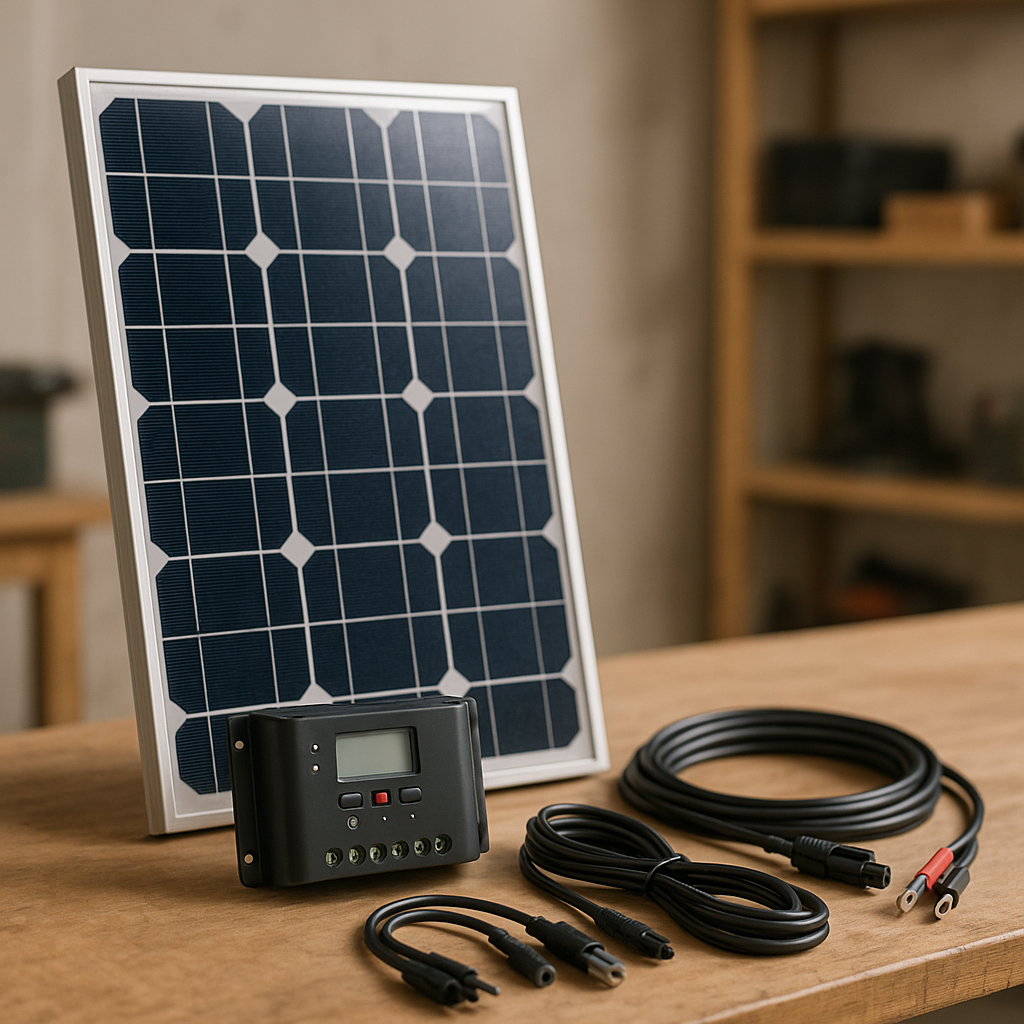
To navigate the world of solar power, we must first become fluent in its language. The primary vocabulary consists of three interrelated terms: Volts (V), Amperes (A), and Watts (W). Grasping their meaning is not merely an academic exercise; it is the key to making informed decisions that ensure your system is both effective and safe.
Imagine electricity as water flowing through a pipe.
This relationship is the cornerstone of all your calculations. When you see a 100-watt solar panel, you now understand that this rating describes the total power it can produce under ideal conditions. For a 12V nominal panel, this might mean it produces roughly 5.5 amps at about 18 volts (5.5A x 18V ≈ 100W). The voltage is higher than 12V to overcome resistance and effectively "push" energy into a 12V battery. Understanding this simple formula empowers you to look at any component's specifications and comprehend its role and capacity within the whole system.
A common point of confusion arises between power (watts) and energy (watt-hours). While they sound similar, they describe different things, and the distinction is vital for sizing your battery and solar panel.
This concept of energy is what truly matters when designing your solar power system. Your solar panel generates power (watts), but over the course of a day, it produces energy (watt-hours). Similarly, your battery does not store watts; it stores watt-hours. A battery's capacity is often given in Amp-hours (Ah). To convert this to the more useful watt-hours, you simply multiply the amp-hours by the battery's voltage. For example, a 100Ah 12V battery can store approximately 1200 watt-hours of energy (100 Ah × 12V = 1200 Wh). By calculating the total watt-hours your devices will consume in a day, you can determine the size of the battery "tank" you need to hold that energy and the size of the solar "engine" required to refill it.
The most common point of failure in a solar power project is not faulty equipment but a failure of imagination—specifically, the failure to accurately imagine and quantify one's own energy needs. Building a system without first conducting a thorough energy audit is like packing for a long journey without knowing the destination or the climate. You might bring a winter coat to the desert. To avoid this, we must become detectives of our own energy habits, meticulously cataloging every device we intend to power. This process transforms an abstract goal ("I want to power my camper") into a concrete, numerical target that guides every subsequent decision.
This audit is an act of self-knowledge. It requires honesty about your usage patterns. Will you really only use that water pump for 10 minutes a day, or is 30 minutes more realistic? Do you need to run your laptop for 8 hours, or is 4 hours sufficient? Small miscalculations can cascade, leading to a system that consistently falls short, causing frustration and potentially damaging your batteries through excessive discharging. The goal is to create a comprehensive list of all 12V DC devices you will run. For each device, you will need to find its power draw in either watts or amps. This information is usually found on a label on the device itself, in its user manual, or through a quick online search. Once you have this, you will estimate how many hours per day you expect to use each device. With these three pieces of information—the device, its power draw, and its daily runtime—you have everything you need to calculate your total daily energy consumption.
The fundamental unit of our audit is the watt-hour (Wh). It is the universal currency of energy that allows us to compare the consumption of a small LED light with that of a large water pump. The process is straightforward.
For each device, you will perform the following calculation:
Let's walk through an example for a small off-grid cabin setup:
Now, you sum the watt-hours for all devices to find your total daily energy requirement: Total Daily Energy = 60 Wh + 12 Wh + 144 Wh + 96 Wh = 312 Wh
This number, 312 Wh, is your target. It is the amount of energy your solar panels must generate and your battery must store and deliver each day.
| Device Example | Power (Watts) | Est. Hours/Day | Daily Energy (Wh) |
|---|---|---|---|
| Interior LED Light | 5 W | 4 h | 20 Wh |
| 12V Refrigerator | 60 W (runs 30% of the time) | 7.2 h (24h * 0.3) | 432 Wh |
| Water Pump | 48 W | 0.5 h | 24 Wh |
| Ventilation Fan | 18 W | 6 h | 108 Wh |
| Laptop Charging (via 12V adapter) | 65 W | 2 h | 130 Wh |
| Phone Charging (2 phones) | 24 W (each) | 1.5 h (each) | 72 Wh |
| Total | 786 Wh |
An energy audit that stops at the simple sum of watt-hours is incomplete. A real-world system is not 100% efficient. Energy is lost as heat in the wires, during the charging and discharging of the battery, and within the charge controller itself. To build a resilient system, we must account for these losses and plan for contingencies, like cloudy days.
System Inefficiencies: A conservative and safe practice is to add a buffer to your total daily energy calculation to account for these inherent losses. A typical lead-acid battery system might be around 85% efficient, while a lithium-based system can be closer to 95% efficient. To simplify, we can apply a general inefficiency factor. A good rule of thumb is to multiply your total daily watt-hours by 1.25 to ensure you generate enough power to cover both your needs and the system's losses.
Days of Autonomy: What happens when the sun doesn't shine? A storm could bring several days of overcast skies, drastically reducing your solar panel's output. "Days of autonomy" refers to the number of days your system can continue to power your devices without any solar input. For a critical system, you might want 3 or more days of autonomy. For a weekend camper, 1 or 2 days might be sufficient. This decision directly impacts the size of your battery bank.
These two adjustments—for inefficiency and autonomy—transform your initial, optimistic calculation into a robust, realistic plan. It ensures that your solar power 12v charger will not just work on a perfect, sunny day, but will provide reliable power through the variable conditions of the real world. This foresight is the difference between a frustrating hobby and a dependable utility.
The solar panel is the most visible component of your system, the silent producer that turns sunlight into usable power. Its selection is a decision that balances efficiency, cost, physical space, and durability. While all solar panels perform the same fundamental task, the technologies they employ and the forms they take vary significantly. Choosing the right panel is not about finding the "best" one in an absolute sense, but about finding the one best suited to the unique demands of your application and the energy target you established in your audit. A panel that is perfect for a large RV roof may be entirely impractical for a portable setup you carry in a backpack.
The primary function of the panel is to replenish the energy your battery uses each day. Therefore, the panel's size (in watts) is directly tied to your daily energy consumption and the amount of sunlight available at your location. This available sunlight is measured in "peak sun hours," which is not simply the number of daylight hours. A peak sun hour is an hour during which the intensity of solar irradiation is 1,000 watts per square meter, the standard used for rating panel output. Locations in the American Southwest might average 5-6 peak sun hours per day, while the Northeast might only get 3-4, especially in winter. Understanding this geographical and seasonal variable is paramount. A 100-watt panel in Arizona will produce significantly more energy over a day than the same 100-watt panel in Maine. Your task is to select a panel or array of panels with enough wattage to meet your "Adjusted Daily Energy" target within the average peak sun hours you can expect.
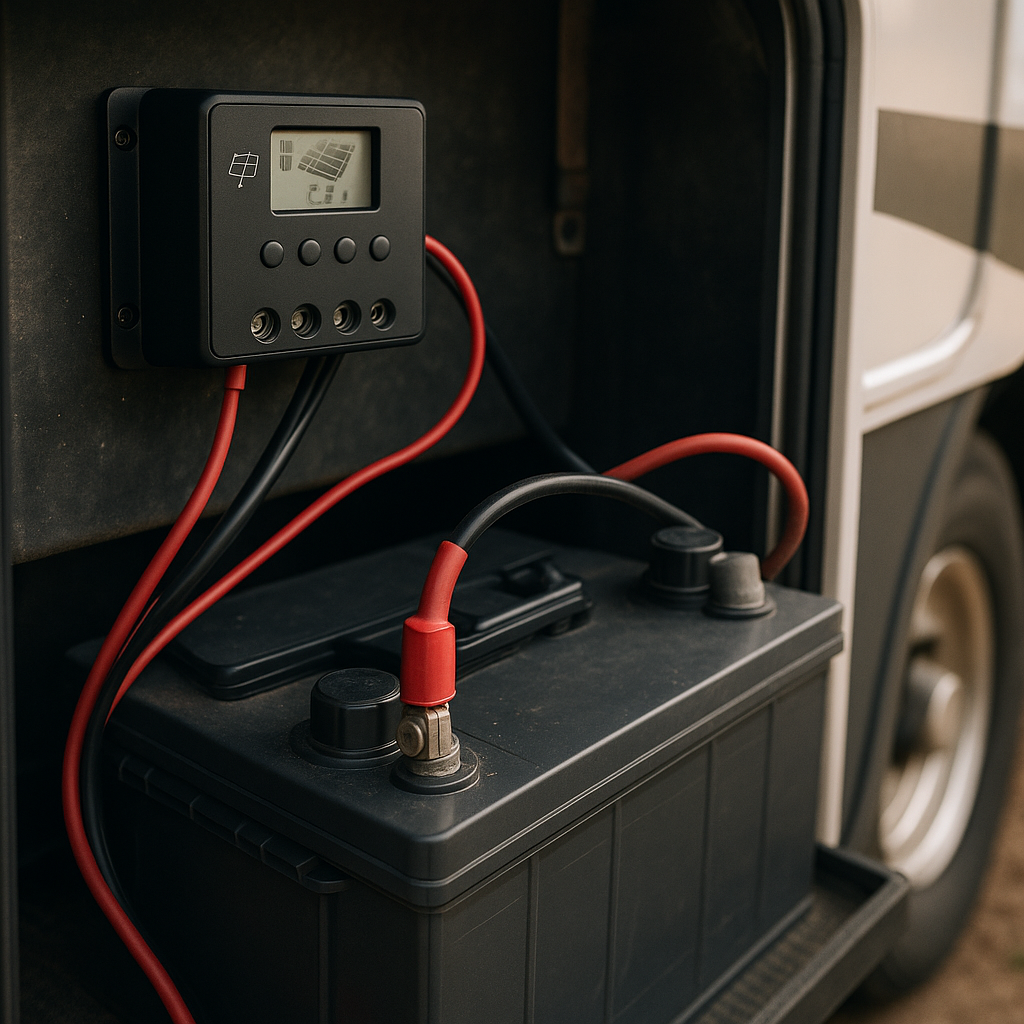
The commercial solar panel market is dominated by three main types of technology, each with a distinct manufacturing process, appearance, and performance profile.
Monocrystalline Panels: These are the elder statesmen of the solar world, known for their high efficiency and distinctive dark, uniform appearance. They are made from a single, pure crystal of silicon. The silicon is formed into a large cylindrical ingot, which is then sliced into thin wafers. Because the crystal is a single, continuous structure, electrons have a clear, unimpeded path to flow, which results in higher efficiency. They typically have efficiency ratings between 18% and 23%. This means they can produce more power in a smaller physical area compared to other types. This makes them the ideal choice for applications where space is at a premium, such as on the roof of a van or a small boat. They also tend to perform slightly better in low-light conditions and have a better temperature coefficient, meaning their performance degrades less in high heat. The trade-off for this premium performance is a higher initial cost.
Polycrystalline Panels: Often recognizable by their blue, marbled appearance, polycrystalline panels are made from fragments of silicon crystals that are melted together and poured into a square mold. This process is less wasteful and less expensive than growing a single crystal. However, the boundaries between the different crystals in the wafer create obstacles for electron flow, which results in lower efficiency, typically in the range of 15% to 18%. To produce the same amount of power as a monocrystalline panel, a polycrystalline panel will need to be physically larger. While their temperature coefficient is slightly worse than monocrystalline, their lower price point makes them a compelling option for larger, stationary installations where space is not a concern and budget is a primary driver.
Thin-Film Panels: This category represents a different approach entirely. Instead of using silicon wafers, thin-film panels are made by depositing one or more thin layers of photovoltaic material onto a substrate like glass, plastic, or metal. Common materials include amorphous silicon (a-Si), Cadmium Telluride (CdTe), and Copper Indium Gallium Selenide (CIGS). Thin-film panels have the lowest efficiency, often between 10% and 13%. However, they offer unique advantages. They can be made flexible, making them suitable for curved surfaces. They are also less affected by high temperatures and shading than their crystalline counterparts. Their lightweight and flexible nature have made them popular for portable and specialized applications, such as roll-up solar chargers for backpacking.
| Feature | Monocrystalline | Polycrystalline | Thin-Film (Amorphous) |
|---|---|---|---|
| Efficiency | Highest (18-23%) | Medium (15-18%) | Lowest (10-13%) |
| Appearance | Uniform black/dark blue | Blue, marbled surface | Dark, uniform, often flexible |
| Space Required | Least | Medium | Most (for same wattage) |
| Cost | Highest | Medium | Lowest |
| Heat Tolerance | Good | Fair | Best |
| Shade Tolerance | Poor | Poor | Better |
| Best Use Case | Space-constrained areas (RVs, boats) | Large, budget-conscious installs | Portable, flexible, curved surfaces |
With your "Adjusted Daily Energy" target from Step 1, you can now calculate the solar panel wattage you need. This calculation hinges on the concept of peak sun hours. You can find maps and charts online from sources like the National Renewable Energy Laboratory (NREL) that provide average daily peak sun hours for your specific location, often broken down by season. It is wise to use the figure for the season with the least sun (usually winter) to ensure your system is viable year-round.
The formula is as follows:
Let's continue with our cabin example. Our adjusted daily energy need is 390 Wh. Let's assume our cabin is in a location that gets an average of 4 peak sun hours per day in the winter.
This calculation tells us that we need a solar panel (or an array of panels) with a total rated output of at least 97.5 watts. To account for less-than-ideal days and to ensure a healthy charging margin, it is a common practice to oversize the panel by about 20-25%.
In this case, a single 120W or 125W panel would be a good choice. If space is tight, you might opt for a high-efficiency 120W monocrystalline panel. If you have more room and a tighter budget, two 60W polycrystalline panels wired in parallel might be a better fit. This calculation provides a solid, data-driven starting point for your selection, moving you from guesswork to a confident decision.
When you look at the specification sheet on the back of a solar panel, you will see a list of electrical ratings that can seem intimidating. However, they are simply a more detailed description of the panel's performance under Standard Test Conditions (STC). The four most important are:
These four values give you a complete electrical picture of the panel. The Voc and Isc are the upper limits for safety and component compatibility, while the Vmp and Imp describe the panel's optimal operating point. A good charge controller, particularly an MPPT model, is designed to operate the panel at or near its Vmp to extract the most power possible throughout the day.
If the solar panel is the heart of your system, the charge controller is unequivocally its brain. This small, often overlooked box performs a task of immense significance: it manages the flow of energy from the variable source of the solar panel to the sensitive chemistry of the battery. Without it, the raw, unregulated power from the panel would quickly destroy the battery through overcharging. On a bright, cold day, a 12V nominal panel can output over 20 volts, a level that would effectively "boil" the electrolyte in a lead-acid battery or cause catastrophic failure in a lithium battery. The charge controller acts as a sophisticated voltage and current regulator, ensuring the battery receives a charging profile that is both safe and efficient, thereby maximizing its performance and lifespan.
Furthermore, the controller prevents reverse current flow. At night, a solar panel, without a controller, would act like a load, and the energy stored in your battery would flow backward out of the panel and dissipate as heat into the night sky. The controller contains a diode or electronic switch that acts as a one-way valve, allowing power to flow only from the panel to the battery. Its role is not passive; it is an active manager, constantly monitoring the battery's state of charge and adjusting its output accordingly. It employs multi-stage charging algorithms—typically Bulk, Absorption, and Float stages—to replenish the battery quickly without causing damage. Choosing the right controller is not just about compatibility; it is about choosing the intelligence that will protect your most expensive component—the battery—and optimize the harvest from your solar investment.
The charge controller market is dominated by two distinct technologies: Pulse Width Modulation (PWM) and Maximum Power Point Tracking (MPPT). While both perform the same basic function, they do so with vastly different levels of sophistication and efficiency.
Pulse Width Modulation (PWM) Controllers: A PWM controller is the simpler and less expensive of the two. It works by acting as a rapid on-off switch between the solar panel and the battery. To regulate the voltage, it uses a series of short pulses. When the battery is low, the "switch" is on most of the time, allowing nearly all of the panel's power to flow through. As the battery's voltage rises to the target absorption level, the controller starts to "pulse" the current, turning the switch on and off thousands of times per second to hold the voltage steady. In essence, a PWM controller pulls the voltage of the solar panel down to match the voltage of the battery.
The main drawback of this method is its inefficiency. Recall that power is volts multiplied by amps (P=V×A). A 12V nominal solar panel has a maximum power voltage (Vmp) of around 18V. If this panel is connected to a 12V battery through a PWM controller, the controller forces the panel to operate at the battery's voltage (e.g., 12.5V). If the panel is producing 5 amps of current, the power delivered to the battery is 12.5V × 5A = 62.5W. However, the panel was capable of producing power at its Vmp of 18V, so its potential output was 18V × 5A = 90W. The PWM controller has effectively wasted over 30% of the panel's potential power. This loss is most pronounced in cold weather when panel voltage is highest. Despite this, PWM controllers are reliable and cost-effective for small, simple systems, typically those with panels of 150W or less and where the panel's nominal voltage matches the battery's nominal voltage.
Maximum Power Point Tracking (MPPT) Controllers: An MPPT controller is a far more sophisticated device. It is essentially a smart DC-to-DC converter. Instead of pulling the panel's voltage down to match the battery, it allows the panel to operate at its maximum power voltage (Vmp), where it is most efficient. The controller constantly monitors the panel's voltage and current and uses an algorithm to find the "maximum power point." It then takes this high-voltage, low-current power from the panel and converts it into the lower voltage and higher current needed to charge the battery.
Let's revisit our example. The MPPT controller allows the 90W panel to operate at its sweet spot of 18V and 5A. It takes this 90W of power and converts it. To charge the 12.5V battery, it transforms the power, increasing the current: 90W / 12.5V = 7.2A. So, while the PWM controller delivered only 62.5W (at 5A), the MPPT controller delivers the full 90W (at 7.2A) to the battery. This represents a significant gain in harvested energy, often up to 30% or more, especially in cooler conditions or when the battery is in a low state of charge. This efficiency allows you to use a smaller panel to get the same charge, or to get more power from your existing panel. MPPT controllers are more expensive, but for any system larger than about 150W, the increase in energy harvest typically justifies the additional cost over the life of the system. They also offer more flexibility, as they can charge a 12V battery bank from a higher voltage solar array (e.g., panels wired in series for 24V or 48V).
Sizing a charge controller is a matter of safety and must be done correctly to prevent immediate and catastrophic failure. There are two key parameters you must consider, both of which are based on the specifications of your solar panel or array.
Amperage Rating: The controller must be able to handle the maximum current your solar panels can produce. This is determined by the Short-Circuit Current (Isc) of your panels. You should also add a safety margin of at least 25% to account for periods of enhanced solar radiation (the "edge of cloud" effect, where sunlight is briefly intensified).
Voltage Rating: The controller must be able to withstand the maximum voltage your solar array can produce. This is determined by the Open-Circuit Voltage (Voc). You must be particularly careful here, as solar panel voltage increases in cold temperatures. Most quality controller manuals will provide a formula or chart for derating the maximum input voltage based on the lowest expected ambient temperature. A rule of thumb is to ensure the controller's max voltage rating is well above the array's total Voc at standard conditions.
Failing to respect the amperage rating will cause the controller to overheat and fail. Exceeding the voltage rating will instantly and permanently destroy the controller. Always read the controller's manual carefully and size it conservatively.
Beyond the core PWM vs. MPPT decision, modern charge controllers offer a range of features that can enhance the performance, safety, and usability of your solar power 12v charger.
The battery is the cornerstone of your system's utility. While the solar panel produces the power, the battery gives that power persistence, allowing you to use it long after the sun has set. It is an energy bank, accepting deposits from the sun during the day and allowing withdrawals on demand. The capacity and health of this bank determine the reliability and autonomy of your entire system. A poor battery choice can cripple an otherwise well-designed system, leading to a short lifespan, frustrating performance, and wasted investment. The selection of a battery goes far beyond simply finding one that is "12V." It is a deep dive into chemistry, cycle life, and the realities of maintenance.
Your energy audit from Step 1 gave you a target for the total energy storage you need in watt-hours (Wh). Now, you must translate that target into a real-world battery or bank of batteries. The capacity of deep-cycle batteries is rated in Amp-Hours (Ah). To convert your Wh target to Ah, you use a simple formula:
However, this number represents the usable capacity. Different battery chemistries have different rules about how much of their total capacity you can safely use. This concept, known as Depth of Discharge (DoD), is perhaps the most important factor in battery selection and longevity. Discharging a battery to 100% (or 0% state of charge) is damaging to all types, but some tolerate deep discharges far better than others. Your choice of battery technology will dictate the actual nameplate capacity you need to buy to achieve your target usable capacity.
The 12V deep-cycle battery market is primarily a contest between two families of chemistry: the long-established lead-acid family and the newer, high-performance lithium-ion family, specifically Lithium Iron Phosphate (LiFePO4).
The Lead-Acid Family: Lead-acid has been the workhorse of the battery world for over a century. It is a proven, reliable, and relatively inexpensive technology. Lead-acid deep-cycle batteries are characterized by their heavy weight and their sensitivity to discharge depth. There are three main types you will encounter:
A critical limitation of all lead-acid batteries is their relationship with Depth of Discharge (DoD). To maximize their lifespan, it is recommended that you do not discharge them beyond 50% of their rated capacity (Powertron Battery Co., 2016). If you consistently discharge them to 80% or more, their cycle life (the number of charge/discharge cycles they can endure) will be drastically reduced from over a thousand cycles to just a few hundred. This means that to get 100Ah of usable capacity from a lead-acid battery, you need to purchase a battery with a nameplate rating of 200Ah.
The Lithium Iron Phosphate (LiFePO4) Advantage: LiFePO4 is a specific and very stable type of lithium-ion battery that has become the new gold standard for deep-cycle applications. It surmounts many of the limitations of lead-acid chemistry.
The primary disadvantage of LiFePO4 has historically been its high upfront cost. However, when you consider their vastly longer cycle life and greater usable capacity, their total cost of ownership over time is often lower than repeatedly replacing lead-acid batteries. For any application that involves frequent and deep cycling, LiFePO4 is the superior long-term investment.
When you buy a battery, you are not just buying a box that holds energy; you are buying a specific number of energy cycles. The relationship between how deeply you discharge the battery (DoD) and how many cycles it will last (cycle life) is the key to understanding its true value.
Consider two 100Ah batteries, one AGM and one LiFePO4.
Despite being twice the upfront cost, the lithium battery delivers nearly five times the total energy over its life, and the cost of that energy is less than half. This economic reality is a powerful argument for choosing lithium, especially for a solar power 12v charger system that will be used heavily.
For larger energy needs, you will often need to connect multiple batteries together to create a single "battery bank." There are two ways to do this, and it is imperative to understand the difference.
When building a battery bank, it is a strict rule that you must use batteries of the exact same make, model, capacity, and age. Mixing different batteries will cause imbalances, leading to one battery being consistently overcharged while another is undercharged, rapidly destroying the entire bank (Powertron Battery Co., 2016). Always start with fresh, identical batteries.
You have done the intellectual work: you have audited your energy needs, selected a panel, a controller, and a battery. Now comes the tangible act of bringing these individual components together into a functioning whole. This stage is where theory meets practice, and a methodical, safety-conscious approach is not just recommended—it is mandatory. Electricity, even at 12 volts, demands respect. A short-circuited 12V battery can release an astonishing amount of energy, capable of melting metal, starting fires, and causing severe injury. Therefore, safety is the first and last principle of assembly.
The goal is to create a circuit with clean, secure connections that minimize energy loss and are protected from overcurrent events. The fundamental path of energy is from the solar panel, through a circuit breaker, to the charge controller's PV terminals. The controller's battery terminals are then connected, through another circuit breaker or fuse, to the battery bank. Finally, your DC loads are connected to the controller's load terminals or, for high-amperage loads, directly to the battery via a fuse block. Each connection must be tight and corrosion-free, and every positive wire must be protected by a correctly sized fuse or breaker placed as close to the power source as possible. This is not a step to rush. Taking the time to crimp connectors properly, use the correct wire gauge, and install safety devices is the hallmark of a professional and durable installation.
There is a specific, unchangeable sequence for connecting the components of your solar charging system. Following this order ensures the charge controller can correctly identify the system voltage and configure itself before high-voltage power from the panel is introduced. Deviating from this order can confuse or even damage the controller.
The order is as follows:
Disconnection is the exact reverse of this process:
Committing this sequence to memory is one of the most important things you can do. Many controller failures are a direct result of connecting the solar panel before the battery.
The wires that connect your components are the arteries of your system. Using wires that are too small (a higher gauge number means a thinner wire) is a common and critical mistake. An undersized wire acts like a constriction, creating resistance to the flow of current. This resistance does two negative things: it generates heat, which is a fire hazard, and it causes "voltage drop," which is a loss of energy.
Voltage drop means that the voltage at the end of the wire is lower than the voltage at the beginning. In a 12V system, every fraction of a volt is precious. A significant voltage drop between your solar panel and controller means less power is available for charging. A drop between your controller and battery means the controller gets an inaccurate reading of the battery's voltage, leading to improper charging. A drop between your battery and your devices means they may not function correctly.
The goal is to keep voltage drop below 3% for the entire circuit. Selecting the correct wire gauge depends on two factors: the amperage the wire will carry and the length of the wire run (round trip). There are numerous online calculators and charts based on the National Electrical Code (NEC) that will tell you the required American Wire Gauge (AWG) for a given amperage and distance to stay within a 3% voltage drop.
For example, for a 15-amp circuit in a 12V system:
Always err on the side of a thicker wire (lower gauge number). The extra cost is minimal compared to the benefits of efficiency and safety. Using a high-quality power conversion solution to run AC devices from your battery also requires careful wire sizing for the DC input side to handle the high current draw.
Fuses and circuit breakers are the essential safety devices in your system. Their sole purpose is to protect the wiring and components from overcurrent situations that could cause a fire. A fuse is a one-time use device that blows to interrupt the circuit, while a circuit breaker is a switch that "trips" and can be reset. Both function to the same end.
A fuse or breaker must be installed on every positive wire connected to the battery's positive terminal.
The rule is simple: fuse for the wire gauge. The fuse's rating must be less than the maximum amperage capacity of the wire it is protecting. For example, a 10 AWG wire is typically rated for 30 amps. You should protect this wire with a 30A fuse or smaller. Placing a 50A fuse on a 30A wire creates a dangerous situation where the wire could overheat and melt its insulation before the fuse blows. Proper fusing is the most important safety measure you will take.
What size solar power 12v charger do I need for a 100Ah battery? The size of the charger (solar panel and controller) depends on how quickly you want to recharge the battery and your available sunlight. A common rule of thumb for a 12V 100Ah battery is to use a 100W to 200W solar panel paired with a 10A to 20A charge controller. A 100W panel in 5 peak sun hours will generate about 30Ah, taking over three days to fully charge an empty battery. A 200W panel could do it in under two days. Your calculation should be based on your daily energy use, not just the battery size.
Can I use a solar panel without a charge controller? It is strongly advised against. A charge controller is essential for protecting your battery from overcharging, which can cause permanent damage, especially to sealed AGM, Gel, or Lithium batteries. It also prevents reverse current at night, where the battery would discharge back through the panel. The only exception is for very small "trickle charge" panels (5W or less) on a large battery, but even then, a small controller is a wise investment for battery health.
How do I connect multiple solar panels? You can connect panels in series or parallel. Parallel connection (positive to positive, negative to negative) adds the current (amps) of the panels together while keeping the voltage the same. This is common for 12V systems using multiple 12V nominal panels. Series connection (positive of one panel to the negative of the next) adds the voltage together while keeping the current the same. This is often used with an MPPT controller, as the higher voltage can be more efficient over long wire runs.
Why is my battery not reaching a full charge? This can be due to several factors. Your solar panel might be undersized for your daily energy consumption. You may be experiencing fewer peak sun hours than anticipated due to weather or shading. Your wiring could be too thin, causing significant voltage drop. There could be a dirty or loose connection somewhere in the system. Finally, your battery itself may be aging and losing its ability to hold a full charge. A systematic check of each component, starting with panel output and ending at the battery terminals, is needed to diagnose the issue.
Can I charge my power tool batteries with a 12V solar system? Yes, but not directly. Power tool batteries (e.g., 18V, 20V) use their own specific chargers that plug into a standard AC wall outlet. To use these chargers with your 12V solar system, you need an inverter. An inverter converts the 12V DC power from your battery into 120V AC power. You would connect the inverter to your battery and then plug the tool charger into the inverter. Ensure the inverter's wattage rating is high enough to handle the power draw of the charger. Some integrated products, like a portable power inverter and charger, are specifically designed for this purpose, simplifying the setup.
What is the difference between PWM and MPPT charge controllers? PWM (Pulse Width Modulation) is a simpler, less expensive technology that essentially pulls the solar panel's voltage down to match the battery's voltage for charging, which can waste a significant portion of the panel's power. MPPT (Maximum Power Point Tracking) is a more advanced technology that converts the panel's optimal high-voltage output into the correct voltage for the battery, capturing up to 30% more energy. For any system over ~150 watts, an MPPT controller is almost always the more cost-effective choice in the long run.
How long will a deep-cycle battery last? The lifespan of a deep-cycle battery is measured in cycles and depends heavily on the battery chemistry and how it's used. A standard lead-acid battery might last 3-5 years or 500-1000 cycles if you regularly discharge it to only 50%. A high-quality Lithium Iron Phosphate (LiFePO4) battery can last 10 years or more, delivering 3000-5000+ cycles even with deep discharges to 80% or more. Proper charging and avoiding prolonged periods in a discharged state are key to maximizing the life of any battery (ChargingChargers.com, 2025).
Constructing a solar power 12v charger is an empowering act. It is a declaration of self-reliance and a practical step toward harnessing the clean, abundant energy that surrounds us. The journey from a collection of individual components to a smoothly functioning system is one of learning and precision. It requires more than just connecting wires; it demands a thoughtful consideration of your own needs, a respect for the principles of electricity, and a commitment to safety. The knowledge you have gained by exploring these steps—from the abstract calculation of a watt-hour to the physical act of crimping a terminal—is the most valuable part of the system. It transforms you from a passive consumer of power to an active, capable producer. This system is more than a convenience; it is a tool that expands your capabilities, a quiet companion that works tirelessly to keep your lights on, your tools running, and your path forward illuminated, wherever it may lead.
{"one"=>"Select 2 or 3 items to compare", "other"=>"{{ count }} of 3 items selected"}