

CONTACT
Please contact us for shipping details.
The selection of an appropriate 36 volt golf cart battery charger is a determination with significant consequences for the longevity and performance of a vehicle's battery pack. This analysis examines the essential criteria for choosing a charger in 2026, navigating the technological landscape that now includes both traditional lead-acid and modern lithium-ion (LiFePO4) deep-cycle batteries. A central consideration is the distinction between the multi-stage charging profiles required for lead-acid batteries and the constant current/constant voltage (CC/CV) method optimal for lithium chemistries. The investigation further explores the implications of amperage ratings on charge duration and battery health, balancing the desire for rapid charging against the risks of thermal degradation. Modern "smart" chargers, equipped with microprocessors and comprehensive safety features like overvoltage and reverse polarity protection, are evaluated for their role in automated, safe, and efficient battery maintenance. The guide also addresses the practicalities of physical connector compatibility across major brands such as EZGO, Club Car, and Yamaha, while weighing the long-term value proposition of warranty, support, and a charger's total cost of ownership.
The process of selecting a 36 volt golf cart battery charger begins not with plugs or power ratings, but with a fundamental understanding of the energy storage system it is meant to serve. To treat the charger as a mere accessory is to misunderstand its role; it is, in a functional sense, the life-support system for your batteries. The most significant distinction in today's market lies between the venerable lead-acid battery and the increasingly prevalent lithium-ion, specifically Lithium Iron Phosphate (LiFePO4), battery. These two technologies, while both serving to power your cart, possess profoundly different internal chemistries and, consequently, demand entirely different methods of replenishment. Using a charger designed for one on the other is not a simple incompatibility; it is a direct path toward diminished performance, shortened lifespan, and in some cases, outright damage.
For decades, the standard for golf carts has been a series of deep-cycle lead-acid batteries, typically six 6-volt batteries linked together to create a 36-volt system. These batteries, whether flooded (requiring distilled water top-ups), AGM (Absorbed Glass Mat), or Gel, all operate on a similar principle of a lead-peroxide plate and a sponge-lead plate submerged in a sulfuric acid electrolyte. Think of charging a lead-acid battery not as simply pouring electricity back in, but as a carefully managed chemical reversal process.
This process is best handled by a multi-stage charging algorithm. Imagine you are trying to fill a large, delicate sponge with water. You can pour water in quickly at first, but as it becomes saturated, you must slow the flow to allow the water to be fully absorbed without spilling over. A smart charger for a lead-acid battery operates in a similar, nuanced fashion.
A charger that lacks these distinct stages, or one that is not properly calibrated for your specific lead-acid batteries, can lead to sulfation (the formation of lead sulfate crystals on the plates when undercharged) or boiling off the electrolyte and corroding the plates (when overcharged).
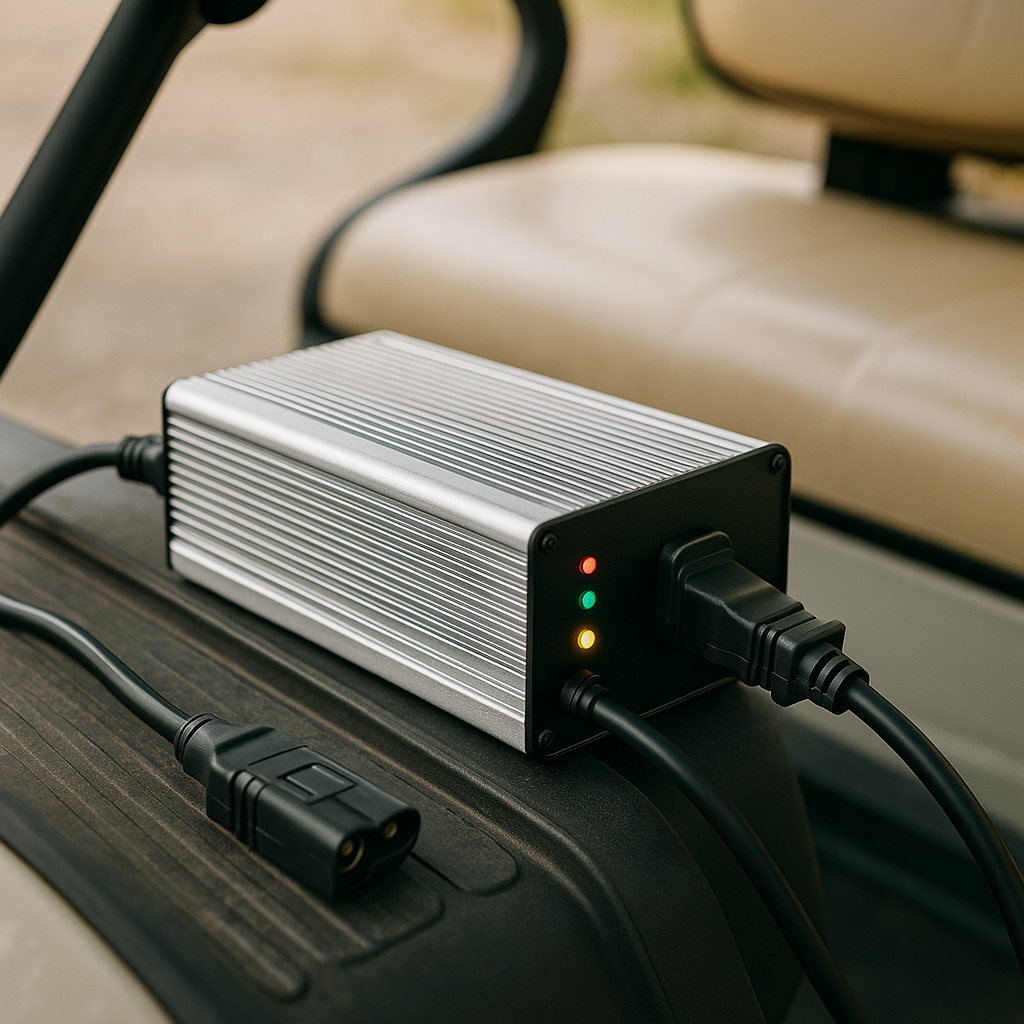
Lithium Iron Phosphate (LiFePO4) batteries represent a significant technological leap. They are lighter, offer more cycles, maintain a more stable voltage throughout discharge, and require virtually no maintenance. Their internal structure and chemistry also dictate a completely different charging philosophy. If a lead-acid battery is a sponge, a LiFePO4 battery is more like a simple bucket. You can fill it at a strong, steady rate until it is full, then you stop. This is known as a CC/CV charging profile.
The brain of the lithium battery system is its Battery Management System (BMS). This internal circuit board is responsible for protecting the cells from over-charging, over-discharging, over-current, and extreme temperatures. It also manages cell balancing, ensuring all cells within the pack are at an equal state of charge. A dedicated lithium charger is designed to communicate effectively with the BMS and follow the precise CC/CV profile it requires.
The application of an incorrect charging profile can have deleterious effects on the battery pack, which is often the single most expensive component of an electric golf cart.
The financial implication is clear: using a $200 charger that is mismatched to your $1,500 battery pack is a false economy that will almost certainly lead to the premature failure of the more valuable component.
| Feature | Lead-Acid Charger Profile | Lithium (LiFePO4) Charger Profile | Implications of Mismatch |
|---|---|---|---|
| Primary Stages | 3-Stage: Bulk, Absorption, Float | 2-Stage: Constant Current (CC), Constant Voltage (CV) | Wrong profile leads to undercharging or overcharging. |
| End of Charge | Transitions to a low-voltage Float/Maintenance mode. | Shuts off completely once charging is finished. | A lead-acid charger's float stage can harm lithium batteries. |
| Voltage Control | Voltages are specifically set for lead-acid chemistry. | Voltages are precisely calibrated for LiFePO4 cells and the BMS. | Incorrect voltage can damage cells and trip BMS protections. |
| Equalization | Some advanced chargers have an equalization mode. | Cell balancing is handled internally by the battery's BMS. | A charger's equalization mode can severely damage lithium cells. |
The core of the matter lies in these profiles. For lead-acid, the process is governed by the battery's internal resistance, which changes as it charges. The absorption stage is a patient process, designed to overcome this rising resistance without forcing too much current, which would cause gassing and heat. The float stage is a recognition of lead-acid's inherent tendency to lose charge over time.
For lithium, the process is more straightforward. The internal resistance is much lower and more stable. The CC/CV method is a direct and efficient way to replenish the cells. The absence of a float stage reflects the very low self-discharge rate of LiFePO4 chemistry. A smart 36 volt golf cart battery charger designed for lithium will respect this, shutting down to protect the battery once its job is done.
Therefore, your first and most important check is to identify your battery chemistry and purchase a charger that explicitly states it is designed for that specific type. Many modern chargers are programmable or have selectable modes for different chemistries, offering flexibility, but you must ensure the correct mode is selected. When in doubt, a dedicated charger for your specific battery type is the safest choice.
Once you have correctly matched the charger's technology to your battery's chemistry, the next critical parameter to consider is the amperage rating of the charger. The amperage, measured in amperes or "amps" (A), is the measure of electrical current. In the context of a 36 volt golf cart battery charger, the amp rating essentially dictates the speed at which it can deliver energy to your batteries. It is analogous to the flow rate of a hose filling a swimming pool; a wider hose with a higher flow rate will fill the pool much faster than a small garden hose. However, just as a torrent of water can cause turbulence and damage the pool liner, a charge current that is too aggressive can generate excessive heat and stress your batteries, ultimately shortening their lifespan.
The capacity of your battery pack is measured in Amp-hours (Ah). A typical 36V lead-acid golf cart battery pack might have a capacity of around 225 Ah. A 36V lithium battery pack designed for the same application might have a capacity of 100 Ah, but because it can be discharged more deeply, it provides a similar range. The relationship between battery capacity, charger amperage, and charge time is straightforward.
A simplified formula to estimate charge time is: Charge Time (in hours) ≈ Battery Capacity (in Ah) / Charger Amperage (in A)
For example, if you have a 225 Ah lead-acid battery pack and a 25A charger, the estimated time to recharge from a fully depleted state would be approximately 9 hours (225 Ah / 25 A = 9 h).
However, this calculation is an oversimplification. It primarily reflects the "bulk" charging phase. As discussed previously, lead-acid batteries require a long absorption phase where the current tapers off. This means the total charge time will be longer than the simple calculation suggests. A full charge for a deeply discharged lead-acid pack can often take anywhere from 8 to 16 hours, depending on the charger's algorithm and the battery's condition (Cartaholics, n.d.). Lithium batteries, on the other hand, can accept a high rate of charge for a much larger portion of their capacity, so the simple formula is a much closer estimate of the actual total charge time. A 100 Ah lithium battery with a 25A charger could realistically be fully charged in about 4 hours.
The "ideal" charge time is a balance between convenience and battery care. For most golf cart owners who use their carts during the day and charge them overnight, a charger that can reliably replenish the batteries in 8-12 hours is perfectly adequate. There is little benefit to a super-fast charge if the cart is going to sit idle for 12 hours anyway.
Consider your usage pattern. Do you need to use the cart for a morning round of golf and then again in the afternoon? In that case, a higher amperage charger that can quickly "top off" the batteries during a lunch break might be beneficial. This is a scenario where lithium batteries particularly excel, as they are much more tolerant of partial, rapid charging cycles (often called opportunity charging) than their lead-acid counterparts.
For a standard 225 Ah lead-acid pack, a charger in the 15A to 25A range is a common and effective choice. A 15A charger might take up to 15-16 hours for a full charge, making it suitable for light users who always charge overnight. A 25A charger reduces that time significantly, offering more flexibility.
Charging is an exothermic process, meaning it generates heat. The higher the amperage, the more heat is generated within the batteries. For lead-acid batteries, excessive heat can accelerate water loss in flooded cells and can hasten the degradation of the internal plates. The internal resistance of the battery creates this heat (P = I²R, where P is power/heat, I is current, and R is resistance). Doubling the charge current can theoretically quadruple the heat generated, illustrating why a moderately paced charge is often healthier for the battery.
A smart 36 volt golf cart battery charger helps manage this by monitoring battery voltage and temperature (if it has a temperature sensor) and adjusting the current accordingly. However, the fundamental physics remain. A slower charge will almost always be cooler and gentler on your batteries.
For lithium batteries, heat is also a primary enemy of longevity. While they can handle higher charge rates, their BMS is designed to protect them from thermal damage. If a charger is too powerful and generates heat faster than the battery pack can dissipate it, the BMS will intervene, throttling back or shutting down the charge cycle entirely. This is why it is crucial to use a charger with an amperage rating that is within the specifications recommended by the battery manufacturer.
Think of it as a long-distance runner versus a sprinter. A slow, steady charge is like a marathon runner who can go for a long time without overheating. A very fast charge is like a sprinter who generates a lot of power and heat in a short burst but cannot sustain it. For the long-term health of your batteries, you want to treat them more like a marathon runner.
While a slower charge is generally better, a charge that is too slow can also be problematic for lead-acid batteries. A charger with a very low amperage (e.g., under 10A for a large 225 Ah pack) may not have enough power to properly agitate the electrolyte during the gassing phase of charging. This mixing is important to prevent stratification, where the heavier acid settles at the bottom of the battery, leading to uneven plate wear and reduced capacity. A general rule of thumb is to use a charger with an output of at least 10% of the battery pack's Ah capacity. For a 225 Ah pack, this would mean a charger of at least 22.5A is preferable to ensure a healthy charge. Most experts recommend a charger with a minimum of 15 amps for any standard 36V golf cart battery pack to ensure it can overcome the battery's internal resistance and execute a proper charging algorithm (Cartaholics, n.d.).
Ultimately, the choice of amperage comes down to a deliberate calculation of your needs. For the average user, a charger in the 18-25A range for a 36V system provides an excellent balance of reasonable charge times and long-term battery care.
In the evolution of battery maintenance, perhaps no development has been more significant than the transition from "dumb" manual chargers to modern "smart" chargers. A vintage charger from a few decades ago was often little more than a transformer and a rectifier, pushing a relatively constant voltage into the batteries with no ability to sense their state or adjust its output. This placed the entire burden of responsibility on the user to monitor the process and unplug the charger at the right time—a recipe for human error leading to undercharged or, more often, overcharged and damaged batteries.
Today, a high-quality 36 volt golf cart battery charger is a sophisticated piece of electronic equipment. Its intelligence stems from an onboard microprocessor that acts as the brain of the operation. This microprocessor constantly monitors the battery pack's voltage, its acceptance of current, and sometimes its temperature, using this real-time data to execute a precise, software-defined charging algorithm. This is what transforms the charger from a blunt instrument into a skilled technician, capable of optimizing every phase of the charging cycle for maximum efficiency and battery longevity.
The "smart" capabilities of a modern charger are what enable the multi-stage charging profiles discussed earlier. Let's revisit this through the lens of the microprocessor's decision-making process for a lead-acid battery:
This automated, data-driven process removes the guesswork and potential for error, ensuring a perfect charge every time. For lithium batteries, the process is similar but follows the CC/CV profile, with the microprocessor ensuring the transition from constant current to constant voltage happens at the precise moment the cells reach their peak voltage, and then shutting down completely when the current falls, all in concert with the battery's own BMS.
Beyond optimizing the charge, the microprocessor in a smart charger also serves as a vigilant safety sentinel. The battery pack in your golf cart is a significant store of energy, and charging it involves handling substantial electrical power. A quality 36 volt golf cart battery charger will incorporate a suite of protection circuits that can prevent costly damage to both the charger and the batteries, and even prevent hazardous situations. Many modern chargers, such as those from KEMIMOTO, integrate a comprehensive set of these features (Kemimoto, n.d.).
| Safety Feature | Function and Purpose | Potential Consequence if Absent |
|---|---|---|
| Overvoltage Protection | Shuts down the charger if its output voltage exceeds a safe limit. | Can "cook" the batteries, boiling off electrolyte in lead-acid or damaging cells in lithium. |
| Overcurrent Protection | Limits the output current to the charger's rated maximum. | Can overheat the charger's internal components, leading to failure. |
| Short Circuit Protection | Instantly cuts power if the output leads are shorted together. | Prevents dangerous sparks, fire hazard, and catastrophic damage to the charger. |
| Reverse Polarity Protection | Prevents current from flowing if the charger is connected to the batteries backward (positive to negative). | Prevents severe damage to the charger's electronics and the battery's BMS or cells. |
| Overheating Protection | Monitors the internal temperature of the charger and reduces power or shuts down if it gets too hot. | Prevents charger failure due to use in a hot environment or with blocked ventilation. |
These protections are not luxury features; they are fundamental requirements for a safe and reliable charging system. They work in the background to guard against common mistakes and unexpected electrical faults, providing peace of mind and protecting your valuable equipment.
For lead-acid batteries, the ideal charging voltage changes with temperature. A cold battery requires a slightly higher charging voltage to fully accept a charge, while a hot battery requires a slightly lower voltage to prevent overcharging and excessive gassing. A truly advanced 36 volt golf cart battery charger for lead-acid systems will include a remote temperature sensor. This is a small probe that you attach directly to one of the battery terminals. The charger's microprocessor uses the data from this sensor to adjust its charging voltages in real time.
This feature is particularly valuable for cart owners in climates with wide temperature swings. It ensures that on a cold winter morning or a hot summer afternoon, your batteries are receiving the optimal voltage for their condition, which can have a substantial positive impact on their overall service life. Lithium batteries are less sensitive to this, and their charging is typically restricted below freezing anyway, so temperature compensation is a feature primarily associated with high-end lead-acid chargers.
Golf carts are often washed, driven in the rain, and stored in damp or dusty garages. The charger, whether on-board or portable, is exposed to these same environmental challenges. To quantify a charger's resistance to these elements, manufacturers use the Ingress Protection (IP) rating system. An IP rating consists of two numbers.
For a golf cart charger, a rating of IP67 is considered excellent .
A charger with an IP67 rating, often housed in a sealed aluminum casing, is built to withstand the rigors of its environment. It can handle being splashed, rained on, or exposed to a dusty garage without its internal electronics being compromised. This level of durability is a key indicator of a well-engineered, high-quality product designed for a long service life.
After navigating the complex internal chemistries and electronic intelligence of chargers, we arrive at the most tangible and immediate point of connection: the physical plug. It is a seemingly simple detail, but choosing a 36 volt golf cart battery charger with the wrong connector is like having a key for the wrong car; no matter how well-engineered it is, it simply will not work. The world of golf carts, despite being dominated by a few major manufacturers, has not standardized on a single charging plug. Over the years, different brands have adopted different proprietary or semi-proprietary connectors for their 36V systems.
Identifying the correct plug for your cart is a crucial, non-negotiable step. Using the wrong plug, even if it seems to fit, can result in a poor connection, arcing, or incorrect polarity, all of which pose significant safety risks and can damage the charger, the cart's charging receptacle, or the batteries.
Before you even begin shopping, the most effective action you can take is to take a clear photograph of your golf cart's charging port (the receptacle on the cart itself). This visual reference will be your single most valuable tool. While there are dozens of minor variations, the 36V market is largely centered around a few common styles.
Many reputable charger manufacturers and retailers, such as FORM Charge, provide clear visual guides and compatibility lists that match these plug types to specific golf cart makes, models, and years (FORM Charge, n.d.). When purchasing your 36 volt golf cart battery charger, comparing the plug on the charger to the photo of your cart's receptacle is the best way to guarantee a perfect match. Some chargers are sold with interchangeable adapter cords, offering flexibility, but you must confirm the correct adapter for your cart is included.
While many third-party charger manufacturers produce excellent products, it is helpful to understand the landscape of the major golf cart original equipment manufacturers (OEMs).
Third-party charger manufacturers design their products to be direct replacements for these OEM chargers, often offering more advanced features or better value. The key is that they build them with the correct, brand-specific connector to ensure a seamless, plug-and-play experience.
Another practical consideration is the form factor of the charger. Your choice will be between an on-board unit and a traditional portable, or "shelf," charger.
Portable (Shelf) Chargers: This is the classic style—a standalone box with a handle, an AC power cord, and a DC cord with the golf cart plug.
On-Board Chargers: These are smaller, more compact units designed to be permanently mounted inside the golf cart's body. An AC power cord is then run from the charger to a port on the cart's exterior, where you simply plug in a standard extension cord to charge.
The decision often comes down to your specific use case. If your cart never leaves your property and is always parked in the same spot in your garage, a portable charger is a simple and reliable solution. If you take your cart to different locations, use it at a vacation home, or value the convenience of just plugging in an extension cord, an on-board charger is an excellent choice. Many modern, high-quality on-board chargers are fully sealed (with high IP ratings) and designed to handle the vibration, making them just as reliable as their portable counterparts.
You may encounter so-called "universal" chargers that come with a variety of adapter tips. While these can seem like a flexible solution, they introduce more points of potential failure. Each connection between the main cord and an adapter tip is a place where resistance can build, or a loose fit can develop. For a high-current application like charging a 36V battery pack, a dedicated charger with a single, permanently affixed, high-quality connector designed for your specific cart is almost always the more robust and safer long-term solution. The integrity of that final connection is paramount to a safe and efficient charge.
In the calculus of purchasing a 36 volt golf cart battery charger, it is tempting to let the upfront sticker price be the dominant factor. Cheaper options are readily available, and on the surface, they promise to perform the same basic function as their more expensive counterparts. However, this perspective is often a shortsighted one. A golf cart charger should not be viewed as a disposable commodity but as a long-term investment in the health and vitality of your battery pack—which is, by a significant margin, the most expensive and critical component of your cart's electric powertrain. A thoughtful assessment of value extends far beyond the initial purchase price to include the charger's impact on battery lifespan, the robustness of its warranty, and the availability of reliable support.
Imagine two chargers. Charger A costs $150, and Charger B costs $300. The immediate choice seems obvious. But let's consider the system they support: a new lead-acid battery pack costing $1,200 with an expected lifespan of 500 charge cycles.
Charger A is a basic model with a less sophisticated charging algorithm and minimal safety features. Its less-than-optimal charging profile (e.g., an abbreviated absorption stage or an incorrect float voltage) consistently undercharges or overcharges the batteries. This added stress reduces the battery pack's effective lifespan by 30%, from 500 cycles down to 350 cycles.
Charger B is a high-quality smart charger with a precision multi-stage algorithm, temperature compensation, and a full suite of safety protections. It consistently delivers an optimal charge, allowing the battery pack to achieve its full expected lifespan of 500 cycles.
Let's analyze the true cost:
In this realistic scenario, the "cheaper" charger actually resulted in a system that was nearly 30% more expensive to operate over its lifetime, not to mention the inconvenience of having to replace the batteries much sooner. The slightly higher initial investment in a quality charger acts as an insurance policy for the much larger investment in your batteries. This principle holds even more true for expensive lithium battery conversions, where a single mistake by a low-quality charger could potentially damage a battery pack worth thousands of dollars. The true value of a 36 volt golf cart battery charger lies in its ability to maximize the life and performance of your batteries.
A manufacturer's warranty is a direct statement of the confidence they have in their own product's quality and durability. When evaluating a charger, look beyond the simple duration of the warranty and consider the substance of what is being offered.
A strong warranty is not just about getting a free replacement if something breaks; it is an indicator of the engineering and component quality of the charger itself.
What happens when your charger's indicator lights are blinking in a pattern you do not recognize? What if you are unsure if your batteries are accepting a charge correctly? This is where the value of accessible and knowledgeable support becomes evident.
When you purchase a charger from a generic online marketplace or a big-box store, you are often left on your own to troubleshoot problems. The seller may have no specific knowledge of golf cart electrical systems.
Conversely, purchasing from a specialist retailer provides you with a resource. A good retailer can help you:
This expertise is an intangible but incredibly valuable part of the purchase. It can save you hours of frustration and potentially prevent you from making a costly mistake.
Finally, consider your long-term plans for your golf cart. Are you currently using lead-acid batteries but thinking about upgrading to lithium in the next year or two? If so, it may be prudent to invest in a 36 volt golf cart battery charger that can accommodate both. Many modern, high-end chargers are "multi-chemistry," meaning they have selectable modes for different battery types, including Flooded Lead-Acid, AGM, and LiFePO4.
By purchasing a charger with this flexibility, you make a single investment that can serve you both now and after a future battery upgrade. This prevents the need to buy a second charger down the road, saving you money and ensuring you have a high-quality unit ready for your new lithium pack. This kind of forward-thinking approach embodies the principle of long-term value, ensuring your charging solution evolves with your needs.
1. Can I use a 48V charger for my 36V golf cart batteries?
Absolutely not. You must always match the charger's voltage to the nominal voltage of your battery pack. Using a 48V charger on a 36V battery system will create a severe overvoltage condition. This will cause lead-acid batteries to violently gas, overheat, and boil their electrolyte, permanently damaging the plates. For lithium batteries, it would immediately trigger the Battery Management System's (BMS) overvoltage protection, and if that were to fail, it could lead to catastrophic cell damage and a potential fire hazard.
2. How can I tell if my 36 volt golf cart battery charger is working correctly?
There are several signs of a properly functioning charger. You should hear a low humming sound from the internal fan and transformer when it is running. The charger's casing will become warm to the touch, but it should not be excessively hot. Most importantly, modern smart chargers have indicator lights that communicate their status. These lights will typically show when the charger is connected to AC power, when it is actively charging, and when the charge is complete (often by a solid green light or a blinking pattern). You can also use a multimeter to check the voltage of your battery pack before and during charging; you should see the voltage steadily rise during the bulk charge phase.
3. How long does it take to fully charge a 36V golf cart?
The charge time depends on two main factors: the amp-hour (Ah) capacity of your battery pack and the amperage (A) rating of your charger. A rough estimate can be found by dividing the Ah capacity by the charger's amps. For example, a common 225 Ah lead-acid pack with a 25A charger will take approximately 9-10 hours for the main charge, plus several more hours for the tapering absorption stage. A complete charge from a deep discharge can take up to 16 hours. A 100 Ah lithium pack with the same 25A charger could be fully charged in about 4 hours.
4. Is it okay to leave my golf cart plugged in all the time?
If you have a modern, automatic, "smart" charger, then yes. These chargers are designed to complete the charge cycle and then transition into a "float" or "maintenance" mode (for lead-acid) or shut off completely (for lithium). In this state, they will not overcharge the batteries. It is perfectly safe and often recommended to leave them plugged in to ensure the batteries are always topped off and ready to go. However, if you have an older, manual charger without automatic shut-off, you must unplug it once the batteries are full to prevent severe damage from overcharging.
5. What happens if I use a lead-acid charger on my new lithium golf cart batteries?
Using a charger designed for lead-acid batteries on a lithium (LiFePO4) battery pack is not recommended and can be harmful. A lead-acid charger's profile is different; it may not charge the lithium battery to its full capacity because its absorption voltage might be too low. More critically, the "float" stage on a lead-acid charger continuously applies a voltage to the battery. This is unnecessary for lithium batteries, which have a very low self-discharge rate, and holding them at a high voltage can cause stress to the cells and potentially reduce their overall lifespan.
6. Why is my golf cart charger getting very hot?
It is normal for a charger to become warm during operation as the electrical components generate heat. A cooling fan is used to dissipate this heat. However, if the charger becomes too hot to comfortably touch, it could indicate a problem. Common causes include poor ventilation (e.g., operating the charger in a tight, enclosed space or with the fan blocked), a fault within the charger itself, or an issue with the batteries (such as a high-resistance shorted cell) causing the charger to work too hard. Ensure the charger has plenty of space for air to circulate around it.
7. Can I use a regular car battery charger on my golf cart?
No, you should not use a standard 12V car battery charger for your 36V golf cart battery pack. There are two primary reasons. First, the voltage is incorrect. A 12V charger cannot provide the necessary voltage (over 44V) to charge a 36V series of batteries. Second, car chargers are designed for shallow-cycle "starting" batteries, not deep-cycle batteries. They typically have a very aggressive, high-amperage profile that is not suitable for the slow, deep replenishment that golf cart batteries require.
The journey to selecting the right 36 volt golf cart battery charger is one that requires more than a simple matching of plugs and prices. It demands a thoughtful consideration of the technology that powers your cart and an appreciation for the charger's role as a caretaker for that technology. As we have explored, the distinction between lead-acid and lithium chemistries forms the primary branching point in this decision, with each path requiring a specific and carefully executed charging algorithm. Understanding the interplay of amperage and charge time allows for a deliberate choice that balances convenience with the long-term health of your batteries.
Furthermore, the sophisticated intelligence of modern smart chargers, with their protective safety features and environmentally-aware construction, represents a significant evolution from the manual devices of the past. These features are not mere conveniences; they are essential safeguards for your investment. The practicalities of brand-specific connectors and the choice between on-board and portable units ground these technical considerations in the day-to-day use of your vehicle.
Ultimately, viewing the charger not as an afterthought but as an integral part of your golf cart's power system is the key. A well-chosen charger, matched to your batteries and your needs, will work quietly in the background, ensuring that every time you turn the key, your cart is ready and able to perform, preserving the life of your batteries and delivering value far beyond its initial cost.
Cartaholics. (n.d.). 36 Volt golf cart battery charger recommendations. Cartaholics Golf Cart Forum. Retrieved January 15, 2026, from https://cartaholics.com/threads/36-volt-golf-cart-battery-charger-recommendations.15168/
FORM Charge. (n.d.). 36 Volt Golf Cart Chargers. Retrieved January 15, 2026, from
KEMIMOTO. (n.d.). KEMIMOTO 36V Golf Cart Battery Charger. Retrieved January 15, 2026, from
Manly Battery. (2025, October 23). 2025 How to Choose a Deep Cycle Battery.
McDonald, R. (2016). FY 2015 annual progress report for vehicle systems program. U.S. Department of Energy.
{"one"=>"Select 2 or 3 items to compare", "other"=>"{{ count }} of 3 items selected"}