

CONTACT
Please contact us for shipping details.
Selecting an appropriate deep cycle battery charger is a determining factor in the longevity and operational efficiency of deep cycle batteries. This analysis examines the critical parameters for choosing a charger, emphasizing the necessity of matching the charger’s technology to the specific chemistry of the battery, such as flooded lead-acid (FLA), absorbed glass mat (AGM), gel, and lithium iron phosphate (LiFePO4). It explores the significance of multi-stage charging profiles—bulk, absorption, and float—and the role they play in optimizing the charge cycle while preventing damage from over or undercharging. The relationship between a charger's amperage output and the battery bank's capacity, measured in amp-hours (Ah), is detailed as a crucial element for efficient and safe charging. Furthermore, the importance of advanced features like temperature compensation is discussed, illustrating how environmental factors influence charging voltage. The objective is to provide a comprehensive framework for making an informed decision that protects the battery investment and ensures reliable, sustained power.
There is a quiet and often overlooked component at the heart of every great adventure that relies on independent power. Whether you are navigating a glassy lake at dawn in your trolling boat, setting up a remote campsite under a canopy of stars with your RV, or ensuring your off-grid cabin remains a sanctuary of light and warmth, the deep cycle battery is your silent partner. It is the reservoir of energy that powers your experiences. Yet, this reservoir can run dry, and how it is replenished is a matter of profound consequence for its health and lifespan. We often spend a great deal of time and resources selecting the perfect battery, but what about the device tasked with nourishing it? Have you ever considered that the deep cycle battery charger you use is not merely an accessory but the very life-support system for your power investment?
To appreciate the role of a specialized charger, one must first grasp the fundamental distinction between a deep cycle battery and its more common automotive counterpart, the starting, lighting, and ignition (SLI) battery. An SLI battery is designed for a single, Herculean task: to deliver a massive burst of energy for a few seconds to crank an engine. It is a sprinter. A deep cycle battery, conversely, is a marathon runner. It is engineered with thicker plates and a denser active material to provide a steady, reliable current over many hours, capable of being discharged to a significant depth (often 50% or more) and then recharged, hundreds or even thousands of times.
Using a standard car battery charger on a deep cycle battery is akin to feeding a marathon runner a sprinter's diet; it might provide energy, but it lacks the specific nutrients for long-term health and can cause harm over time. The charging requirements are fundamentally different. A dedicated deep cycle battery charger is an intelligent device, a sophisticated nutritionist for your battery, that understands its unique needs. It does not simply dump power into the cells; it manages the flow, adjusts the voltage, and monitors the battery's state, guiding it through a carefully orchestrated process to ensure a full, safe, and life-extending charge. This guide will explore the seven critical factors you must consider when selecting this unsung hero, ensuring your power source remains robust and ready for whatever lies ahead.
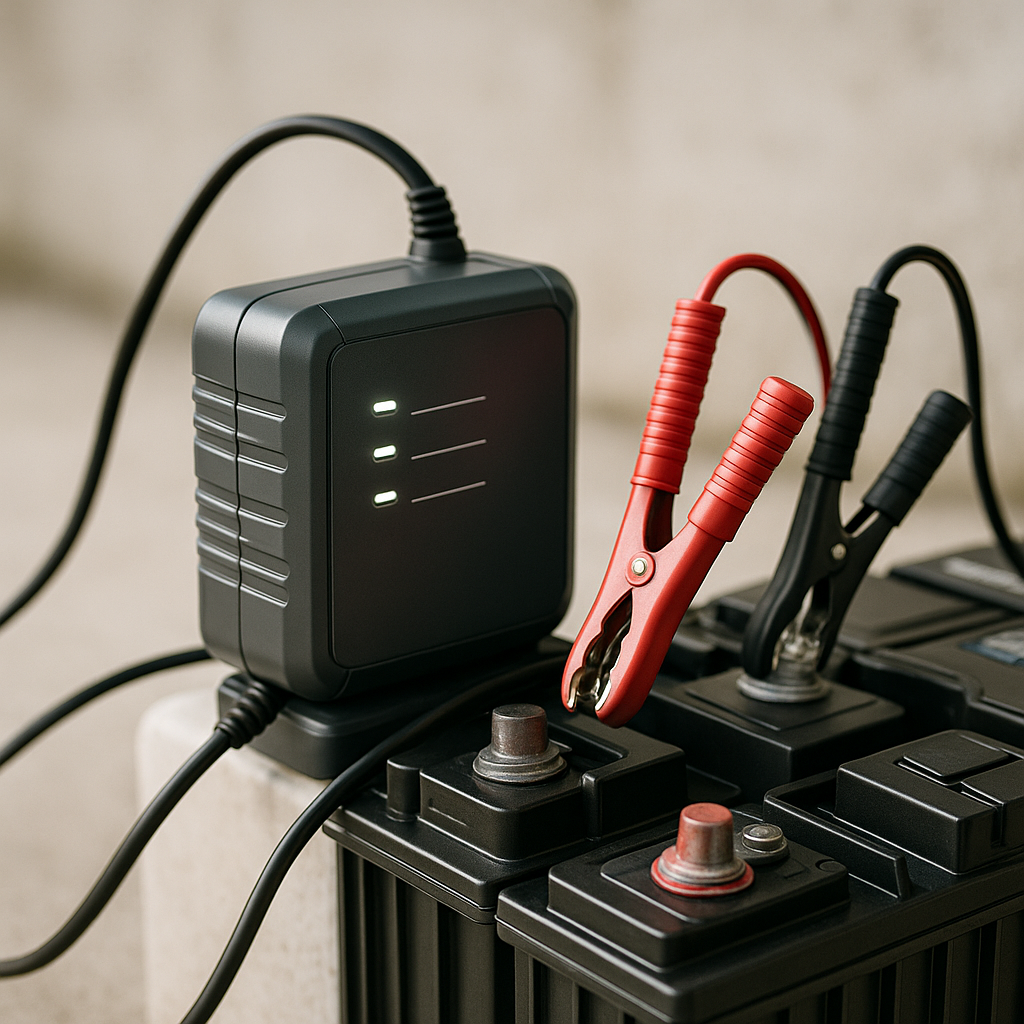
The world of deep cycle batteries is not monolithic. It is a diverse ecosystem of different chemical technologies, each with its own personality, its own strengths, and, most critically, its own unique charging requirements. Think of these different battery chemistries as individuals who speak different languages. A charger that only "speaks" the language of a flooded lead-acid battery will fail to communicate effectively with a sensitive gel battery or a modern lithium battery. This miscommunication does not just lead to inefficient charging; it can lead to permanent damage and a drastically shortened lifespan. Therefore, the first and most foundational step in choosing a deep cycle battery charger is to ensure it is compatible with, and preferably has dedicated settings for, your specific battery chemistry.
Flooded lead-acid batteries are the oldest, most traditional, and often most affordable deep cycle technology. They are true workhorses, known for their durability and ability to withstand a certain amount of abuse. Inside, lead plates are suspended in a liquid electrolyte (sulfuric acid and water). This design means they require regular maintenance, including topping off with distilled water as it is consumed during the charging process.
A key characteristic of FLA charging is the "gassing" phase. As the battery nears full charge, the charging process creates hydrogen and oxygen gas. A proper deep cycle battery charger designed for FLA batteries anticipates this and manages it. More importantly, FLA batteries benefit from a special charging phase called "equalization." Over time, slight inconsistencies in the cells can lead to stratification of the electrolyte and sulfation on the plates. An equalization charge is a controlled overcharge at a higher voltage, which causes the electrolyte to bubble (mixing it) and helps dissolve sulfate crystals. A charger without an equalization mode cannot perform this vital maintenance, leading to a gradual decline in the battery's capacity.
AGM batteries represent a significant evolution from their flooded ancestors. They are a type of Valve Regulated Lead-Acid (VRLA) battery, meaning they are sealed. The electrolyte is not free-flowing but is absorbed into fine fiberglass mats pressed between the lead plates. This design makes them spill-proof and mountable in any orientation.
The magic of an AGM battery lies in its internal oxygen recombination cycle. During charging, oxygen produced at the positive plate travels through the mat to the negative plate, where it recombines with hydrogen to form water. This prevents the loss of water, making the battery maintenance-free. However, this delicate process is highly sensitive to charging voltage. If the voltage from the deep cycle battery charger is too high, it can force the battery to vent gas through its safety valves. Since you cannot replace the lost electrolyte in a sealed battery, this venting causes irreversible capacity loss. A proper AGM charging profile uses a slightly lower voltage than FLA batteries and never includes an equalization charge, which would swiftly destroy it. The charger must supply a clean, stable voltage, as excessive AC ripple can cause internal heating of the mat, another source of damage.
Gel batteries are the other common type of VRLA battery. In this design, silica is added to the electrolyte to create a thick, gel-like substance. This makes them extremely resistant to vibration and shock, and like AGM batteries, they are sealed and maintenance-free. Gel batteries are prized for their excellent performance in very deep discharge applications.
However, they are the most sensitive of all lead-acid chemistries when it comes to charging. The gelled electrolyte has a higher internal resistance, and the charging voltage must be carefully controlled. The voltage required for a Gel profile is even lower than that for an AGM. An excessively high charging rate or voltage can create voids or pockets in the gel electrolyte that are next to the plates, which can lead to a permanent loss of capacity. Even a standard AGM charging profile can be too aggressive for a Gel battery. A premium deep cycle battery charger will have a distinct, selectable "Gel" setting that provides the gentle, precise voltage these stable performers require to thrive.
LiFePO4 is a specific type of lithium-ion battery that has revolutionized the deep cycle market. It is significantly lighter, offers a much longer cycle life (often 3,000 to 5,000 cycles compared to 300-1,000 for lead-acid), and can be safely discharged much more deeply without ill effect. Its charging needs are radically different from any lead-acid chemistry.
LiFePO4 batteries do not require a multi-stage charging profile in the same way lead-acid batteries do. Their ideal charge method is a two-stage process: Constant Current (CC) followed by Constant Voltage (CV). During the CC phase, the charger supplies its maximum rated current until the battery voltage reaches a specific level (e.g., 14.4V). Then, it switches to the CV phase, holding that voltage steady while the current naturally tapers off. Once the current drops to a very low level, the battery is full, and the charger should shut off completely. LiFePO4 batteries do not need a "float" or "equalization" charge. A continuous float charge, even at a low voltage, can cause stress to the cells over long periods.
Every LiFePO4 battery contains a critical component called a Battery Management System (BMS). The BMS is an onboard computer that protects the cells from over-voltage, under-voltage, over-current, and extreme temperatures. A "LiFePO4-compatible" deep cycle battery charger is designed to work in harmony with the BMS, providing the correct CC/CV profile and shutting off when the job is done.
| Feature | Flooded Lead-Acid (FLA) | Absorbed Glass Mat (AGM) | Gel | Lithium (LiFePO4) |
|---|---|---|---|---|
| Typical Absorption Voltage | 14.4V - 14.8V | 14.2V - 14.6V | 14.0V - 14.2V | 14.4V - 14.6V (CV Stage) |
| Typical Float Voltage | 13.2V - 13.5V | 13.2V - 13.8V | 13.5V - 13.8V | None (Charger should shut off) |
| Equalization Required? | Yes, periodically | No, will cause damage | No, will cause damage | No, will cause damage |
| Charging Speed Sensitivity | Tolerant | Moderately Sensitive | Very Sensitive | Tolerant (within BMS limits) |
| Maintenance | Regular water top-ups | None | None | None |
Once you have identified a charger that speaks the right chemical language, the next critical consideration is its power, or more specifically, its amperage (amp) rating. The amp rating of a deep cycle battery charger determines the rate at which it delivers current to the battery. Think of your battery as a swimming pool and the charger as the hose you use to fill it. A small garden hose will eventually fill the pool, but it will take a very long time. A massive fire hose will fill it quickly, but the force of the water might damage the pool liner. The goal is to find a hose that is just the right size—powerful enough to fill the pool in a reasonable time without causing any harm.
Sizing your charger correctly is a balancing act. It is about matching the charger's output to the battery bank's ability to accept a charge. This ability is directly related to the battery's total capacity, which is measured in Amp-hours (Ah). A battery with a 100 Ah capacity can, in theory, supply 1 amp of current for 100 hours, or 10 amps for 10 hours. This capacity (Ah) is the key number you need to size your charger.
For lead-acid deep cycle batteries (FLA, AGM, and Gel), a widely accepted guideline for charger sizing is to select a deep cycle battery charger with an amp rating that is between 10% and 25% of the total battery bank capacity in Amp-hours.
Let's break this down with an example. Suppose you have a single 100 Ah deep cycle battery.
If you have multiple batteries connected in parallel to form a larger battery bank, you must use the total capacity. For instance, four 100 Ah AGM batteries wired in parallel create a 400 Ah battery bank.
For LiFePO4 batteries, the rule is more flexible, as their BMS can handle higher charge rates. Many manufacturers specify a recommended charge rate, often around 50% (or 0.5C, where C is the capacity). A 100 Ah LiFePO4 battery could therefore be comfortably charged with a 50-amp charger, resulting in a much faster charge time of about two hours. However, it is always best to consult the battery manufacturer's specifications.
Using a charger with too low an amp rating (the "garden hose" scenario) presents several problems, especially for lead-acid batteries.
Using a charger that is too powerful (the "fire hose" scenario) is equally, if not more, dangerous.
Choosing the right size is not about getting the biggest charger you can find; it is about finding the one that fits the specific needs of your battery capacity (Ah). It is a critical calculation that directly impacts both charging efficiency and the long-term health of your entire power system.
A modern, high-quality deep cycle battery charger is often called a "smart" charger, and for good reason. It does not just apply a brute-force current to the battery terminals. Instead, it acts like a skilled technician, employing a sophisticated, multi-stage charging algorithm to replenish the battery's energy. This process is far more effective and safer than the simple, constant-voltage charging of older or cheaper models. To understand the value of a smart charger, one must understand the purpose of each stage in its charging profile. Imagine it not as a single action, but as a carefully planned three-course meal designed for optimal battery health.
This is the first and most powerful stage of the charging process. When you connect the charger to a discharged battery, it enters the Bulk stage. During this phase, the charger delivers its maximum rated current (e.g., all 25 amps from a 25-amp charger) to the battery. This constant current flow causes the battery's voltage to rise steadily. The Bulk stage does the heavy lifting, quickly replenishing the majority of the battery's capacity. This phase continues until the battery's voltage reaches a predetermined level, typically around 14.4V-14.8V for a 12V lead-acid battery. By the end of the Bulk stage, the battery is roughly 80% charged. It is the fastest and most efficient part of the cycle.
Once the battery's voltage hits the target setpoint, the deep cycle battery charger intelligently transitions to the Absorption stage. If the Bulk stage was about constant current, the Absorption stage is about constant voltage. The charger will now hold the voltage steady at that peak level (e.g., 14.4V) and allow the battery's internal resistance to dictate the current. As the battery becomes more saturated with charge, it will naturally accept less and less current.
Think of it like filling a glass of water. You can pour quickly at first (Bulk), but as you get near the top, you must slow down the flow to avoid spilling (Absorption). This stage is critical for "topping off" the final 20% of the battery's capacity. It ensures that all the cells are brought to a full and equal state of charge. This stage is often on a timer or ends when the current drops below a certain threshold, indicating the battery is full. Skipping or shortening this stage is a common cause of chronic undercharging and sulfation in lead-acid batteries.
After the Absorption stage is complete, the battery is fully charged. If left connected, a smart charger will then transition to the final stage: Float. In this phase, the charger reduces the voltage to a much lower, safe level (e.g., 13.2V-13.8V for a 12V lead-acid battery). This lower voltage is not high enough to actively charge the battery but is just enough to provide a small trickle of current to counteract the battery's natural self-discharge.
The Float stage allows you to leave the charger connected to the battery indefinitely for maintenance without any risk of overcharging or damaging it. It keeps the battery in a state of readiness, ensuring it is 100% full whenever you need it. This is particularly useful for batteries in storage over the winter or in backup power applications. As mentioned before, LiFePO4 batteries do not require a Float stage, and a proper lithium charger will typically shut off completely after the Absorption (CV) phase is complete.
Some advanced chargers offer additional, specialized stages.
A charger that only has one or two of these stages is simply not giving your battery the complete care it needs. A true multi-stage deep cycle battery charger that executes these charging profiles correctly is fundamental to maximizing both the performance and the lifespan of your deep cycle battery.
A battery is an electrochemical device, and like all chemical reactions, its behavior is profoundly influenced by temperature. The relationship between charging voltage and battery temperature is one of the most critical, yet frequently overlooked, aspects of proper battery care. A truly "smart" deep cycle battery charger does not just consider the battery's voltage; it also considers its temperature. This feature, known as temperature compensation, is not a luxury. For lead-acid batteries in particular, it is a vital function that protects against both undercharging in the cold and overcharging in the heat.
To charge a battery, the charger's voltage must be higher than the battery's voltage to push current into it. However, the ideal charging voltage for a lead-acid battery changes with its temperature.
This inverse relationship is a fundamental principle. As temperature goes down, required charge voltage goes up. As temperature goes up, required charge voltage goes down. The standard charging voltages you see specified (e.g., 14.4V) are typically based on a baseline temperature of 25°C (77°F). For every degree the battery's temperature deviates from this baseline, the charging voltage should be adjusted accordingly.
A deep cycle battery charger with temperature compensation accomplishes this adjustment automatically. It comes equipped with a remote temperature sensor—a small probe on the end of a long wire. This probe is designed to be attached directly to the battery's terminal or case. It is crucial that the sensor measures the battery's temperature, not the ambient air temperature, as the battery's own temperature can rise during charging.
The sensor continuously reports the battery's temperature back to the charger's microprocessor. The charger then uses this real-time data to precisely adjust its output voltage. On a cold winter day, it might raise the absorption voltage to 14.8V. On a hot summer day, it might lower it to 14.1V. This constant, dynamic adjustment ensures the battery receives the perfect voltage for its exact condition, moment by moment. It prevents undercharging in the winter and overcharging in the summer, dramatically extending the life of the battery bank. When shopping for a deep cycle battery charger for any lead-acid chemistry, the inclusion of a remote temperature sensor should be considered a non-negotiable feature.
The charging characteristics of LiFePO4 batteries are different. Their charging voltage does not need to be adjusted based on temperature in the same way as lead-acid. However, temperature is still a critical factor for them, which is managed by the Battery Management System (BMS).
The most important temperature threshold for LiFePO4 is freezing. Attempting to charge a LiFePO4 battery at temperatures below 0°C (32°F) can cause a phenomenon called lithium plating on the anode. This is an irreversible process that permanently reduces the battery's capacity and can create internal short circuits, posing a safety risk. A well-designed BMS will have a low-temperature cutoff that will prevent charging from occurring if the cell temperature is too low. Some advanced LiFePO4 batteries even have built-in heating elements that will warm the cells to a safe temperature before allowing charging to begin. While the deep cycle battery charger itself may not be adjusting voltage, it is working within the safety net provided by the battery's own intelligent BMS.
Beyond the internal electronics and charging algorithms, the physical form factor and intended use case of a deep cycle battery charger play a significant role in its suitability for your needs. A charger that is perfect for a workshop bench might be entirely inappropriate for the bilge of a boat. Considering where and how you will be using the charger is a practical step that ensures convenience, safety, and durability. Chargers generally fall into a few main categories.
These chargers are designed to be permanently mounted within a vehicle, boat, or system. They are the ideal choice for applications like RVs, marine vessels, and off-grid power systems where the batteries are also permanently installed.
Portable chargers are standalone units that are not permanently installed. They are the versatile choice for users who need to charge batteries in various locations or for batteries that are removed from their application for charging.
It is important to recognize that for any solar power system, the solar charge controller is, in fact, a specialized type of deep cycle battery charger. Its job is to take the variable power generated by solar panels and convert it into a stable, multi-stage charge that is appropriate for the connected battery bank.
Choosing the right type of charger is about aligning the product's design with your lifestyle and the demands of your power system.
| Charger Type | Primary Use Case | Key Features | Ideal Application |
|---|---|---|---|
| On-Board Charger | Permanent installation | Waterproof (IP67+), Ignition Protected, Multi-Bank Options | Boats, RVs, Off-Grid Systems |
| Portable/Benchtop Charger | Mobile & workshop use | LCD Displays, Power Supply Mode, Easy to Transport | Garage, Workshop, Charging spare batteries |
| Solar Charge Controller | Solar power systems | MPPT for efficiency, Programmable Voltages, DC-powered | Any system using solar panels for charging |
The difference between a basic battery charger and a premium deep cycle battery charger often lies in the suite of intelligent features and redundant safety protections built into the device. These features not only provide a better, more effective charge but also safeguard the user, the battery, and the charger itself from a variety of potential faults and accidents. When evaluating a charger, looking beyond the basic amp and voltage ratings to these advanced functionalities is what separates a wise investment from a risky purchase.
This is arguably the most essential safety feature. It is surprisingly easy, especially in poor light or a cramped space, to accidentally connect the charger's clamps to the wrong battery terminals—positive to negative and negative to positive. With a basic, unprotected charger, this action would create a direct short circuit, resulting in a massive surge of current. This could generate dangerous sparks, melt the charger clamps, destroy the charger's internal electronics, and even cause the battery to overheat or explode. A charger with reverse polarity protection will simply not turn on if it detects an incorrect connection. An indicator light will typically illuminate to alert you to the error, allowing you to correct the mistake with no harm done. It is a simple feature that prevents a costly and dangerous accident.
Short circuit protection prevents the charger from being damaged if the output clamps touch each other while the charger is powered on. Instead of creating a damaging arc, the charger's internal logic will detect the short and immediately cut the output power. Similarly, overload protection monitors the charger's output. If the charger is undersized for a very large or faulty battery bank that is trying to draw more current than the charger is designed to supply, the overload protection will scale back the output to a safe level or shut down to prevent the charger from overheating and failing.
A feature often found on more advanced portable chargers, power supply mode transforms the deep cycle battery charger into a versatile benchtop tool. In this mode, the charger delivers a clean, stable, and continuous DC voltage (e.g., 13.6V) at its full rated current, even without a battery connected. This has several practical uses:
The way a charger communicates its status to the user is a key part of its functionality.
These features are not mere gimmicks; they are the hallmarks of a well-engineered device designed for safety, versatility, and user confidence. They are what make a modern deep cycle battery charger a truly "smart" piece of equipment.
In the journey of selecting a deep cycle battery charger, the final consideration often comes down to price. It can be tempting to look at two chargers with the same amp rating and opt for the one that costs significantly less. However, it is here that a shift in perspective from cost to value becomes paramount. The charger is not a standalone purchase; it is an integral part of a larger power system, and its primary role is to protect your most expensive component: the batteries. Framing the decision in this context reveals that a high-quality charger is not an expense but a critical investment.
A low-cost charger achieves its price point by cutting corners. These compromises can have devastating financial consequences down the line.
The "savings" from buying a cheap charger are quickly erased when it prematurely destroys a battery bank that may have cost hundreds or even thousands of dollars. It is a classic case of being "penny wise and pound foolish."
When you invest in a premium deep cycle battery charger from a reputable brand, you are paying for quality, precision, and peace of mind.
The most logical way to view the purchase is to consider the total cost of ownership. A $300 high-quality charger that allows your $800 AGM battery bank to achieve its full potential of 800 cycles has a very different value proposition than a $75 charger that causes the same bank to fail after only 200 cycles. The superior charger not only saves you the cost of replacing the batteries three extra times but also provides greater reliability and performance throughout its life.
Ultimately, the deep cycle battery charger should be seen as a form of insurance for your battery investment. By choosing a high-quality, feature-rich unit that is correctly sized and configured for your specific batteries, you are not just buying a piece of equipment; you are buying longevity, reliability, and the confidence that your power system will be ready when you need it most.
It is strongly discouraged. A standard car battery charger is designed for SLI (starting) batteries, providing a high initial current that tapers off. This can be too aggressive for a deep cycle battery and often lacks the proper multi-stage charging profiles (especially absorption and float) needed to bring a deep cycle battery to a full, healthy charge without causing damage. Chronic use of a car charger will lead to undercharging, sulfation, and a significantly shorter lifespan for your deep cycle battery.
The charging time depends on three main factors: the battery's capacity (Ah), its depth of discharge (DOD), and the charger's amperage. A rough estimate can be calculated by dividing the Amp-hours to be replaced by the charger's amp rating. For example, a 100 Ah battery discharged by 50% (50 Ah to replace) on a 10-amp charger will take approximately 5 hours for the Bulk stage, plus another few hours for the Absorption stage to complete. A full charge from 50% DOD often takes 7-10 hours with a correctly sized charger.
If you are using a modern, multi-stage "smart" charger, it is perfectly safe. Once the battery is fully charged, the charger will automatically switch to a "Float" or "Maintenance" mode. In this mode, it provides a very low, safe voltage that counteracts the battery's natural self-discharge, keeping it topped off and ready for use without the risk of overcharging. If your charger is not a smart charger, you should disconnect it once the battery is full.
Yes, absolutely. LiFePO4 batteries require a specific CC/CV (Constant Current/Constant Voltage) charging profile. A charger designed for lead-acid batteries, even one with an AGM mode, will not charge a LiFePO4 battery correctly. Lead-acid profiles include float and equalization stages that are unnecessary and potentially harmful to lithium cells. Always use a deep cycle battery charger with a dedicated, selectable LiFePO4 charging mode.
First, fully charge the battery with a proper multi-stage charger until the charger indicates the cycle is complete. Let the battery rest for a few hours, then measure its voltage with a multimeter. A healthy, fully charged 12V lead-acid battery should read around 12.7V or higher. A LiFePO4 battery will be around 13.4V. If the resting voltage is significantly lower (e.g., under 12.4V for lead-acid), it may have a weak or dead cell. The most definitive method is a load test, where a specific current is drawn from the battery while monitoring its voltage drop. Many auto parts stores can perform this test for you.
Equalization is a deliberate, controlled overcharge performed on flooded lead-acid (FLA) batteries. It raises the voltage to around 15-16V, causing the electrolyte to gas and bubble vigorously. This process reverses chemical stratification (where the acid becomes concentrated at the bottom) and helps dissolve lead sulfate crystals from the plates. It is a critical maintenance step for FLA batteries, typically performed every 30-90 days depending on use. It is NOT necessary and is highly damaging to sealed AGM, Gel, or LiFePO4 batteries.
The selection of a deep cycle battery charger is a decision that extends far beyond mere convenience. It is an act of stewardship for the heart of your independent power system. As we have explored, the charger is not a passive accessory but an active partner to your battery, a sophisticated device whose performance directly dictates the health, lifespan, and reliability of your energy storage. The path to a sound decision is paved with an understanding of a few fundamental principles: the immutable link between charger profile and battery chemistry, the critical balance of amperage and capacity (Ah), the intelligent dance of multi-stage charging, and the protective embrace of temperature compensation.
To disregard these factors in favor of a lower upfront cost is to engage in a false economy, one that inevitably leads to the premature demise of a far more valuable asset. The modern deep cycle battery charger, with its suite of safety protections and diagnostic feedback, transforms the task of charging from a guessing game into a precise science. It empowers you with the confidence that your batteries are not just being replenished, but are being nurtured. By investing in a charger that honors the specific needs of your batteries, you are ensuring that your boat, RV, or off-grid retreat will have the enduring power it needs to support your adventures for years to come.
{"one"=>"Select 2 or 3 items to compare", "other"=>"{{ count }} of 3 items selected"}