

CONTACT
Please contact us for shipping details.
The selection of an appropriate lithium-ion battery charger is a determination of profound consequence for the longevity, safety, and operational efficacy of power tools. This analysis examines the multifaceted nature of modern charging technology, moving beyond superficial specifications to explore the intricate interplay of electronic controls, safety mechanisms, and user-centric design. It evaluates the critical charging phases, specifically the constant current (CC) and constant voltage (CV) stages, and their impact on battery cell health. The discourse extends to a comparative assessment of original equipment manufacturer (OEM) versus aftermarket chargers, scrutinizing differences in build quality, firmware intelligence, and warranty support. Furthermore, the document investigates advanced features such as multi-chemistry compatibility, diagnostic feedback systems, and thermal management protocols. The objective is to provide a comprehensive framework that empowers both professional tradespeople and dedicated enthusiasts to make informed decisions, ensuring their power tool investments are protected through optimal charging practices and the selection of a superior lithium ion battery charger.
Before we can properly appreciate the nuances of a high-quality lithium-ion battery charger, we must first develop a more intimate understanding of the device it serves: the battery itself. To view a power tool battery as a mere plastic box that holds electricity is to miss the elegant and dynamic chemical process occurring within. Imagine the battery not as a static container, but as a bustling city of charged particles, with ions as its citizens, constantly migrating between two distinct neighborhoods: the anode and the cathode.
The fundamental principle of a lithium-ion cell rests on the reversible movement of lithium ions. When your drill is spinning or your saw is cutting—during discharge—lithium ions travel from the anode (typically graphite) through a medium called an electrolyte, to the cathode (often a metal oxide like lithium cobalt oxide). As they do this, electrons are forced to take an external path—through the tool's motor—creating the electrical current that powers your work. The electrolyte itself is not just a simple liquid; it's a sophisticated chemical solution that acts as a gatekeeper, allowing only ions to pass through, not electrons. A separator, a micro-perforated membrane, is soaked in this electrolyte and physically divides the anode and cathode to prevent a direct short circuit. Think of it as a secure border crossing within our battery city.
When you place the battery on a charger, this entire process is reversed. The charger applies an external voltage, compelling the lithium ions to migrate back from the cathode, through the electrolyte, and re-intercalate, or embed themselves, within the porous structure of the anode. The battery is then ready for another work cycle. This constant migration is a delicate dance. Each round trip, or cycle, causes microscopic wear and tear on the anode and cathode materials. The quality of the charging process, therefore, has a direct and profound impact on how gracefully the battery ages and how many of these cycles it can endure before its capacity to store energy diminishes noticeably (Buchmann, 2023). This is why the choice of a lithium ion battery charger is not a trivial one; it is the selection of a caretaker for the very heart of your cordless tool system.
Different types of rechargeable batteries exist, each with its own set of characteristics. For decades, Nickel-Cadmium (NiCd) and Nickel-Metal Hydride (NiMH) were the standards in cordless tools. However, lithium-ion technology has largely superseded them for compelling reasons related to energy density, weight, and maintenance. A direct comparison reveals the substantial advantages that make Li-ion the preferred chemistry for modern high-performance applications.
| Feature | Lithium-Ion (Li-Ion) | Nickel-Cadmium (NiCd) | Nickel-Metal Hydride (NiMH) |
|---|---|---|---|
| Energy Density | Highest (150-250 Wh/kg) | Low (45-80 Wh/kg) | Medium (60-120 Wh/kg) |
| Weight | Lightest | Heaviest | Heavier than Li-Ion |
| Memory Effect | None | High (requires periodic deep discharge) | Moderate (less than NiCd) |
| Self-Discharge Rate | Very Low (~1-3% per month) | High (~15-20% per month) | Very High (~20-30% per month) |
| Cycle Life | Moderate (500-1500 cycles) | High (1000+ cycles) | Low to Moderate (300-1000 cycles) |
| Environmental Impact | Moderate (concerns with cobalt/lithium) | High (Cadmium is highly toxic) | Low (considered more environmentally friendly) |
| Maintenance | Low | High | Moderate |
As the table illustrates, lithium-ion batteries present a superior value proposition for most power tool users. Their high energy density means more power in a lighter package, reducing user fatigue. The absence of a memory effect simplifies charging routines, as you no longer need to perform periodic full discharges to maintain battery health—a constant chore for NiCd users (Ereplacementparts.com, n.d.). The low self-discharge rate is another practical benefit; a Li-ion battery pulled from storage after a month will still hold most of its charge, whereas a NiMH battery might be nearly depleted. While the initial cost may be higher, the combination of performance, convenience, and low maintenance makes Li-ion the dominant technology in today's cordless tool landscape. This dominance further underscores the need for a sophisticated lithium ion battery charger designed to manage this advanced chemistry properly.
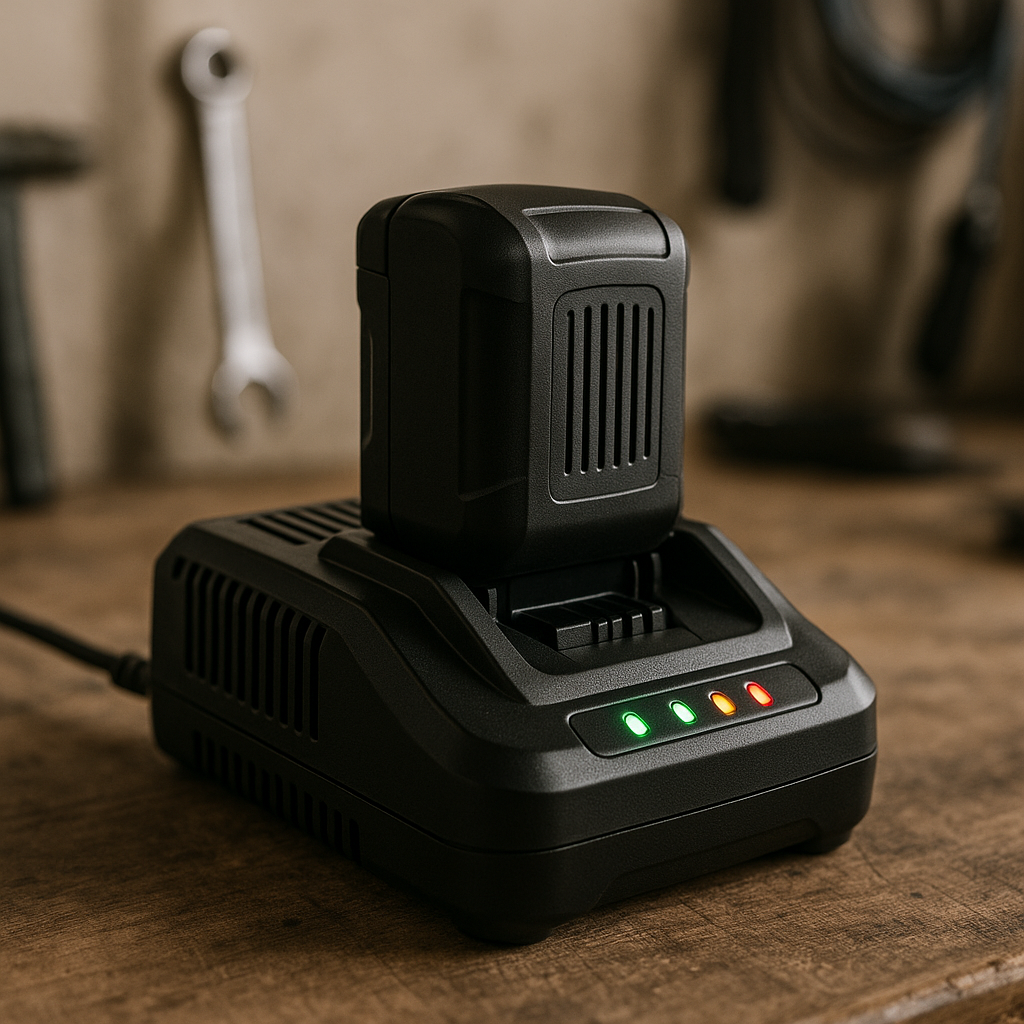
The process of replenishing a lithium-ion battery is far more sophisticated than simply "pumping electricity" back into it. A proper lithium ion battery charger acts as a meticulous conductor, orchestrating a two-act performance known as the Constant Current/Constant Voltage (CC/CV) charging algorithm. Understanding this two-stage process is fundamental to appreciating what separates a quality charger from a potentially damaging one.
Imagine you are filling a large, empty bucket with water using a hose. At first, you can turn the hose on full blast to fill the bulk of the bucket quickly. This is analogous to the Constant Current (CC) phase. When a depleted lithium-ion battery is connected to the charger, the charger applies a steady, regulated current. This current is the "charge rate" and is typically a fraction of the battery's total capacity. For instance, a 4.0 Amp-hour (Ah) battery might be charged at a constant current of 2.0 Amps. During this stage, the battery's voltage rises steadily as it absorbs energy. This phase is the workhorse of the charging process, responsible for replenishing approximately 70-80% of the battery's total capacity in the shortest amount of time. The charger's intelligence is crucial here; it must deliver this current consistently without exceeding the battery manufacturer's specified limits, as an excessive current can lead to overheating and damage the internal cell structure (Buchmann, 2023).
As our bucket nears the top, if we continue blasting water at full force, it will overflow and make a mess. We must reduce the flow, topping it off carefully. This is the Constant Voltage (CV) phase. Once the battery's voltage reaches a predetermined peak—typically 4.2 volts per cell for most lithium-ion chemistries—the charger's strategy shifts. It locks the voltage at this peak level and allows the current to taper off naturally. As the battery cells become saturated, their internal resistance increases, and they accept less and less current. The charger holds the voltage steady, "topping off" the remaining 20-30% of the capacity. This phase is essential for achieving a full charge, but it must be managed with precision. The charger continuously monitors the current, and once it drops to a very low level (a termination threshold, often around 3-5% of the initial charge current), the charger knows the battery is full and terminates the charging process completely. This termination is a critical safety function. A crude charger that fails to terminate properly could continue to apply a "trickle charge," which is highly detrimental to lithium-ion cells and can lead to a dangerous condition known as overcharging.
A well-designed lithium ion battery charger executes this CC/CV choreography flawlessly every time. It's a delicate balance between speed and safety, ensuring the battery is replenished efficiently without compromising its long-term health or creating a hazardous situation. The electronics inside a quality charger are constantly monitoring voltage, current, and often temperature, making micro-adjustments to ensure the charging process stays within the safe operating parameters defined for that specific battery pack.
The first and most foundational feature of any respectable lithium ion battery charger is its faithful and precise implementation of the Constant Current/Constant Voltage (CC/CV) charging algorithm. This is not merely a feature to be listed on a box; it is the very essence of proper lithium-ion battery care. The intelligence of the charger is demonstrated in its ability to manage the transition between these two stages and to terminate the charge at the precise moment of full capacity.
At the heart of a modern charger lies a microprocessor, a small computer dedicated to managing the charging process. This microprocessor is loaded with firmware—a set of instructions specific to the batteries it is designed to charge. When you connect a battery, the charger often communicates with a similar chip inside the battery pack itself. This "handshake" allows the charger to identify the battery's voltage, capacity, chemistry, and sometimes even its age and charge history.
Based on this information, the charger's microprocessor sets the optimal parameters for the CC/CV cycle. It determines the maximum safe current for the CC phase and the precise voltage ceiling for the CV phase. Throughout the process, it is not simply following a dumb timer; it is actively monitoring the battery's response. This active management is what allows for both speed and safety. For example, the charger can push the current to the maximum safe limit during the CC phase for a fast bulk charge, then seamlessly transition to the CV phase to gently top off the cells without causing stress.
A charger that poorly implements the CC/CV protocol poses a significant risk. Imagine a charger that is sloppy with its voltage limit in the CV stage. If it allows the voltage to creep even slightly above the 4.2V per cell limit, it can cause a phenomenon called lithium plating. Metallic lithium begins to deposit on the anode, which permanently reduces the battery's capacity and can, in more extreme cases, grow into sharp dendrites that puncture the separator, causing an internal short circuit—a primary cause of battery fires (Zhang et al., 2018).
Similarly, a charger that fails to terminate the charge correctly is a major hazard. Continuously applying a voltage, even a small one, after the battery is full subjects the cells to stress, accelerates degradation of the electrolyte and cathode materials, and generates excess heat. This is why you will never see a reputable lithium ion battery charger advertise a "trickle charge" feature. The concept is antithetical to proper Li-ion care. The process must have a definitive end. A quality charger will cease all current flow once the termination threshold is reached and will only re-engage if it detects that the battery's voltage has dropped significantly over time (a process known as a "top-off," which should only occur infrequently). This level of precision and control is the hallmark of a well-engineered lithium ion battery charger and the first pillar of protecting your battery investment.
While intelligent charging control is about maintaining battery health, a suite of advanced safety protocols is about protecting the battery, the charger, and you from catastrophic failure. A lithium ion battery stores a remarkable amount of energy in a small space. Under fault conditions, this energy can be released in a rapid and uncontrolled manner. A quality lithium ion battery charger acts as a vigilant guardian, equipped with multiple layers of protection to prevent such an event. These are not optional luxuries; they are non-negotiable requirements for any charger you should consider connecting to your valuable power tool batteries.
Heat is the arch-nemesis of a lithium-ion battery. Excessive heat, whether generated by high-rate charging, a hot ambient environment, or an internal fault, dramatically accelerates the degradation of battery components and can lead to a dangerous state known as thermal runaway.
A superior charger incorporates robust thermal monitoring. Most genuine battery packs, like those from or Dewalt, contain a thermistor—a type of resistor whose resistance changes with temperature. The charger has a dedicated contact pin that reads this thermistor. If the charger detects that the battery's temperature is too high (perhaps it just came off a heavy-duty job) or too low (lithium-ion batteries cannot be safely charged below freezing), it will refuse to start the charging cycle. It will wait, often with an indicator light to signal a temperature delay, until the battery pack returns to a safe temperature range. During the charging process itself, it continuously monitors this temperature. If it detects an abnormal rise in heat, it will immediately reduce the charging current or shut down the process entirely to prevent a dangerous situation.
As discussed previously, overcharging is one of the most dangerous conditions for a lithium-ion cell. Overcharge protection is the final line of defense against a charger that fails to terminate the CV phase correctly. This protection can exist in multiple layers. The primary layer is the charger's own microprocessor, which is programmed to cut off the current once the termination threshold is met.
A second layer of protection often exists within the battery pack's own Battery Management System (BMS). The BMS is a small circuit board inside the battery that acts as its onboard bodyguard. If the external charger malfunctions and continues to apply voltage, the BMS can intervene and internally disconnect the cells from the charging terminals to prevent a dangerous overvoltage condition. A quality charger and a quality battery work in tandem, providing redundant safety systems. Relying on a cheap, uncertified charger without this intelligence is like removing the safety net and hoping the trapeze artist never slips.
While this is primarily a function managed by the tool and the battery's BMS during use, the charger plays a secondary role. A battery that has been deeply over-discharged (its voltage has fallen to a critically low level) can be permanently damaged. Attempting to charge a battery in this state with full current can be hazardous.
An intelligent lithium ion battery charger can detect this condition. Instead of hitting it with the full constant current, it will attempt a "pre-charge" or "revival" phase. It applies a very small, gentle current to slowly and safely raise the cell voltage back into the normal operating range. If the battery responds and its voltage recovers, the charger will then transition to the standard CC/CV cycle. If the battery's voltage does not rise or if it is below a certain non-recoverable threshold, the charger will flag the battery as defective and refuse to charge it, preventing a potentially unsafe charging attempt.
These protections safeguard the charger itself and prevent accidents. Short-circuit protection ensures that if the charging terminals are accidentally bridged by a metal object, the charger will instantly cut power and not destroy itself or create a spark. Reverse-polarity protection prevents damage if a battery were to be somehow inserted backward (most modern battery designs make this physically impossible). The charger simply will not activate, protecting both its own circuitry and the battery from harm. Together, these safety features form an integrated system that makes the charging process remarkably safe and reliable, provided you are using a well-engineered lithium ion battery charger.
In the professional world, time is money. A battery that spends hours on a charger is a tool that is not on the job site earning its keep. This reality has driven the demand for "rapid" or "fast" chargers. However, the pursuit of speed is a delicate negotiation with the laws of chemistry and physics. A faster charge inevitably generates more heat and places more stress on the battery's internal components. The third essential feature, therefore, is not just raw speed, but the intelligent management of charging rate and efficiency.
The speed at which a battery is charged or discharged is often expressed as a "C-rate." A C-rate of 1C means that the battery is charged at a current equal to its entire capacity in one hour. For a 4.0 Ah battery, a 1C charge rate would be 4.0 Amps. A 0.5C rate would be 2.0 Amps (taking two hours), and a 2C rate would be 8.0 Amps (taking 30 minutes).
While it is technically possible to charge batteries at very high C-rates, doing so consistently can shorten their overall cycle life. The primary reason is heat. Pushing ions back into the anode at high speed is an energetic process that generates significant internal resistance and, consequently, heat. As we know, heat is the enemy of battery longevity. A study by the American Chemical Society highlighted that high-rate charging can lead to non-uniform lithium deposition and mechanical stress on the electrode particles, accelerating capacity fade (Liu et al., 2019).
A well-designed rapid lithium ion battery charger mitigates these risks through several strategies.
A basic comparison of standard and rapid chargers for a typical 18V/20V MAX system illustrates the trade-offs.
| Feature | Standard Charger | Rapid Charger |
|---|---|---|
| Typical Charge Current | 1.5 - 2.0 Amps | 4.0 - 8.0+ Amps |
| Approx. Charge Time | 90 - 120 minutes | 30 - 60 minutes |
| Heat Generation | Low to Moderate | High |
| Active Cooling (Fan) | Rarely | Often |
| Impact on Battery Life | Minimal | Moderate (if used exclusively) |
| Best Use Case | Overnight charging, home/shop use | Job site use, quick turnaround needed |
For many professionals, having a rapid charger is a necessity. The key is to use it wisely. A good strategy is to use a rapid charger on the job site for quick turnarounds but to use a standard, slower charger for overnight charging or when time is not a factor. This approach gives you the best of both worlds: speed when you need it and gentle care when you don't, maximizing the service life of your expensive power tool batteries. The existence of a robust portfolio of charging options, from standard to rapid to multi-bay, is a sign of a mature tool platform, as seen with brands like .
As a tradesperson or serious DIYer accumulates tools, they often find themselves managing a fleet of batteries with different voltages. You might have a 12V drill for tight spaces, a powerful 18V/20V MAX impact driver, and perhaps even a 40V or 60V tool for demanding outdoor equipment. In the past, this meant a cluttered workbench with a dedicated charger for each voltage platform. A fourth, highly valuable feature in a modern lithium ion battery charger is the ability to act as a universal translator, intelligently handling batteries from different systems.
The most common form of this versatility is the multi-voltage charger. These chargers are designed to accept and correctly charge batteries of different nominal voltages from the same brand. For example, DeWalt's popular DCB115 and DCB118 chargers can handle both their 12V MAX and 20V MAX battery packs. Ryobi offers a dual-platform charger that can service both their 18V ONE+ and 40V batteries ().
The engineering behind this is elegant. The charger's microprocessor, upon "handshaking" with the connected battery, identifies its voltage and required charging profile. It then adjusts its output accordingly. For a 12V MAX battery (which is nominally 10.8V, composed of three 3.6V cells in series), it will set the CV phase limit to 12.6V. For a 20V MAX battery (nominally 18V, five cells in series), it will set the CV limit to 21V. This automatic adjustment simplifies the charging station, saves space, and reduces the number of items you need to haul to a job site. It represents a significant improvement in user convenience and system efficiency.
A slightly different, though increasingly rare, form of versatility is multi-chemistry capability. Some older charger models were designed to charge both a brand's legacy NiCd battery packs and their newer Li-ion packs. This was a critical feature during the transitional period when users were slowly upgrading their toolkits.
This capability is more complex to engineer because NiCd and Li-ion batteries require fundamentally different charging algorithms. As we've established, Li-ion uses the CC/CV protocol with a strict voltage limit and a definitive charge termination. NiCd batteries, on the other hand, are typically charged using a method called "negative delta-V" detection. During a NiCd charge, the battery's voltage rises until it is full, at which point the voltage experiences a slight but detectable dip. A NiCd charger looks for this voltage dip to terminate the main charge and then often switches to a low-level "trickle charge" to keep the battery topped up.
A multi-chemistry charger must be able to accurately identify the battery type and apply the correct algorithm. Applying a NiCd charging algorithm to a Li-ion battery would be catastrophic, as it would never receive the correct CV phase and would be dangerously overcharged. Applying a Li-ion algorithm to a NiCd battery would be ineffective, as it would likely terminate the charge prematurely. While many users have now fully transitioned to Li-ion, if you still have older NiCd tools in service, a multi-chemistry charger can be a valuable bridge technology. However, for new buyers in 2025, a multi-voltage lithium ion battery charger is the more relevant and forward-looking feature.
A charger's primary role is to replenish a battery, but its secondary role can be just as valuable: to act as a diagnostic tool. A simple "charging" and "charged" light provides the bare minimum of information. A superior lithium ion battery charger, however, communicates more nuanced information, acting as a "battery whisperer" that gives you insight into the health and status of your power source. This diagnostic capability is a fifth essential feature that helps you manage your battery fleet effectively and avoid unexpected downtime.
Modern chargers use a series of LEDs, often with different colors, flashes, or patterns, to convey a range of information. While the specific codes vary by brand (it is always wise to consult the charger's manual or look for the key printed on the charger's housing), they typically communicate the following states:
These simple light patterns transform the charger from a dumb power supply into an intelligent diagnostic station. Before a long day on the job, you can quickly test all your batteries. A quick green light tells you you're good to go. A flashing red light tells you that a specific battery is unreliable and should be left behind, preventing a situation where you discover you have a dead battery miles from the workshop.
While LEDs are the most common interface, some high-end chargers and battery systems are moving towards more sophisticated displays. These might include:
While Bluetooth might be overkill for the average user, the fundamental value of clear, actionable diagnostic feedback cannot be overstated. A lithium ion battery charger that can tell you why it isn't charging is infinitely more useful than one that simply fails to work. It empowers you to troubleshoot problems, manage your assets, and maintain a reliable and productive workflow.
A power tool charger often lives a hard life. It gets tossed in the back of a truck, set up on dusty and debris-strewn job sites, and exposed to a wide range of ambient temperatures. The sixth essential feature, therefore, pertains to its physical embodiment: its construction, durability, and internal thermal design. A charger with brilliant electronics housed in a flimsy, poorly ventilated case is a charger destined for a short life.
The outer shell of the charger is its first line of defense. A quality lithium ion battery charger is typically made from a high-impact, durable polymer, similar to the housing of the tools themselves. Look for features that suggest a thoughtful, rugged design:
These may seem like minor details, but they are indicative of a manufacturer that understands the environment in which their products will be used. They are designing for the realities of the job site, not just a pristine laboratory.
Just as heat is a concern for the battery, it is also a concern for the charger's internal components. The process of converting 120V AC wall power to low-voltage DC charging power generates heat in the transformer and power regulation circuitry. A charger's ability to manage its own heat is critical to its longevity and safety.
When evaluating a lithium ion battery charger, don't just look at the specs on the box. Pick it up. Feel its weight and rigidity. Examine the quality of the plastic molding. Look at the ventilation design. These physical attributes are a tangible reflection of the engineering quality within and are a strong predictor of how well the charger will hold up to the rigors of real-world use.
The final set of features to consider moves beyond the core function of charging and into the realm of user convenience and expanded utility. In a world where we are surrounded by electronic devices, a charger that can do more than just charge tool batteries offers significant added value. These features demonstrate a manufacturer's commitment to creating a holistic and user-friendly power ecosystem.
One of the most practical and sought-after convenience features on a modern lithium ion battery charger is an integrated USB port. Many chargers from leading brands like and Ryobi now include one or more USB-A or even USB-C ports.
The utility of this is immediately obvious. The job site charging station becomes a central hub not just for tool batteries, but for phones, tablets, Bluetooth speakers, and other personal electronics. This eliminates the need to carry separate USB wall adapters and hunt for available outlets. The charger leverages the large capacity of the power tool battery it's connected to or the wall power it's plugged into to provide a convenient source of low-voltage power. Some designs even allow the USB port to function when the charger is unplugged from the wall, effectively turning your power tool battery into a portable power bank. This dual functionality is incredibly useful for staying connected and powered up in remote locations or during power outages.
Taking this concept a step further are dedicated power source adapters. These are not chargers, but rather accessories that slide onto a power tool battery and provide a variety of outputs. For example, DeWalt's DCB090 Power Source slides onto any 20V MAX battery and provides two USB-A ports. Ryobi offers a 150-Watt power inverter () that clips onto an 18V ONE+ battery and provides not only USB ports but also a 120V AC outlet, capable of powering small devices like laptops or LED work lights.
These adapters are a brilliant extension of the tool battery platform. They recognize that the energy stored in these batteries is a valuable resource that can be used for much more than just spinning a drill. For professionals who have already invested heavily in a particular battery system, these adapters unlock new levels of utility and convenience, making the entire system more versatile and valuable. When choosing a tool platform, it is wise to look beyond the tools themselves and consider the breadth and quality of the charging and power accessory ecosystem.
For the mobile professional, portability is key. Chargers designed with transport in mind offer distinct advantages.
By considering these seven features—Intelligent Control, Safety Protocols, Charging Rate, Compatibility, Diagnostics, Build Quality, and Convenience—you can move beyond a simple price comparison and make a truly informed decision. You are not just buying a lithium ion battery charger; you are investing in a system to protect, maintain, and maximize the utility of your most critical cordless assets.
It is strongly recommended to only use the charger specifically designed for your battery's brand and voltage. While a battery from one brand might physically fit onto another brand's charger, the internal communication protocols, safety thermistor connections, and charging algorithms are proprietary. Using an incompatible charger can lead to the battery not charging at all, charging improperly (damaging the battery), or creating a significant safety hazard.
Yes, with a modern, quality lithium ion battery charger, it is safe. These chargers are designed to automatically terminate the charging process once the battery is full. They do not apply a continuous "trickle charge," which is harmful to Li-ion cells. The charger will stop the current flow and only re-engage if the battery's voltage drops significantly over a long period.
The fan in a rapid charger is a crucial safety and performance feature. Fast charging generates a significant amount of heat, which is the primary enemy of battery longevity. The fan actively pulls cool air over both the battery pack and the charger's internal electronics to dissipate this heat. A loud fan is a sign that the charger is working hard to protect your battery during a high-speed charge cycle.
A flashing red light is a diagnostic signal. The exact meaning varies by brand, so you should check your user manual. However, a slow flashing red light often indicates a temperature delay (the battery is too hot or too cold to charge). A fast flashing red light typically indicates a fault, meaning the battery is likely damaged, defective, or has been depleted beyond a recoverable point.
While some aftermarket chargers may work, it is generally a significant gamble. Original Equipment Manufacturer (OEM) chargers are designed with specific firmware and safety features tailored to their own batteries. Many aftermarket chargers are less sophisticated, may lack critical safety protections like thermal monitoring, and may not implement the CC/CV charging protocol as precisely. Using a non-certified aftermarket charger can lead to diminished battery life, poor performance, and an increased risk of failure or fire. It may also void your tool and battery warranty.
The selection of a lithium ion battery charger, a choice often relegated to an afterthought, emerges upon closer examination as an act of profound significance for the modern tool user. It is a decision that resonates through the lifespan of our batteries, the safety of our workspaces, and the reliability of our craft. To choose a charger is to choose a partner in the maintenance of our most vital cordless assets. A thoughtfully engineered charger, replete with the intelligence to control voltage, the vigilance to monitor temperature, and the integrity to protect against failure, does more than replenish energy. It preserves potential. It safeguards an investment. It ensures that the power we rely on is not only available but also dependable and safe. In our pursuit of efficiency and performance, let us not neglect the quiet, dutiful guardian on the workbench. For in its silent, meticulous work lies the foundation of a productive and secure workflow.
Buchmann, I. (2023). Charging lithium-ion. Battery University. https://batteryuniversity.com/article/bu-409-charging-lithium-ion
Liu, H., Wei, Z., He, W., & Zhou, J. (2019). Thermal issues about Li-ion batteries and recent progress in battery thermal management systems: A review. Energy Conversion and Management, 153, 304-330.
Toolguyd. (2013). Cordless power tool battery specs for popular brands. https://toolguyd.com/cordless-power-tool-battery-specs/
Zhang, X., Wang, Z., Zhang, Z., & Chen, C. (2018). A review on recent progress of challenging issues in lithium-ion batteries. Journal of Power Sources, 378, 367-383.
Ereplacementparts.com. (n.d.). Cordless power tool buying guide: How to choose battery type. https://www.ereplacementparts.com/repair-center/article/3084/Cordless_Power_Tool_Buying_Guide_How_to_Choose_Battery_Type.html
Ryobi Tools. (n.d.). Batteries & chargers. Retrieved from
CPO Power Tools. (n.d.). Batteries and chargers. Retrieved from
Tenergy. (n.d.). Chemistry. Retrieved from
BatteryMall. (n.d.). Power tool batteries. Retrieved from
Complete Battery Source. (n.d.). Power tool batteries. Retrieved from
{"one"=>"Select 2 or 3 items to compare", "other"=>"{{ count }} of 3 items selected"}