

CONTACT
Please contact us for shipping details.
A wheeled battery charger represents a significant evolution in vehicle and equipment maintenance, providing a robust solution for charging, maintaining, and starting engines. This analysis examines the multifaceted nature of these devices, moving beyond their superficial utility to explore the underlying principles of electrical engineering and battery chemistry that govern their operation. It investigates the critical parameters of amperage and voltage, distinguishing between their roles in charging speed and system compatibility. The document further contrasts traditional manual chargers with modern microprocessor-controlled smart chargers, detailing the nuances of multi-stage charging algorithms designed for various battery chemistries, including lead-acid, AGM, Gel, and lithium-ion. Special attention is given to the high-current engine start function and the emerging integration of ultracapacitor technology. By deconstructing the components, safety features, and operational protocols, this guide provides a comprehensive framework for evaluating a wheeled battery charger not merely as a tool, but as a sophisticated diagnostic and power management system for both professional and enthusiast use in 2026.
It can be a moment of quiet frustration. You walk into your garage or workshop, ready to start a vehicle or a piece of equipment, and you are met with silence. The click of a solenoid, or perhaps nothing at all, tells you the battery is depleted. In these situations, the difference between a minor inconvenience and a significant delay often comes down to the quality of your support equipment. For years, the go-to solution for serious power needs in workshops, agricultural settings, and fleet maintenance bays has been the wheeled battery charger. These units, with their substantial build and robust capabilities, are far more than simple "jump boxes." They are the unsung workhorses of power management.
However, as we navigate 2026, the landscape of battery technology has become wonderfully complex. It is no longer just a world of simple flooded lead-acid batteries. We now have AGM, Gel, and a wide array of lithium chemistries, each with its own unique personality and needs. Consequently, the wheeled battery charger has had to evolve. Choosing one is no longer a simple matter of finding the biggest one you can afford. It requires a more thoughtful, educated approach. Think of this not as a shopping trip, but as an intellectual exercise in matching a sophisticated tool to a specific set of problems. Our goal here is to empower you with the understanding needed to make a truly informed decision, transforming you from a mere user into a knowledgeable custodian of your equipment's power systems. We will proceed by examining five fundamental areas of consideration, moving from the basic principles of electricity to the fine points of modern electronic intelligence.
Before we can intelligently compare different models of wheeled battery charger, we must first return to the foundational principles of electricity that govern their function. It is tempting to look at the large numbers printed on these units and assume bigger is always better, but the reality is far more nuanced. Amperage and voltage are the two primary forces at play, and understanding their distinct roles is like learning the grammar of a new language. Once you are fluent, the specifications on any charger will tell you a detailed story.
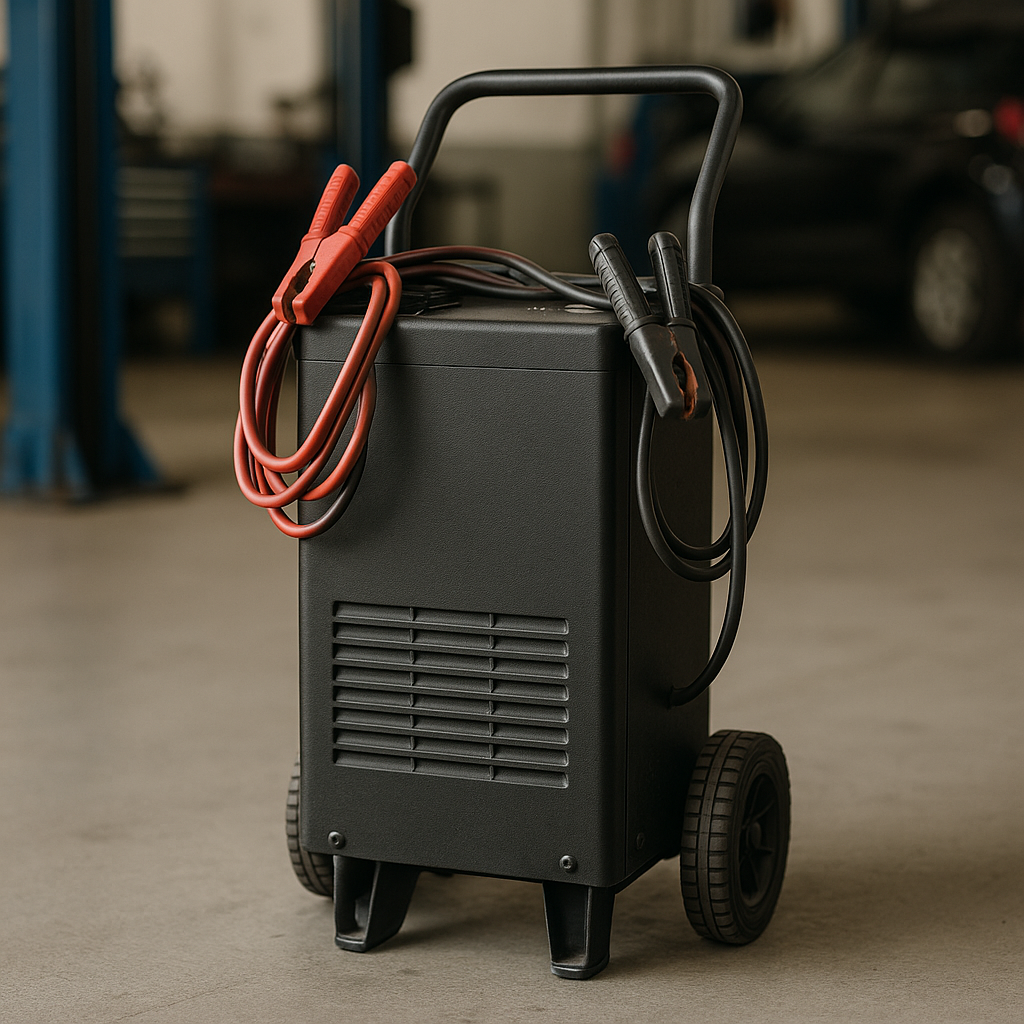
Let us begin with amperage, often abbreviated as "Amps" or simply "A." Imagine you need to fill a large bucket with water. The rate at which the bucket fills depends on the width of the hose you are using. A narrow garden hose will fill the bucket slowly, while a wide fire hose will fill it very quickly. In this analogy, the water is electrical charge, the bucket is your battery, and the amperage is the width of the hose. Amperage is a measure of electrical current, or the volume of electrons flowing through a circuit over a period of time. A higher amperage setting on a wheeled battery charger means it is pushing more electrical current into the battery per hour.
A battery's capacity is typically measured in Amp-hours (Ah). A 100Ah battery, for instance, can theoretically supply 1 amp of current for 100 hours, or 10 amps for 10 hours. When charging, this relationship is inverted. A very basic formula to estimate charging time is:
Charging Time (in hours) = Battery Capacity (in Ah) / Charging Current (in Amps)
So, if you are charging that 100Ah battery with a 10-Amp charger, the simple calculation suggests it would take 10 hours (100Ah / 10A = 10h). This is a useful starting point, but it is incomplete. The process is not perfectly efficient; some energy is always lost as heat. Therefore, a more realistic calculation often includes a correction factor, typically between 1.2 and 1.4, to account for these losses (Jackery, 2023). Using this, our 10-hour estimate becomes a more realistic 12 to 14 hours.
When you look at a wheeled battery charger, you will often see multiple amperage settings, such as 2A, 10A, and 40A.
The critical takeaway is that you must choose an amperage that is appropriate for the battery's size and your time constraints. A powerful wheeled battery charger gives you options, allowing you to choose the right tool for the job at hand.
If amperage is the width of the hose, voltage is the water pressure. Voltage, measured in Volts (V), is the electrical potential difference that "pushes" the current through the circuit. For our purposes, the most important aspect of voltage is ensuring the charger's output voltage matches the battery system's nominal voltage.
The vast majority of passenger cars and light trucks use a 12V electrical system. Therefore, nearly every wheeled battery charger on the market will have a 12V setting. However, many professional-grade units, like those found on sites such as , also offer a 24V setting. This is crucial for anyone working with:
These systems often use two 12V batteries connected in series to create a 24V system, which allows for smaller-gauge wiring to deliver the same amount of power. Attempting to charge a 24V system with a 12V charger will simply not work; the "pressure" is too low to overcome the battery's own voltage and push current into it. Conversely, and far more dangerously, attempting to charge a 12V battery on a 24V setting will cause a catastrophic failure. The excessive voltage will force a massive, unregulated current into the battery, causing it to overheat violently, boil its electrolyte, and potentially explode.
Therefore, the first and most non-negotiable check when selecting a wheeled battery charger is its voltage capability. If you only ever work on 12V systems, a 12V-only charger is sufficient. If you manage a mixed fleet of vehicles or heavy equipment, a selectable 12V/24V wheeled battery charger is not a luxury; it is a necessity.
A quality wheeled battery charger is a versatile instrument precisely because of its selectable rates. Let's revisit the example of a charger with 2A, 40A, and 230A settings. We have already framed these in our water hose analogy, but it is useful to consider the specific application for each.
The 2A setting is for battery maintenance. A lead-acid battery is a living chemical system that slowly loses its charge over time, a phenomenon called self-discharge. The 2A rate provides a gentle "trickle" of current that counteracts this loss, keeping the battery at an optimal state of charge without the stress of a high-current charge cycle. This is the setting you would use for a classic car stored for the winter or a boat battery between seasons.
The 40A setting is for bulk charging. When a car battery is significantly depleted after, for example, the headlights were left on overnight, this is the setting you would use. It pushes a substantial amount of current to restore the bulk of the battery's capacity in a matter of hours, not days. This is the primary "charging" function of a wheeled battery charger.
The 230A setting is an entirely different function: engine starting. This is not a charging rate but a short, powerful burst of current designed to supplement a weak battery, providing the immense power needed to turn over a cold engine. We will explore this function in greater detail, as it is one of the key reasons to invest in a wheeled battery charger. Understanding these distinct roles allows you to see the charger not as a single-function tool, but as a multi-mode power solution.
Sometimes, when comparing chargers, you might encounter the term "Watts" (W). Watts provide a holistic measure of power by combining both voltage and current. The formula is simple and elegant:
Power (in Watts) = Voltage (in Volts) × Current (in Amps)
This concept is useful for a few reasons. First, it helps you understand the total power output of a charger. A charger delivering 10 Amps at 14 Volts (a typical charging voltage for a 12V system) is outputting 140 Watts of power. A charger delivering 10 Amps to a 24V system (at around 28 Volts) is outputting 280 Watts. This shows why charging a 24V system requires more power from the wall outlet.
Second, it can help you compare chargers that might list their specifications differently. By calculating the wattage, you can get an apples-to-apples comparison of their true power output. A wheeled battery charger is fundamentally a power conversion device. It takes high-voltage, low-current AC power from your wall outlet and converts it into low-voltage, high-current DC power suitable for charging a battery. The wattage rating gives you a sense of the scale of that conversion capability.
The feature that most dramatically separates a wheeled battery charger from its smaller, handheld cousins is the engine start function. This is the feature that transforms the tool from a patient battery tender into an emergency first responder for your vehicle. When an engine refuses to crank, especially in cold weather, the engine start function can provide the massive, instantaneous power needed to get you moving again. But not all engine start functions are created equal, and understanding how they work is key to choosing a unit that will perform when you need it most.
Using the engine start feature is often colloquially called "jump starting," but what the charger is doing is technically different from jumping a car with another car. When you use jumper cables, you are putting a healthy battery in parallel with your weak battery. The good battery provides the majority of the current to crank the engine.
A wheeled battery charger's engine start function, in contrast, acts more like a power supply. Internally, the charger's large transformer is switched to a mode that allows it to deliver its maximum possible current output for a very short period. This is not a charging process; it is a direct power injection. The charger provides a high-amperage, DC current (e.g., 175A, 230A, or more) that flows directly to the vehicle's starter motor, supplementing whatever power the weak battery can offer.
Think of it this way: a weak battery might be able to provide 100 amps, but your starter needs 300 amps to turn over a cold, sluggish engine. The engine start function supplies the missing 200 amps, allowing the starter to spin and the engine to fire. This is why these units are so much larger and heavier than simple chargers; the size of the internal transformer and capacitors required to safely handle these immense currents is substantial. They are built for the demanding environment of a professional shop, as noted by manufacturers like who design them for busy service environments.
When you look at the specifications for an engine start function, you will encounter different amperage ratings. It is vital to understand the distinction between "Peak Amps" and "Cranking Amps" (or Cold Cranking Amps, CCA).
The CCA rating of your battery is what determines its ability to start your engine in the winter. When selecting a wheeled battery charger, you want to find one whose engine start amperage is a significant fraction of your vehicle's required CCA. For example, if you have a large V8 truck with a battery rated at 800 CCA, a charger that offers a 200A engine start function will provide a very meaningful boost. A smaller charger with only a 50A boost might struggle to make a difference on a very cold day.
When you are shopping, focus on the Cranking Amps or a clearly defined "Engine Start" amperage rating. Do not be swayed by an inflated "Peak Amps" number. The sustained current is what actually cranks the engine.
The immense power involved in the engine start function demands respect and a strict adherence to safety protocols. A mistake here can damage your vehicle's sensitive electronics or, worse, cause a battery to explode, releasing corrosive acid and flammable hydrogen gas.
The correct procedure is a critical piece of knowledge:
Following this procedure every single time mitigates the risks and ensures you are using the tool as it was intended.
A fascinating development in high-end wheeled charger technology, as seen in some 2026 models like those from schumacherelectric.com, is the integration of ultracapacitors. A capacitor stores energy in an electric field, unlike a battery which stores it chemically. An ultracapacitor (or supercapacitor) can do this on a much larger scale.
What is the advantage? Ultracapacitors can discharge their stored energy almost instantaneously, far faster than a battery. When used in an engine start function, an ultracapacitor-assisted wheeled battery charger can deliver an incredibly powerful punch to the starter motor. The charger uses its conventional circuitry to charge up the internal ultracapacitors and then unleashes that stored energy in a massive, controlled burst.
This technology offers several benefits:
While this technology is currently found on premium models, it represents the future direction of high-performance engine starting and is a key feature to look for in a top-tier wheeled battery charger in 2026.
Perhaps the most significant evolution in battery charging over the past two decades has been the shift from manual, timer-based chargers to sophisticated, microprocessor-controlled "smart" chargers. This is not merely a matter of convenience; it is a fundamental change in how the charger interacts with the battery. Understanding this difference is crucial because choosing the right technology will have a direct impact on the health and lifespan of your expensive batteries.
In the not-too-distant past, most high-power chargers were manual. These are the brutes of the charging world—simple, powerful, and effective, but lacking any sort of finesse. A manual wheeled battery charger, like some timer-controlled models you might still find on amazon.com, functions like a fixed power supply. When you set it to "10A," it attempts to deliver 10 amps of current continuously.
The primary control mechanism on these units is often a simple mechanical timer. You estimate how long the battery needs to charge, turn the dial, and walk away. The charger will continue to push current into the battery until the timer runs out and shuts it off.
The Danger of Overcharging: The inherent problem with this approach is that a battery's ability to accept current changes as it becomes full. A fully charged lead-acid battery cannot accept any more charge. If a manual charger continues to force current into it, the excess energy is converted into heat and begins to electrolyze the water in the battery's electrolyte, breaking it down into hydrogen and oxygen gas. This process, known as gassing, not only consumes the battery's water (in a serviceable battery) but can also damage the internal lead plates, severely shortening its life. In a sealed battery (like AGM or Gel), this pressure buildup can be catastrophic.
While manual chargers are robust and have fewer electronic components that can fail, they require constant supervision. You, the operator, must be the "brains" of the operation, monitoring the battery's voltage and state of charge to know when to stop the process.
A smart wheeled battery charger is an entirely different class of machine. It has a microprocessor—a small computer—that actively monitors the battery and adjusts the charging process in real-time. Instead of a single, continuous charge, it employs a multi-stage charging algorithm designed to charge faster, more efficiently, and more safely. While the exact stages can vary by manufacturer, a typical advanced profile includes the following:
This intelligent, responsive process is fundamentally better for the battery's health. It charges as fast as is safely possible and then automatically transitions to a perfect long-term storage mode.
The heart of a smart charger is its microprocessor. This tiny computer is constantly running a program that makes decisions based on feedback from the battery. It uses sensors to measure:
This closed-loop feedback system allows the smart wheeled battery charger to tailor its output perfectly to the needs of the individual battery it is connected to. It is the difference between a blunt instrument and a surgical tool.
| Feature | Manual Wheeled Battery Charger | Smart Wheeled Battery Charger |
|---|---|---|
| Control Method | Mechanical Timer / Manual On-Off | Microprocessor-controlled algorithm |
| Charging Process | Single-stage, constant current | Multi-stage (Desulfation, Bulk, Absorption, Float) |
| Overcharge Risk | High; requires operator supervision | Very Low; automatically switches to maintenance mode |
| Battery Lifespan | Can be shortened by improper use | Maximized through optimal charging profiles |
| Diagnostics | None; only shows current output | Can detect sulfation, bad cells, and failure to hold charge |
| Ease of Use | Requires knowledge and monitoring | "Connect and forget" simplicity and safety |
| Best For | Users with deep knowledge in specific, controlled scenarios | Almost all users, especially with modern, sensitive batteries |
In the early days of motoring, life was simple: you had a flooded lead-acid battery, and your charger was designed for it. Today, in 2026, the garage is a complex chemical laboratory. Vehicles come with a variety of battery types, each with a unique internal structure and specific charging requirements. Using the wrong charging profile is like feeding the wrong diet to a high-performance athlete—at best, performance will suffer; at worst, you will cause serious harm. A modern wheeled battery charger must be a polyglot, able to "speak" the correct electrical language to each type of battery.
The traditional flooded lead-acid battery is the oldest and, in some applications, still the most common type of rechargeable battery. It consists of lead plates submerged in a liquid electrolyte of sulfuric acid and water. They are typically serviceable, meaning they have caps that can be removed to top off the water level.
The main enemy of a lead-acid battery is a process called sulfation. When the battery discharges, the lead on the plates reacts with the sulfate in the electrolyte, creating soft, small lead sulfate crystals. During charging, this process is reversed. However, if a battery is left in a discharged state for too long, these soft crystals harden and grow, forming an inert layer on the plates that can no longer be reconverted. This is sulfation, and it permanently reduces the battery's capacity.
A quality smart wheeled battery charger addresses this in two ways:
When charging a flooded battery, especially at high amperage, it is normal for some gassing to occur. This is why it is crucial to charge them in a well-ventilated area.
Absorbent Glass Mat (AGM) and Gel batteries are two types of Valve Regulated Lead-Acid (VRLA) batteries. They are sealed and non-spillable, making them safer and more versatile.
The key vulnerability of both AGM and Gel batteries is their intolerance for over-voltage. Because they are sealed, the gasses produced during overcharging cannot escape. While they have pressure-relief valves, repeated overcharging will dry out the electrolyte and permanently damage the battery.
A smart wheeled battery charger must have specific settings for "AGM" or "Gel." These settings use a slightly different charging profile, typically with a lower peak voltage in the absorption stage compared to a standard flooded battery. Using a standard lead-acid profile on an AGM battery can shorten its life, and using it on a Gel battery can destroy it very quickly. The ability to select the correct battery chemistry is a hallmark of a high-quality, modern wheeled battery charger.
Lithium-ion batteries are no longer just for phones and laptops. They are increasingly common in high-performance vehicles, RVs, marine applications, and even as replacements for standard car batteries. The most common type for these applications is Lithium Iron Phosphate (LiFePO4), prized for its safety, long cycle life, and thermal stability.
However, charging a lithium battery with a charger designed for lead-acid is extremely dangerous and ineffective. Lithium batteries require a completely different charging algorithm known as CC/CV (Constant Current / Constant Voltage).
Crucially, lithium batteries must not be float charged or have a desulfation mode applied to them. A lead-acid float charge voltage is too high for a fully charged lithium battery and will cause damage. A desulfation pulse can destroy the sensitive internal electronics of a lithium battery's Battery Management System (BMS).
A proper lithium-compatible wheeled battery charger will have a dedicated "Lithium" or "LiFePO4" mode. This mode implements the correct CC/CV profile and ensures the charger shuts off completely once the charge is finished. As seen on specialty sites like , a "12V" LiFePO4 battery requires a charging voltage of around 14.4V to 14.6V. A charger that cannot precisely hold this voltage is unsuitable. Given the high cost of lithium batteries, investing in a compatible wheeled battery charger is not optional; it is essential insurance for your investment.
| Battery Chemistry | Key Charging Characteristic | Required Charger Setting | Risk of Incorrect Charging |
|---|---|---|---|
| Flooded Lead-Acid | Tolerant of slight over-voltage; benefits from desulfation. | Standard / Flooded | Reduced lifespan due to sulfation or water loss. |
| AGM (Absorbent Glass Mat) | Sensitive to over-voltage; requires a controlled absorption phase. | AGM | Permanent damage from drying out the electrolyte mats. |
| Gel | Very sensitive to over-voltage; requires a lower peak voltage. | Gel | Rapid destruction from internal voids created by gassing. |
| Lithium (LiFePO4) | Requires strict CC/CV profile; no float or desulfation allowed. | Lithium / LiFePO4 | Fire risk, BMS damage, and permanent capacity loss. |
A wheeled battery charger is a significant investment, and it is often used in demanding environments like busy automotive shops or dusty farm workshops. Its utility is determined not just by its electrical specifications but also by its physical construction, its built-in safety mechanisms, and the clarity of its user interface. When you are evaluating a unit, you are not just buying a circuit board; you are buying a piece of heavy-duty equipment that needs to withstand years of service. This final check focuses on the tangible, physical attributes that define a professional-grade tool.
The "wheeled" part of a wheeled battery charger is fundamental to its purpose. These units are heavy—often weighing 40 pounds or more—due to their large transformers and robust construction (). The mobility offered by the wheels is essential for moving the charger around a vehicle, across a shop floor, or out into a yard.
When examining a charger, pay close attention to the build quality of the cart:
The overall design should feel balanced. You want a unit that is stable and not prone to tipping over when you are pulling on the cables. This physical robustness is a clear indicator of a tool built for professional use, as emphasized in materials for chargers designed for demanding shops ().
The parts of the charger you interact with most—the cables and clamps—are often where manufacturers cut corners on cheaper models. This is a critical mistake, as these components are vital for both performance and safety.
These "boring" components are often the difference between a tool that lasts for three years and one that lasts for twenty.
Beyond the smart charging logic, a modern wheeled battery charger should incorporate a suite of safety features that protect the user, the battery, and the vehicle. These are non-negotiable in a professional-quality tool.
These automated safety nets remove sources of human error, making the powerful tool significantly safer to operate for both novices and seasoned professionals.
The user interface is how the charger communicates with you. It tells you what it is doing and what it has learned about your battery.
The best interface depends on your needs. For simple, reliable charging, LEDs are excellent. For in-depth diagnostics and a more precise understanding of the charging process, a digital display is superior. Regardless of the type, the interface should be easy to read and understand, even in the dim light of a garage.
Yes, but with caution. You must use the lowest amperage setting available, typically 2A. Using a high-amperage setting (like 10A or 40A) on a small-capacity battery will overwhelm it, causing rapid overheating and permanent damage. The 2A maintenance setting is generally safe for these smaller batteries.
A good rule of thumb is to use a charging amperage that is no more than 25% of the battery's Amp-hour (Ah) capacity. For a typical 60Ah car battery, a 10A to 15A charge rate is ideal. While a higher setting like 40A can be used for a quick boost, it should not be the default choice for regular charging as it can generate more heat and stress on the battery.
Yes, that is precisely what a smart charger is designed for. Once it completes the charging cycle, it will automatically switch to a "Float" or "Maintenance" mode. In this mode, it only provides a tiny amount of current to offset the battery's natural self-discharge. This keeps the battery at 100% readiness without the risk of overcharging, making it perfect for long-term storage.
Lithium batteries require a very specific charging profile called CC/CV and are extremely sensitive to voltage. A lead-acid charger's profile, especially its float charge and desulfation modes, will damage a lithium battery and its internal Battery Management System (BMS). A float charge holds the voltage too high for a full lithium battery, and the voltage pulses of a desulfation mode can destroy the BMS electronics. You must use a charger with a dedicated lithium mode.
Yes, you absolutely should. AGM batteries are a type of sealed lead-acid battery that are sensitive to over-voltage. The "AGM" setting on a smart charger uses a slightly different voltage curve than the standard setting for flooded lead-acid batteries. This tailored profile ensures the AGM battery gets a full charge without being subjected to voltages that could damage its internal structure.
A wheeled battery charger with an engine start function plugs into an AC wall outlet and uses its internal transformer to generate a high-current DC output to assist in starting a vehicle. A jump starter (or jump box) is a portable device with its own internal battery. It does not need to be plugged in to work, but its capacity is limited. A wheeled charger can provide sustained power as long as it's plugged in, while a jump starter will eventually run out of charge.
First, ensure your connections are clean and tight, with the negative clamp on a proper engine or chassis ground. Second, give the charger several minutes to rest and cool down between attempts. If it still does not work, the vehicle's battery may be internally shorted or so deeply discharged that it is drawing all the charger's power. In some cases, the problem may not be the battery but a faulty starter motor or electrical connection on the vehicle itself.
Navigating the world of the wheeled battery charger in 2026 is an exercise in applied science. It requires moving beyond simple brand preference or an attraction to the highest numbers on a spec sheet. It demands a genuine engagement with the principles of electricity and chemistry that animate these powerful tools. By methodically considering the five key areas—the fundamental roles of amperage and voltage, the true capability of the engine start function, the critical distinction between manual and smart charging intelligence, the chemical nuances of battery compatibility, and the physical realities of durability and safety—you arm yourself with a framework for sound judgment.
A wheeled battery charger is not a disposable commodity; it is a long-term investment in the reliability and longevity of all your other equipment. Choosing the right one is an act of stewardship. It ensures that your batteries are not just recharged, but are properly cared for, their lifespans maximized, and their performance optimized. Armed with this deeper understanding, you can now select a unit not just based on what it does, but on a comprehensive knowledge of how and why it does it, ensuring you have a reliable power partner in your workshop for years to come.
Jackery. (2023, August 12). Battery charge time calculator: How to calculate battery charging time. Jackery Inc. https://www.jackery.com/blogs/knowledge/how-to-calculate-battery-charging-time
Renogy. (2023, April 20). All-encompassing guide to solar battery chargers. Renogy. https://www.renogy.com/learning-center/solar-basic/battery-charger-101/solar-battery-charger-guide
Schumacher Electric Corporation. (n.d.). Wheeled 12V ultracap battery charger and engine starter. https://www.schumacherelectric.com/products/wheeled-12v-ultracap-battery-charger/
{"one"=>"Select 2 or 3 items to compare", "other"=>"{{ count }} of 3 items selected"}